
If your executive board, real estate project developers, and structural design engineers still view structural fire testing as a superficial, qualitative specimen-burning ritual to satisfy administrative fire safety clearances, your enterprise is wagering billions of dollars of operating capital and human lives on an extreme-risk asset abyss. In the era of infrastructure technocracy, international audit bodies and insurance syndicates reject safety claims based on subjective visual checks; they deploy forced hydrocarbon heating curves and dynamic hydraulic ram loading systems to expose every structural connection weakness and material degradation mechanism hidden deep within the structural skeleton.
The integrity of load-bearing structures under fire attack tolerates zero behavioral margins. A single trace of concrete spalling induced by internal vapor pressure kinetics ($Spalling$), or an uncorrected drop in the ultimate structural load-bearing limit ($R$) prior to specified regulatory time windows, instantly triggers immediate project sealing, refusal of fire safety clearance, or permanent construction suspension decrees.
For Project Development Directors and Lead Structural Engineers, mastering this fire-intensive experimental blueprint represents the only technocratic weapon to eradicate catastrophic collapse risks, dictate commercial terms to sub-tier material vendors, and secure absolute legal sign-offs for asset completion.
1. Microscopic Bottlenecks: Thermal-Mechanical Degradation and Physical Deformation Silently Deactivating Load-Bearing Structures
Through post-fire structural forensic analysis (Post-Fire Structural Forensic Analysis) and local structural collapse crisis interventions, we have isolated 3 structural blind spots that routinely deplete infrastructure safety margins:
- Explosive Concrete Spalling Kinetics Driven by Microscopic Vapor Pressure: Under the vertical temperature rise curves of standard fires, free and chemically bound water inside the concrete crystal lattice vaporizes abruptly. Because the pore structure is blocked, preventing rapid outgassing, internal vapor pressure builds up beyond localized compressive caps ($> 5\text{ MPa}$), causing explosive peeling of the concrete shell, directly exposing the load-bearing steel reinforcement to immediate thermal attack.
- Structural Yield Drop and Loss of Plastic Lattice Bonds in Rebar: As temperatures approach the critical 550 độ C boundary, the body-centered cubic iron lattice (alpha-Fe) of structural steel undergoes a micro-structural phase transformation, shearing over 50% of its yield strength and elastic modulus in minutes. If fire-retardant barriers (intumescent coatings, gypsum linings) detach due to adhesion failure (Delamination), structural beams and slabs deflect excessively and collapse.
- Thermal Stress Concentration and Out-of-Phase Strain at Structural Joints: Failures triggered by asymmetrical coefficients of thermal expansion (Standard CTE) between composite interfaces of structural steel and concrete under load. This non-homogeneous expansion generates extreme torsional moments concentrated at structural bolt clusters and weld profiles, fracturing joint bracing configurations long before the individual components reach their theoretical thermal limits.
The consequence of loose structural fire-testing governance is immediate exposure to severe criminal liabilities regarding public safety, total asset asset freeze on the project site, and permanent disqualification from bidding on national infrastructure tenders.
2. Solution Matrix: Locking Fire Tolerances via 4-Tier Automated Furnace Testing Barriers
To completely eliminate structural variables and thermal shock hazards, our quality framework enforces systematic multi-tier dynamic furnace checks directly across structural component matrices:
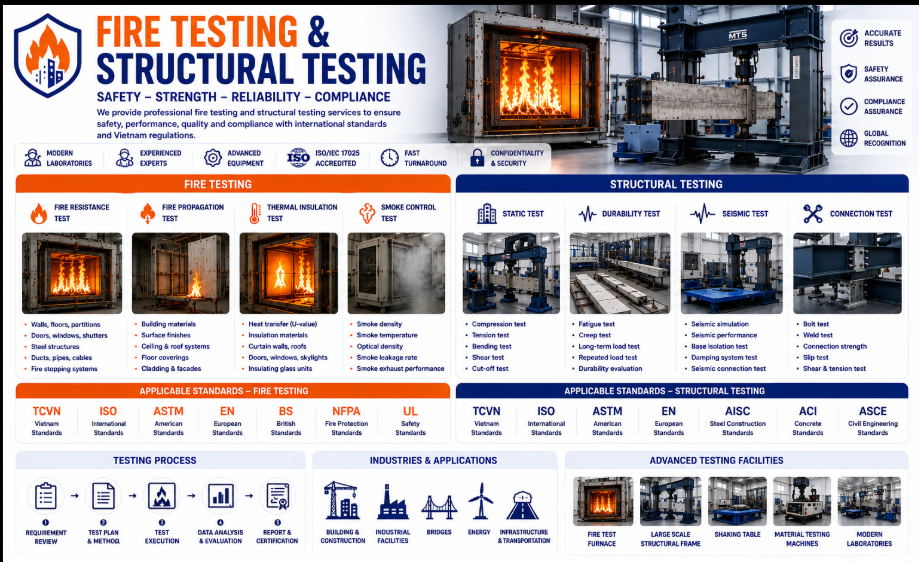
- Loaded Fire Resistance Testing Across Wide Dynamic Payload Configurations: Placing full-scale structural components (beams, columns, slabs, partition walls) into industrial vertical or horizontal testing furnaces, forcing thermal escalation along target curves (ISO 834 or UL 1709) while simultaneously applying hydraulic rams to simulate real-world compression and torsional payloads to isolate the exact ultimate load-bearing limit (R).
- Structural Integrity and Narrow-Band Thermal Insulation Verification (E & I Critical Validation): Deploying high-density thermocouple arrays (Thermocouples) synchronized with cotton-pad leak diagnostic tools to precisely measure structural flame/gas containment (E – Integrity) alongside unexposed surface temperature limits (I – Insulation), holding a definitive safety buffer at least 20% away from regulatory redlines.
- Caloric Release and Exhaust Smoke Mass Spectrometry (Cone Calorimetry Analysis): Analyzing material core formulations utilizing cone calorimetry arrays to quantify exact heat release rates (HRR), total heat released (THR), and the mass spectrum of toxic gas compounds (such as hydrogen cyanide and chloride vapors) to guarantee human biosecurity during emergency egress windows.
- Finite Element Thermal Simulation and Digital Thermal Passport Integration: Utilizing advanced Finite Element Analysis (FEA) solvers, such as ANSYS or SAFIR, to construct unalterable thermodynamic flow models of the structure, while embedding experimental testing data into the component’s digital identifier (Thermal Passport) to expedite technical green-channel customs and occupancy approvals.
3. Performance Metrics: Converting Fire Compliance Boundaries into Material Optimization Leverage (OPEX Efficiency)
Mastering structural fire-testing technology based on empirical data is the ultimate financial mechanism to safeguard project investment capital and optimize material raw costs:
| Operational Structural Risk Indicators | Saturated Thermal-Mechanical Forensic Governance | Passive Project Operations Reliant on Nominal Material Certs |
| Fire Safety Authority Acceptance Velocity | Secures a 100% approval rate for fire protection dossiers on initial submission, cutting asset completion and project handover timelines by 40%. | Handover dossiers are repeatedly rejected by local civil defense boards due to deficient load-bearing fire data, freezing capital loops indefinitely. |
| Structural Material Cost Margins (OPEX) | Leverages empirical stress data to optimize intumescent coating thickness or down-gauge shielding sheets while maintaining safety caps, cutting material costs by 15%. | Structural configurations rely on guesswork, causing expensive over-design (Over – design) that bloats project weight, or under-design that risks collapse. |
| B2B Brand Equity and Contract Procurement | Satisfies elite international fire ratings, unlocking access to tier-1 hyper-projects and securing prime contractor statuses from multinational developers. | Trapped in low-margin, low-specification subcontractor tiers, legally barred from projects with stringent life-safety and asset-protection mandates. |
4. Technical Action Roadmap: Phasing Structural Control Barriers from Laboratories to the Construction Site
Our fire risk mitigation protocol is deployed sequentially, embedding directly into raw material procurement and site-execution control loops:
- Step 1 – Material Thermodynamics and Sourcing Risk Mapping: Auditing the structural physical-chemical properties of incoming material inventories, mapping a rigid hazard matrix regarding thermal expansion differentials and flammability to isolate substandard materials at the warehouse gate.
- Step 2 – Destructive Prototype Small-Scale Burn Challenges: Testing initial prototype components inside scaled-down test furnaces to measure real-time thermal transmission kinetics through protective skins, allowing engineering adjustments to fireproofing dimensions prior to mass casting.
- Step 3 – Full-Scale Verification via Accredited ISO/IEC 17025 Laboratory Systems: Routing structural finished goods through closed-loop loaded industrial furnaces to generate legally binding test records backed by global underwriting insurers.
- Step 4 – Automated Site Installation SOPs and Laser Scan Locking: Locking down structural connection assemblies and fireproofing coating execution profiles on-site through automated 3D laser-scanning algorithms, completely eradicating structural assembly errors induced by field labor behavior.
5. Driving Verifiable ESG Milestones via High-Fidelity Life-Safety Structural Parameters
Enforcing rigorous structural fire-testing profiles represents definitive proof of an enterprise’s execution of its ESG (Environmental, Social, Governance) mandates with scientific honesty:
- The Environmental Pillar (Environment): Verifying and utilizing bio-based or inorganic advanced fireproofing materials that emit zero greenhouse gases minimizes the corporate carbon footprint and prevents hazardous chemical smoke plume generation during structural thermal incidents.
- The Social Pillar (Social): Establishes an ironclad life-safety boundary for urban communities by extending structural integrity limits (R, E, I > 180 minutes), providing critical golden time windows for emergency response teams to execute zero-casualty extraction maneuvers.
- The Governance Pillar (Governance): Swaps ambiguous, greenwashed marketing claims for unalterable, digitized testing data mapped directly into the project’s technical asset file, ensuring total transparency under international asset disclosure statutes.
Conclusion
Fire & Structural Testing is no longer a superficial quality checkmark tucked away at the tail end of a construction timeline. It is the core technocratic competency that dictates legal project sovereignty, operational asset safety, and your legitimate right to build high-margin, landmark developments within the global smart urban ecosystem.
Commanding a component portfolio that controls material thermodynamics and structural mechanics via an ironclad destructive testing matrix provides your business with a definitive passport across international auditing barriers. It insulates your real estate capital from compliance holdbacks and establishes your organization as an elite provider of resilient, world-class civil infrastructure.
Contact us today to receive dedicated advice and the most suitable solution for your business!
Hotline: +84 933096426 – +84 868 591 260
Email:
Website:
Partners in Vietnam:
Contact Vietnam representative: Duc Luong Services
Hotline: +84 933096426 – +84 868 591 260
Email: ducluongservices@gmail.com
Website:
STC VN Co., Ltd.
Hotline: +84 933096426 – +84 868 591 260
Email: info@staunchlyservices.com.vn
Website: https://stauchlyservices.com.vn


No responses yet