For manufacturers selling to European and global retailers, an amfori BSCI audit has become one of the most frequently requested social-compliance assessments. Yet many factories still misunderstand what it actually is — and that misunderstanding can cost them a buyer relationship. This guide explains the amfori BSCI system clearly, walks through the 13 Performance Areas and the A–E rating, and shows how ISC Global helps export-oriented businesses in Vietnam prepare with confidence.
What Is amfori BSCI?
BSCI stands for Business Social Compliance Initiative. It was launched in 2003 by the Foreign Trade Association — now known as amfori — an association of brands, retailers and importers from more than 40 countries. The name “amfori” is derived from amphorae, the clay shipping vessels of the ancient trading world, a nod to the timelessness of trade.
Here is the single most important clarification for any supplier:
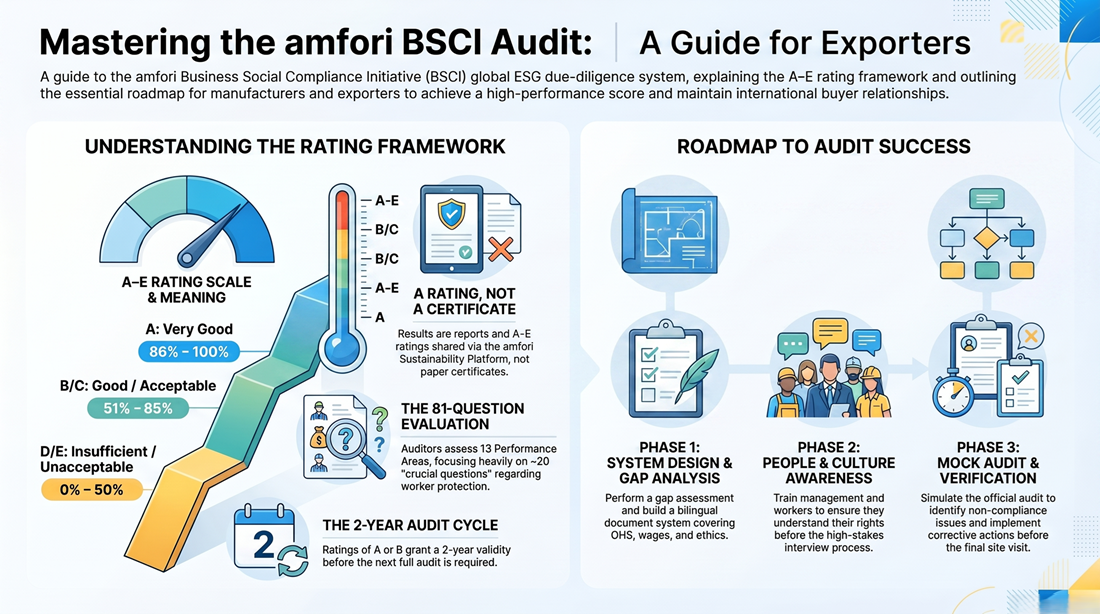
amfori BSCI is not a certification. It is a member-based ESG due-diligence system that produces a social audit report and a rating, not a pass/fail certificate.
Because amfori is a member-led association, it does not issue “BSCI certificates.” Instead, brands and retailers (the members) ask their suppliers to be audited against the amfori BSCI Code of Conduct, and the resulting report is shared on the amfori Sustainability Platform. When a salesperson or buyer says they need your factory to “get BSCI certified,” what they really mean is: complete a satisfactory amfori BSCI audit. Understanding this distinction is the first sign of a mature supplier.
The amfori BSCI Code of Conduct
The current amfori BSCI Code of Conduct (version 2021) has been in force since 1 January 2023 (refreshed in 2024 to match amfori’s brand guidelines, with content unchanged). It is built on internationally recognised instruments, including:
- The Universal Declaration of Human Rights (1948)
- The core Conventions of the International Labour Organization (ILO)
- The UN Guiding Principles on Business and Human Rights (UNGPs)
- The OECD Guidelines for Multinational Enterprises
- The UN Global Compact and the Children’s Rights and Business Principles
The Code is organised around a set of core values and principles that translate into 13 Performance Areas (PAs) — the categories an auditor evaluates on site.
The 13 amfori BSCI Performance Areas
The 13 Performance Areas are interconnected and grouped logically. In broad terms they cover:
- Social Management System — the governance backbone that makes the Code work day to day.
- Workers’ Involvement and Protection — informing workers of their rights and building grievance channels.
- Freedom of Association and Collective Bargaining — respecting workers’ right to organise (or not).
- No Discrimination, Violence or Harassment — fair, respectful treatment for all.
- Fair Remuneration — legal minimum wage and progress toward a living wage.
- Decent Working Hours — controlling overtime and ensuring rest days.
- Occupational Health and Safety (OHS) — the most document- and evidence-heavy area.
- No Child Labour — age verification and remediation processes.
- Special Protection for Young Workers — safeguards for workers aged 15–18.
- No Precarious Employment — proper contracts and lawful employment relationships.
- No Bonded, Forced Labour or Human Trafficking — including responsible recruitment and no recruitment fees.
- Protection of the Environment — basic environmental management at the site.
- Ethical Business Behaviour — anti-corruption, anti-bribery and accurate record-keeping.
How the amfori BSCI Audit Works
An amfori BSCI audit consists of 81 questions, of which around 20 are “crucial questions” that carry the highest weight because they relate directly to worker protection. Auditors gather evidence through site observation, worker interviews and document review, and answer each question as Yes, No, Partially or Not applicable.
The A–E rating scale
Each Performance Area — and the overall audit — receives a grade:
| Rating | Meaning | Score band |
|---|---|---|
| A | Very Good | 86–100% |
| B | Good | 71–85% |
| C | Acceptable | 51–70% |
| D | Insufficient | 30–50% |
| E | Unacceptable | 0–29% |
A rating of A generally requires at least seven Performance Areas rated A and none rated C or lower.
The two-year audit cycle
The amfori BSCI audit cycle runs over two years. It begins with a full audit covering all 13 PAs. If the result is below “C” (i.e. C, D or E), a follow-up audit is required, typically between two and twelve months later, focusing only on the areas needing improvement. If the result is A or B, the next full audit falls due within two years. Note that amfori has moved away from fully announced audits toward semi-announced windows, and since July 2025 suppliers can directly request their own audits via the platform.
Why amfori BSCI Matters for Vietnamese Exporters
Vietnam is one of the world’s most important sourcing hubs for textiles, footwear, furniture, electronics and agri-food. European retailers in particular increasingly treat a satisfactory BSCI audit as a minimum entry condition. A strong amfori BSCI result helps a Vietnamese supplier to:
- Win and retain export orders from amfori member brands.
- Reduce audit fatigue — one shared report can serve multiple buyers.
- Demonstrate ESG due diligence in line with emerging EU regulations.
- Build a credible, well-documented management system that also supports SMETA/Sedex, SA8000 and customer codes of conduct.
Common Pitfalls We See in Vietnamese Factories
From hundreds of preparation projects, the recurring weak points are predictable: incomplete working-hours and overtime records, gaps in OHS documentation (machine guarding, fire drills, chemical safety data sheets), social-insurance shortfalls, missing grievance mechanisms, and the absence of a documented management system tying it all together. The good news: every one of these is fixable with structured preparation.
How ISC Global Supports Your amfori BSCI Journey
As a specialist consultancy serving export manufacturers across Vietnam, ISC Global — together with our Vietnam representative partners Duc Luong Services and STC VN Co., Ltd. (Staunchly Vietnam) — provides end-to-end support:
- Gap assessment against the 13 Performance Areas and the 81 audit questions.
- Document system build-out (policies, procedures, registers and records) in bilingual Vietnamese/English format.
- Worker and management awareness training on the Code of Conduct and the audit process.
- Mock audit and corrective-action planning to lift your projected rating before the real audit.
- On-site support during the audit and follow-up remediation.
Frequently Asked Questions
Is amfori BSCI a certificate I can frame and hang on the wall? No. amfori BSCI produces a confidential audit report and an A–E rating hosted on the amfori Sustainability Platform, accessible to amfori members and the audited supplier — not a public certificate.
How long is a BSCI audit “valid”? The audit cycle is two years for an A or B result. A result below C triggers a follow-up audit within two to twelve months.
What rating should we aim for? Most buyers expect at least a “C” with a clear improvement plan, but “A” or “B” is the goal for stable, long-term sourcing relationships.
Can ISC Global help if we also need SMETA or SA8000? Yes. The underlying social-management documentation overlaps significantly, and we routinely build systems that serve multiple schemes at once.
Talk to Our BSCI Experts
Preparing for an amfori BSCI audit is far easier — and far cheaper — when you start early with the right guidance.
Contact us for a consultation:
Hotline: +84 933 096 426 – +84 868 591 260
Email: info@iscglobal.asia | van.pham@iscglobal.asia
Website: iscglobal.asia | iscglobal.edu.vn
Beyond the Audit: 5 Surprising Truths About amfori BSCI Every Exporter Must Know
For many Vietnamese manufacturers, the request arrives as a sudden ultimatum from a European buyer: “We need your factory to be BSCI certified before the next order.” For key export sectors like textiles, footwear, furniture, electronics, and agri-food, this triggers an immediate wave of pressure. Management teams often scramble to “obtain” a certificate that doesn’t actually exist, operating under the assumption that social compliance is merely a paperwork hurdle to be cleared once a year.
However, despite being the most recognized social compliance framework in the global supply chain, amfori BSCI remains deeply misunderstood in Vietnam. These misconceptions do more than cause administrative headaches; they can jeopardize long-term partnerships with international retailers who are increasingly under pressure to prove ESG (Environmental, Social, and Governance) due diligence. To navigate the complexities of modern export markets, businesses must look past the audit day and understand the strategic logic of social compliance. The following guide explores the five surprising truths every exporter must master to move from “audit stress” to a position of competitive strength.
1. The “Certificate” That Doesn’t Exist
The most common misunderstanding in the industry is the search for a “BSCI Certificate.” In reality, no such document exists. amfori BSCI is not a traditional pass/fail certification like ISO 9001; it is a member-based ESG due-diligence system.
Instead of a certificate, the process produces a comprehensive audit report and a rating (from A to E) hosted on the amfori Sustainability Platform. When a buyer asks for “BSCI certification,” they are actually asking to see a satisfactory audit report that proves the factory aligns with the amfori Code of Conduct. Distinguishing between a “certification” and a “system” marks the difference between a simple compliance mindset and a mature supplier mindset.
To understand the scope of this evaluation, every exporter should be familiar with the 13 Performance Areas (PAs) evaluated during an audit:
- Social Management System
- Workers’ Involvement and Protection
- Freedom of Association and Collective Bargaining
- No Discrimination, Violence, or Harassment
- Fair Remuneration
- Decent Working Hours
- Occupational Health and Safety (OHS)
- No Child Labour
- Special Protection for Young Workers
- No Precarious Employment
- No Bonded, Forced Labour, or Human Trafficking
- Protection of the Environment
- Ethical Business Behaviour
“amfori BSCI is not a certification. It is a member-based ESG due-diligence system that produces a social audit report and a rating, not a pass/fail certificate.”
2. The “Crucial 20” – Why Not All Questions Are Equal
An amfori BSCI audit involves 81 detailed evaluation questions. For each question, auditors have four scoring options: Yes, No, Partially, or Not Applicable. While every question contributes to the final score, they are not weighted equally.
Within this set, approximately 20 “crucial questions” hold the power to sink a rating regardless of successes in other areas. These questions are non-negotiable because they link directly to fundamental human rights and worker safety. A single “No” on a crucial question regarding child labor, forced labor, or critical fire safety can pull down the entire audit result. From a strategic perspective, exporters must prioritize these “non-negotiables” during the preparation phase to avoid an automatic failure.
3. The Interview Trap – Why Paperwork Is Only Half the Battle
Many factories approach audits by focusing exclusively on their document archives. While organized records are essential, auditors use a three-pronged methodology: site observation, document review, and worker interviews.
As an expert, I often see factories with perfect paperwork still receive a poor rating. Why? Because auditors use random, confidential interviews to “cross-check” the authenticity of the records. If a worker is unaware of their rights, does not know how to use the grievance channel, or provides testimony that contradicts the timesheets, the auditor will flag the discrepancy.
Awareness is Compliance Compliance is not a file stored in the HR office; it must exist in the minds of the workforce. If employees are not trained on the Code of Conduct or safety protocols, the management system is considered incomplete.
4. Decoding the A–E Rating – It’s a Journey, Not a Grade
The rating scale reflects the maturity of your social management system. Understanding the consequences of each grade is vital for operational planning:
- A (Very Good: 86–100%) & B (Good: 71–85%): Grants a two-year audit cycle.
- C (Acceptable: 51–70%), D (Insufficient: 30–50%), or E (Unacceptable: 0–29%): Triggers a follow-up audit within 2 to 12 months.
Achieving an “A” rating is a significant challenge, requiring a minimum of seven PAs at ‘A’ and none below ‘C’. Furthermore, exporters must be aware of a critical “Pro-Tip”: during a follow-up audit (which focuses on previous gaps), auditors are still required to perform “minimum due diligence” on PA 5 (Remuneration), PA 6 (Working Hours), and PA 7 (OHS). You cannot ignore these core areas just because you are fixing a different gap.
“The goal is not to ‘pass the exam’ but to demonstrate the maturity and improvement roadmap of the social management system.”
5. Local Bottlenecks – The Specific Hurdles for Vietnamese Factories
In the Vietnamese market, certain “recurring weak points” frequently derail audits. Often, the failure stems from treating PA 1 (Social Management System) as an afterthought, when it is actually the “backbone” that links the other 12 areas together. Without a documented management system, individual compliance tasks eventually fail.
Common local bottlenecks include:
- Working Hours: Inconsistent records of overtime and mandatory rest days.
- Social Insurance: Shortfalls in mandated insurance contributions—a major focus for auditors in the Vietnamese sector.
- Occupational Health and Safety (OHS): Treating safety as a “paperwork task” rather than risk management (e.g., missing chemical safety data sheets or fire drill logs).
These issues are fixable, but they require a structured Gap Assessment early in the process to identify discrepancies before the official auditor arrives.
Final Thought: From Audit Stress to Competitive Advantage
For Vietnamese exporters, amfori BSCI should not be viewed as a burden, but as a significant competitive advantage. As global markets shift, a strong rating on the amfori Sustainability Platform becomes a powerful credential to win orders from top-tier brands.
The landscape is changing. Starting in late 2025 and moving into 2026, amfori is shifting toward a “Continuous Improvement” methodology. This marks the end of “audit-day-only” compliance; the focus will move toward a culture of ongoing progress. To avoid “audit fatigue” and ensure long-term market access, start your Gap Assessment early. Building a genuine social management system today is the only way to be prepared for the compliance demands of tomorrow.
Contact us to download the bilingual English-Vietnamese PDF standard: from only $50
On the path toward integration and export, correctly understanding and applying international standards is essential. Yet language and technical terminology often pose real barriers. We are pleased to introduce our bilingual (English – Vietnamese) standards documentation service, translated by our own team of certification consultants.
What We Provide
• A clause-by-clause bilingual comparison, easy to consult and file.
• Professional Vietnamese translation in correct technical terminology, ready to use.
• Interpretation notes and application guidance from hands-on experts.
• Fast delivery in editable, easy-to-store PDF/Word format.
Standards Covered
ISO management systems (9001, 14001, 45001, 37001); sustainability certifications (ISCC, FSC, VFCS/PEFC); textiles and recycled materials (GRS, OCS, OEKO-TEX); social responsibility and ESG (SMETA, EcoVadis, Fairtrade), and many other industry standards upon request.
Why Choose Us
Our documents are translated by professionals who directly consult on and audit certifications, so the translation is accurate not only in language but also in real-world application — saving you time and reducing errors when preparing documentation.
Pricing
From only USD 50 per document, depending on length and complexity. Please send us the standard name to receive a free, accurate quotation.
How to Order
1. Contact us with the name of the standard you need.
2. Receive a quotation and delivery time.
3. Make payment and receive your document by email.
Payment
Bank transfer via QR code (provided with the quotation), or via PayPal: ducluongservices@gmail.com.
We look forward to accompanying you on your certification journey.
Best regards,
CONTACT INFORMATION
ISC Global
Hotline: +84 933 096 426 – +84 868 591 260
Email: info@iscglobal.asia
Website: iscglobal.asia | iscglobal.edu.vn
No responses yet