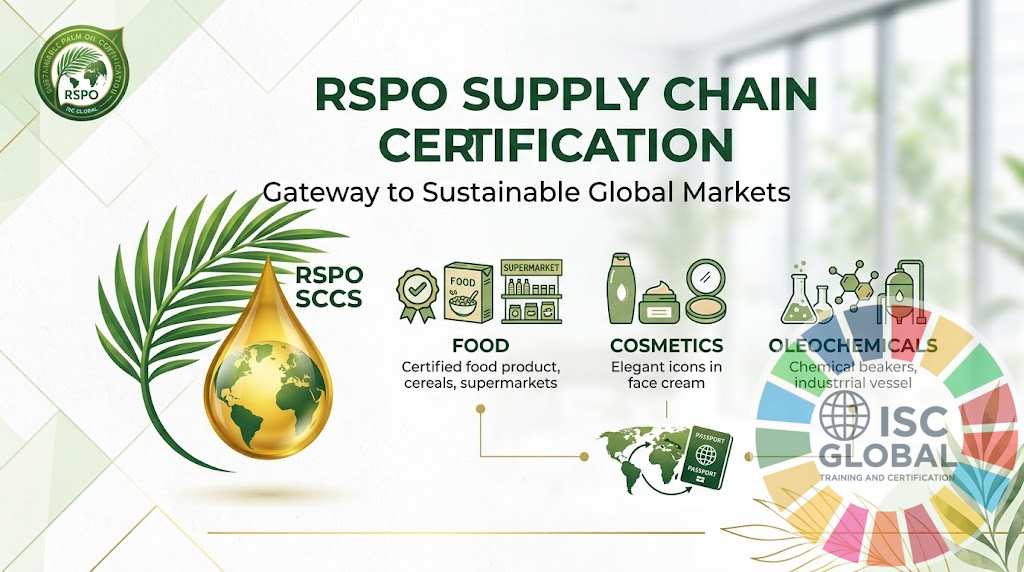
As global buyers and retailers tighten sourcing requirements around traceability and deforestation-free supply chains, RSPO (Roundtable on Sustainable Palm Oil) certification has moved from a nice-to-have to a near-mandatory credential for manufacturers that purchase, process, or incorporate palm oil and its derivatives into finished products. ISC Global offers comprehensive RSPO Supply Chain Certification (RSPO SCCS) consulting, guiding manufacturers in Vietnam and across Asia through every stage — from initial gap assessment to certificate issuance and long-term system maintenance.
What Is RSPO Certification?
RSPO is an international not-for-profit organisation that brings together stakeholders across the palm oil value chain — growers, mills, processors, traders, retailers, and civil society — to develop and implement credible global standards for sustainable palm oil. Companies that do not grow or mill palm oil themselves, but purchase, use, or process palm oil and its derivatives as an ingredient — such as food manufacturers, cosmetics producers, and oleochemical companies — need to comply with the RSPO Supply Chain Certification Standard (RSPO SCCS), which verifies that a company’s system for receiving, controlling, storing, using, and tracing palm oil-derived material meets internationally recognised requirements.
This is distinct from the RSPO Principles & Criteria (P&C) — most recently updated to the 2024 version, adopted at RSPO’s 21st General Assembly — which applies primarily to growers and mills further upstream in the supply chain.
The Four RSPO Supply Chain Models
Before building a certification roadmap, every manufacturer needs to select the supply chain model that fits its operations and budget:
- Identity Preserved (IP): Certified palm oil from a single identifiable source, kept physically separate throughout the supply chain.
- Segregated (SG): Certified palm oil from multiple certified sources, still kept physically separate from conventional palm oil.
- Mass Balance (MB): Certified and non-certified palm oil may be mixed during production, provided the total volume of certified output claimed never exceeds the volume of certified input purchased. This is typically the most practical starting point for food and consumer-goods manufacturers, balancing cost with credibility.
- RSPO Credits (Book & Claim): Companies purchase RSPO credits corresponding to their palm oil usage without requiring physical segregation of the material itself.
Choosing the right model up front — usually Mass Balance for manufacturers beginning their sustainability journey — helps control implementation cost while still meeting full RSPO SCCS requirements.
Our 4-Stage Consulting Approach
ISC Global structures every RSPO SCCS project around four clear stages:
1. Kick-off, Gap Assessment & Awareness Training
We begin with a formal kick-off meeting to align on project objectives, scope, and coordination mechanisms, followed by the client forming a dedicated RSPO team (management representative, coordinator, and department representatives from purchasing, production, quality, warehouse, accounting, and sales — a requirement under the standard). We then conduct an on-site gap analysis of the existing material control and traceability system against RSPO SCCS requirements, and deliver initial RSPO awareness training for relevant staff.
2. Documentation System Development
We help build and standardise the full documentation package: procedures for receiving, controlling, and tracing palm oil-derived material; supply chain model-specific policies (particularly Mass Balance volume declaration procedures); purchasing forms, control records, and traceability documentation. At this stage we also verify that the client’s palm oil suppliers hold a valid RSPO Supply Chain licence, a prerequisite for making any RSPO claim on finished products.
3. Implementation & Evidence Building
Once the documented system is issued, we guide hands-on implementation on the factory floor — warehouse, production, and quality control areas — supporting internal audits and corrective actions to ensure the system works in practice, not just on paper.
4. Certification Audit Support
We help prepare the complete evidence package and coordinate with an RSPO-accredited independent certification body throughout the formal audit, supporting the resolution of any non-conformities identified, through to certificate issuance.
A typical project — from initial assessment to certification — takes 3 to 6 months, depending on the maturity of the client’s existing documentation and the speed of internal coordination. The RSPO Supply Chain certificate is valid for 5 years, subject to annual surveillance audits to maintain validity — certification is a continuous commitment, not a one-time event.
Why RSPO Certification Matters for Exporters
- Market access: Many global FMCG brands and retailers now require 100% RSPO-certified palm oil across their supply chains — certification is often a prerequisite simply to be considered as a supplier.
- Regulatory alignment: Traceability and deforestation-related regulations such as the EU Deforestation Regulation (EUDR) continue to push importers toward supply chains that can demonstrate verifiable, third-party-audited traceability.
- Brand credibility: Certification provides tangible, internationally recognised evidence of a company’s sustainability commitments to consumers, investors, and trading partners.
- Operational discipline: The process of building an RSPO-compliant system typically improves internal material control, reduces waste, and strengthens traceability well beyond what certification alone requires.
Why Work With ISC Global?
ISC Global brings hands-on experience across a wide range of international management system and product certifications — including ISO 9001, ISO 14001, ISO 45001, GRS, OCS, EcoVadis, SEDEX SMETA, and ISCC EU/PLUS — giving our consulting team a practical understanding of both the technical requirements of RSPO SCCS and the operational realities of manufacturing environments. In Vietnam, we work alongside our representative partner Duc Luong Services and independent audit coordination partner STC VN Co., Ltd. (Staunchly Vietnam), forming an end-to-end support ecosystem — from system consulting to certification-body coordination — that helps manufacturers move through the RSPO journey efficiently and cost-effectively.
Get in Touch for a Free Consultation
If your company is evaluating or ready to begin its RSPO Supply Chain Certification journey, our consulting team is ready to help design the right roadmap for your operations.
ISC Global
Hotline: +84 933 096 426 – +84 868 591 260
Email: info@iscglobal.asia | van.pham@iscglobal.asia
Website: iscglobal.asia | iscglobal.edu.vn
No responses yet