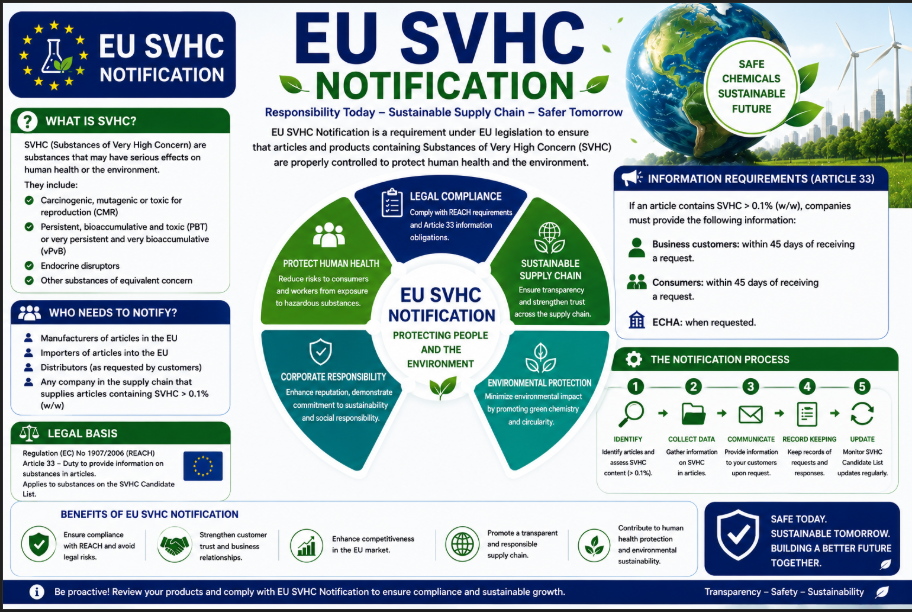
In the European market, having your factory pass audits or securing a general chemical registration is only half the battle. For enterprises exporting finished products (Articles)—ranging from apparel, footwear, and consumer goods to electronics and packaging—there is a highly complex financial and legal puzzle known as: The Obligation for Substances of Very High Concern (SVHC) Notification. If a single substance within your product belongs to the SVHC list, exceeds a concentration of 0.1% by weight, and your total export volume surpasses 1 ton per year, failing to submit a declaration to the European Chemicals Agency (ECHA) can instantly trigger a product ban across the entire EU territory. Our EU SVHC Notification consulting services are not designed to sell you theory; they are engineered to work alongside your enterprise to dissect material flows, eliminate chemical “blind spots,” and directly safeguard your export cash flow.
1. A Pragmatic View of SVHC: The Trap of Complacency in a Dynamic System
The fatal mistake made by many exporters today is the assumption that “if the product complied last year, it is safe this year.” ECHA’s SVHC (Substances of Very High Concern) list is a dynamic registry, updated continuously twice a year. A plasticizer, dye auxiliary, or flame retardant that was perfectly legal yesterday can be classified as hazardous overnight. If an enterprise fails to submit a notification within 6 months of an update, the shipment is treated as a severe regulatory violation. When that happens, the penalty is not limited to administrative fines—it triggers the worst-case scenario: a total recall of your products from European shelves and the permanent termination of your supplier status.
Let’s be frank: In global supply chains, major EU buyers (such as IKEA, Decathlon, H&M) will never shoulder legal risks on your behalf. Proactively mastering SVHC data is not an incidental administrative chore; it is a commercial weapon to demonstrate superior governance capabilities, turning a strict technical barrier into a warranty that locks in million-dollar contracts.
2. Four Practical Obstacles Defused Through Our Consulting Framework
To ensure that your identification and declaration processes are streamlined while minimizing testing costs, our services focus strictly on neutralizing four core links:
- Dissecting the Material Matrix (Material Breakdown): Analyzing product architecture and reviewing the chemical composition of even the smallest components to pinpoint and isolate substances at risk of exceeding the 0.1% weight threshold.
- Establishing the Boundaries of Legal Obligations: Mathematically calculating the total mass of the SVHC exported based on annual order volumes to determine the most optimized compliance route: submitting a formal Notification to ECHA or generating a Communication declaration for your customers.
- Enforcing Standards on the Upstream Supply Chain: Guiding your enterprise on how to police and mandate that raw material suppliers provide transparent Material Declarations, blocking hazardous chemicals right at the source.
- Digitizing Dossiers for the SCIP and REACH-IT Systems: Compiling technical dossiers using the IUCLID platform, submitting formal notifications to ECHA on your behalf, and ensuring data integration into the SCIP database (for products containing SVHCs) aligned with statutory timelines.
3. Direct Commercial Advantages: Translating Transparency into Long-Term Orders
Clearing ECHA’s SVHC filter is the ultimate proof that your enterprise operates an exceptionally clean and safe manufacturing process:
| Strategic Objective | Real-World Commercial Value |
| Insuring Smooth Customs Clearance | Eliminates 100% of the risks associated with product recalls, seizures, or customs rejections at all European Union ports of entry. |
| Gaining an Exclusive Competitive Advantage | Stands ready to supply accurate SVHC/SCIP submission numbers the moment a buyer requests them, winning an absolute edge in international tenders. |
| Proactively Protecting Production Lines | Identifies substances trending toward future bans early on, allowing you to source alternative raw materials and avoid operational gridlock. |
| Elevating Premium Brand Positioning | Products with transparent chemical data are consistently prioritized by high-end retail networks willing to absorb healthier profit margins. |
4. Our Deployment Roadmap: High Speed, Deep Involvement, Guaranteed Results
Recognizing the intense pressure your enterprise faces regarding shipping deadlines and production schedules, we utilize a phased, high-efficiency consulting approach:
- Step 1 – Product Inventory Analysis & Risk Mapping: Collecting product blueprints and raw material Safety Data Sheets (SDS) to categorize and screen for high-risk substance groups based on industry realities.
- Step 2 – Testing Management & Optimization: Guiding sample preparation and optimizing your budget by targeting SVHC screening tests at international certified laboratories (ISO 17025) strictly for high-risk components, preventing unnecessary spending.
- Step 3 – Drafting and Compiling the Technical Dossier: Consolidating analytical data, calculating concentration and total tonnage, and building digital submission dossiers within IUCLID according to ECHA’s standard formats.
- Step 4 – Successful Declaration & Protocol Transfer: Executing submissions through the REACH-IT portal, delivering valid Submission Numbers, and training your internal teams on how to update the system as the SVHC list evolves.
5. Materializing Sustainability Benchmarks Within Your ESG Strategy
In an era where global consumers are actively walking away from products containing hazardous chemicals, executing your EU SVHC Notification obligations is a direct validation of the E (Environment) and G (Governance) pillars of your ESG matrix:
- Eradicating Greenwashing Risks: Your enterprise proves via independent data streams that your products are safe and that hazardous substances are tightly managed, building authentic credibility with consumers and shareholders.
- Driving Sustainable Eco-Design: Instilling a clean manufacturing mindset right from the Research and Development (R&D) phase, systematically reducing dependency on toxic chemical compounds.
- Future-Proofing Against the EU Chemicals Strategy for Sustainability: Building an agile compliance foundation, ensuring your business is never caught off guard by upcoming regulatory tightening concerning the circular economy.
Conclusion:
An EU SVHC Notification is not a passive paperwork exercise to satisfy customs officials at the border. It is a critical, strategic investment that enables your enterprise to control chemical risks at the source, safeguard your export cash flow, and confidently anchor your brand as a trusted leader within the global green supply chain.
Contact us today to receive dedicated advice and the most suitable solution for your business!
Hotline: +84 933096426 – +84 868 591 260
Email:
Website:
Partners in Vietnam:
Contact Vietnam representative: Duc Luong Services
Hotline: +84 933096426 – +84 868 591 260
Email: ducluongservices@gmail.com
Website:
STC VN Co., Ltd.
Hotline: +84 933096426 – +84 868 591 260
Email: info@staunchlyservices.com.vn
Website: https://stauchlyservices.com.vn

No responses yet