Why every company exporting to India needs to understand BIS certification
India is becoming one of the priority export markets for Vietnamese businesses, but it is also a market with increasingly tight technical barriers. At the heart of those barriers lies BIS certification – a certification issued by the Bureau of Indian Standards.
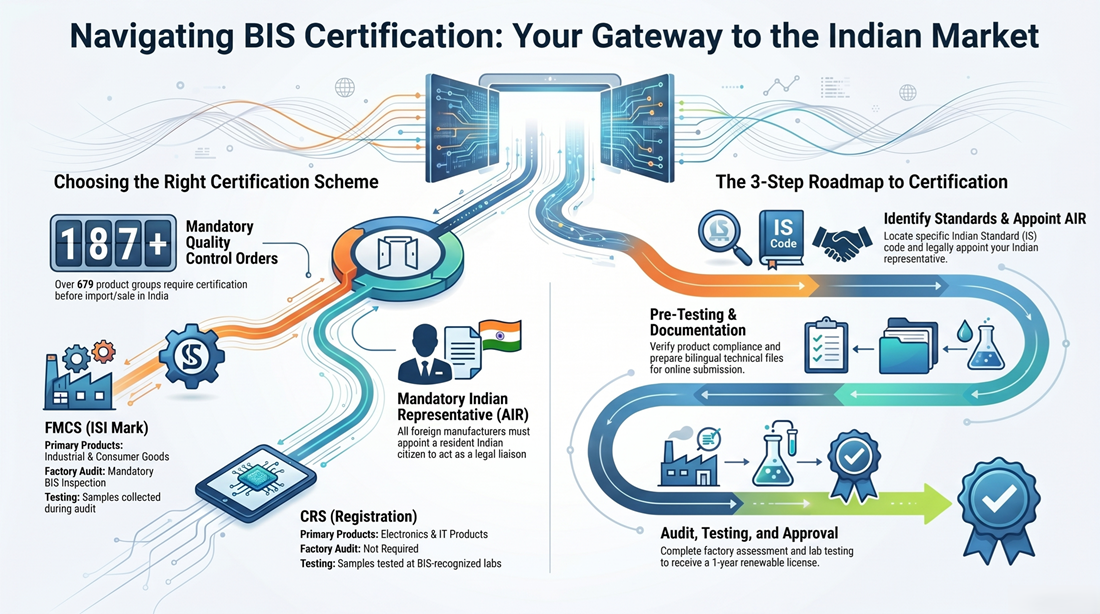
As of 2025, the Government of India had issued roughly 187 Quality Control Orders (QCOs) covering more than 679 product categories, ranging from cement, chemicals, iron and steel products and automotive accessories to food products, toys, electrical equipment and consumer goods. For products falling within a QCO, having no BIS certification means the goods cannot be imported, distributed or sold in India – regardless of any signed contract or order already in production.
For foreign manufacturers, including Vietnamese companies, the only route to bring a product bearing the ISI mark into India is through the FMCS (Foreign Manufacturers Certification Scheme) or Scheme X for certain categories of industrial and electrical equipment.
This article helps businesses understand the nature of the BIS standard, the certification schemes, the implementation process and common challenges – and introduces the end-to-end consulting solution from ISC Global – Staunchly Vietnam – Duc Luong Services.
What is BIS certification?
The Bureau of Indian Standards (BIS) is India’s national standards body, operating under the Ministry of Consumer Affairs, Food and Public Distribution. BIS operates in accordance with the BIS Act, 2016 and the Conformity Assessment Regulations, 2018.
BIS certification confirms that a company’s product or management system conforms to the relevant Indian Standard (IS). Once certified, the product is permitted to carry the BIS Standard Mark – most commonly the ISI mark for products and the CRS registration mark for electronics – a signal of quality and safety that Indian consumers and regulators trust.
One important point: a foreign manufacturer’s product certified under FMCS carries the same ISI mark as products manufactured domestically in India, with no distinction.
The BIS certification schemes you need to know
BIS operates several different certification schemes. Identifying the correct scheme for your product is the first and most important step.
1. Product Certification – ISI Mark (Scheme I)
This is the core product certification scheme, applicable to most regulated consumer and industrial goods. The scheme requires factory inspection and product testing. For foreign manufacturers, the ISI mark is accessed through the FMCS (see below).
2. FMCS – the certification scheme for foreign manufacturers
The FMCS (Foreign Manufacturers Certification Scheme) was launched by BIS in 2000 to extend ISI mark certification to companies with factories located outside India. It is the only pathway for a Vietnamese manufacturer to obtain a legitimate ISI mark for a product within a QCO.
Key features of FMCS:
- Applies to foreign companies exporting products listed under a QCO.
- Appointment of an Authorized Indian Representative (AIR) is mandatory: an individual or legal entity resident in India who acts as the point of contact and bears legal responsibility before BIS.
- Includes a factory assessment by a BIS officer and sample testing.
- The licence is valid for 1 year and must be renewed annually.
3. CRS – Compulsory Registration Scheme (Scheme II)
The CRS (Compulsory Registration Scheme) applies mainly to electronics and IT products. Unlike the ISI route, CRS is based on self-declaration after samples are tested at a BIS-recognised laboratory and does not require a factory audit. This is often a lighter pathway for electronics manufacturers.
4. Scheme X – high-risk industrial and electrical equipment
Under the Machinery and Electrical Equipment Safety (Omnibus Technical Regulation) Order, 2024, Scheme X becomes mandatory for many categories of machinery, electrical equipment and high-risk devices. The process is similar to FMCS and requires rigorous technical documentation.
5. Systems Certification & Hallmarking
Beyond product certification, BIS also issues Systems Certification (management systems) and operates the mandatory Hallmarking programme for gold jewellery – an area whose scope is continuously expanding district by district across India.
What are the steps in the BIS FMCS certification process?
Below is a typical roadmap for a Vietnamese business to obtain FMCS certification:
- Determine whether your product falls under a QCO and identify the relevant Indian Standard (IS code) based on the official BIS product list / gazette notifications.
- Appoint an Authorized Indian Representative (AIR) – mandatory for foreign manufacturers.
- Pre-test the product against the Indian Standard to ensure it meets requirements before applying.
- Prepare and submit the application online on the BIS portal using the correct formats, paying the application fee and the deposit for assessment costs (man-days and officer travel).
- BIS reviews the application and may request clarifications or additional documents.
- Factory assessment by a BIS officer and sample collection for testing at a recognised laboratory.
- Grant of licence and the right to use the ISI mark, together with ongoing surveillance obligations.
- Annual renewal and continuous compliance – any change to the product or process must be approved by BIS.
Important note: The list of products under BIS/FMCS is not fixed. BIS regularly issues new QCOs or updates existing requirements, along with periodic deadline extensions. Businesses should check the latest official notifications before each shipment to avoid supply-chain disruption.
Common challenges Vietnamese businesses face when seeking BIS certification
- Misidentifying the applicable scheme (ISI/FMCS, CRS or Scheme X), leading to incorrectly prepared documentation.
- Difficulty finding and managing a reliable AIR in India.
- Technical files not in the correct BIS format, which prolongs the review.
- Inadequate preparation for the factory assessment, resulting in non-conformities.
- Missing QCO deadlines and annual licence renewal schedules.
- Language and regulatory barriers between the Vietnamese and Indian legal systems.
These are precisely the areas where an experienced consultancy can help a business save time and cost while reducing risk.
End-to-end BIS certification consulting
With deep expertise in international certification and trade-law advisory, the ISC Global supports Vietnamese businesses across the entire BIS certification journey:
- Applicability assessment: determine whether your product falls under a QCO, the relevant IS code, and the appropriate certification scheme (ISI/FMCS, CRS, Scheme X).
- Advisory and support in appointing an AIR in India, ensuring legal compliance.
- Gap analysis of your product and factory against the Indian Standard before submission.
- Preparation of bilingual Vietnamese–English technical files in line with BIS formats and requirements.
- Management of the online application on the BIS portal, tracking progress and responding to requests.
- Preparation for the factory assessment, coordinating sampling and testing at recognised laboratories.
- Support for surveillance and annual licence renewal, with updates whenever new QCOs are issued.
- International trade-law advisory – ISC Global’s distinctive strength in integrating ESG/ISO with legal practice.
Our differentiator is the combination of international certification experience (SMETA, ISCC EU, EcoVadis, FM Approvals, C-TPAT, Fairtrade, and more) with legal capability, helping businesses not only “achieve certification” but also build a sustainable compliance foundation as they expand into the Indian and global markets.
Frequently asked questions about BIS certification (FAQ)
1. Is BIS certification mandatory for my product? It depends on whether the product is listed under a QCO. If it is, BIS certification is mandatory; if not, you may pursue voluntary certification to boost credibility and tendering advantages in India.
2. Which scheme do Vietnamese businesses apply under? Most go through FMCS (for the ISI mark), CRS (for electronics/IT) or Scheme X (for high-risk machinery and electrical equipment).
3. Is an Authorized Indian Representative (AIR) mandatory? Yes. Under FMCS, appointing an AIR resident in India is mandatory.
4. How long is a BIS licence valid? Typically 1 year, with annual renewal required.
5. Are foreign products distinguished from Indian products? No. A product certified under FMCS carries the same ISI mark as a domestically manufactured product.
6. How long does certification take? The timeline depends on the product category, the readiness of the documentation, the factory assessment schedule and testing. An experienced consultancy can significantly shorten the timeline and avoid rounds of document resubmission.
Contact us for BIS certification consulting
For a free QCO applicability assessment of your product and a tailored BIS certification roadmap, please contact:
Partner in Vietnam – Duc Luong Services
- Hotline: +84 933 096 426 – +84 868 591 260
- Email: ducluongservices@gmail.com
- Website: https://ducluongservices.com
ISC Global Co., Ltd.
- Hotline: +84 933 096 426 – +84 868 591 260
- Email: info@iscglobal.asia | van.pham@iscglobal.asia
- Website: https://iscglobal.asia/ | https://iscglobal.edu.vn/
STC VN Co., Ltd. (Staunchly Vietnam)
- Hotline: +84 933 096 426 – +84 868 591 260
- Email: info@staunchlyservices.com.vn
- Website: https://stauchlyservices.com.vn
Reference sources: Bureau of Indian Standards (bis.gov.in); QCO/FMCS information updated 2025–2026. Businesses should check the latest official BIS notifications before each export shipment.



No responses yet