In a marketplace where “sustainability” is no longer a marketing slogan but a precondition for entering global supply chains, businesses must be able to prove the recycled origin of their products in a way that is transparent, verifiable, and credible. Leading fashion brands, international retailers, and end consumers alike are asking increasingly demanding questions: Is this product truly made from recycled materials? What is the exact percentage? Was it manufactured without harming people or the environment? This is precisely where the Global Recycled Standard (GRS) plays its role — as a common language and an objective proof point behind every green claim.
This article from ISC Global will help you understand the GRS standard comprehensively — from its nature and history to its core requirements and how your business can achieve certification in the most effective way.
Understanding the GRS standard
GRS stands for Global Recycled Standard. It is a voluntary, full product standard that sets the criteria for independent, third-party certification of four key areas: recycled content in a product, chain of custody, social and environmental practices, and chemical restrictions in production.
What makes GRS valuable is its comprehensiveness. Unlike self-declarations that a company makes about itself, GRS requires independent verification by an accredited certification body. As a result, when a product carries the GRS logo, buyers can trust that the recycling claim behind it has been rigorously verified — not simply advertised.
GRS is designed to meet the needs of companies that want to verify the recycled content of both finished and intermediate products, while also demonstrating responsible social, environmental, and chemical practices throughout the entire production process. This is a fundamental distinction: GRS does not only ask “how much recycled content does the product contain,” but also “was the process that created it genuinely sustainable.”
How does GRS differ from RCS?
One of the most common points of confusion is the difference between GRS and the Recycled Claim Standard (RCS) — both issued by Textile Exchange. In essence, the two standards share a similar structure, but GRS is the stricter and more comprehensive version:
- RCS focuses mainly on verifying recycled content and tracing the supply chain, with a lower minimum recycled-content threshold.
- GRS requires a higher minimum recycled-content percentage (up to 50% for consumer-facing labeling) and adds a range of requirements covering social responsibility, environmental protection, and chemical management.
It is worth noting that a company certified to GRS is not automatically certified to RCS. However, adding RCS is straightforward because RCS requirements are largely covered within the scope of GRS. The optimal approach recommended by many experts is to apply for both at the same time to save on cost and audit time.
The evolution of GRS and a major upcoming change
GRS has a noteworthy development history. The standard was originally developed by Control Union Certifications (CUC) in 2008, with a focus on verifying recycled content. On 1 January 2011, ownership was transferred to Textile Exchange — a US-based nonprofit organization dedicated to advancing sustainability standards in the textile and related industries, and the body that manages GRS today.
To date, GRS has gone through four versions: 1.0 (2008), 2.0, 3.0 (2014), and 4.0 (released on 1 July 2017) — the version most widely applied today. Each upgrade reflects the maturing of the recycling industry and ever-higher expectations for transparency.
Important update: the Materials Matter Standard transition
This is information that many businesses are not yet fully aware of. Textile Exchange is consolidating its current suite of standards — including GRS, RCS, OCS (Organic Content Standard), and others — into a single unified standard called the Materials Matter Standard.
According to the official timeline published by Textile Exchange:
- The Materials Matter Standard criteria were released on 12 December 2025.
- The standard becomes effective on 31 December 2026.
- It becomes mandatory from 31 December 2027, at which point organizations will need to complete their next audit against the new standard to maintain certification.
This creates a dual challenge for businesses: achieving and maintaining current GRS certification while also preparing for the transition. It is also a key reason to partner with a consultancy that stays continuously up to date, such as ISC Global.
What specific requirements does GRS set?
The entire GRS system is built around the following core pillars.
1. Verification of recycled content
Materials must be verified as meeting the ISO definition of “recycled.” GRS accepts both types of input:
- Pre-consumer material: scrap and production waste that has never reached the end user.
- Post-consumer material: products that have been used and recovered for recycling (for example, PET bottles recycled into polyester fiber).
Regarding thresholds: a product containing at least 20% recycled material can use GRS as a business-to-business (B2B) tool. However, to qualify for consumer-facing GRS labeling, the product must contain at least 50% recycled material.
2. Responsible social and environmental production
Sites applying GRS must meet strict requirements: safe working conditions, no child labor, no forced labor, proper wastewater treatment, and reasonable control of emissions, energy consumption, and solid waste. These criteria make GRS a comprehensive standard rather than merely a certification of recycled percentage.
3. Chemical restrictions
Chemicals with harmful potential that appear on the GRS restricted list are strictly prohibited on any GRS product. This requirement simultaneously protects factory workers, end consumers, and the surrounding environment.
4. Chain of custody
This can be considered the backbone of GRS. The standard requires every stage in the production chain — from recycled input to finished product — to be controlled and certified. Each time goods change hands between parties, a Transaction Certificate (TC) is required. This mechanism enables clear traceability and prevents the mixing of recycled materials with virgin materials — a common form of fraud in the industry.
The real value of holding GRS certification
GRS certification is not just a certificate to hang on the wall. It delivers measurable value:
- Expanded export markets into the EU, the US, Japan, and South Korea — where sustainability commitments are a mandatory condition.
- Enhanced brand reputation and competitiveness, affirming environmental responsibility.
- Greater supply-chain transparency, shortening customers’ supplier audit processes.
- Higher commercial value for recycled product lines, which often command better margins.
- Getting ahead of regulation on the circular economy and anti-greenwashing rules that are tightening worldwide.
- Improved internal operations through tighter control of chemicals, wastewater, energy, and occupational safety.
Which businesses should adopt GRS?
GRS is suitable for any organization participating in the recycled-product supply chain: textile, yarn, fabric, and garment factories; manufacturers of recycled plastic pellets, packaging, and plastic products; collection, sorting, and recycling operators; producers of accessories, leather goods, footwear, and household items made from recycled materials; as well as brands and retailers wishing to verify the recycled origin of their goods.
ISC Global – Your partner in achieving GRS
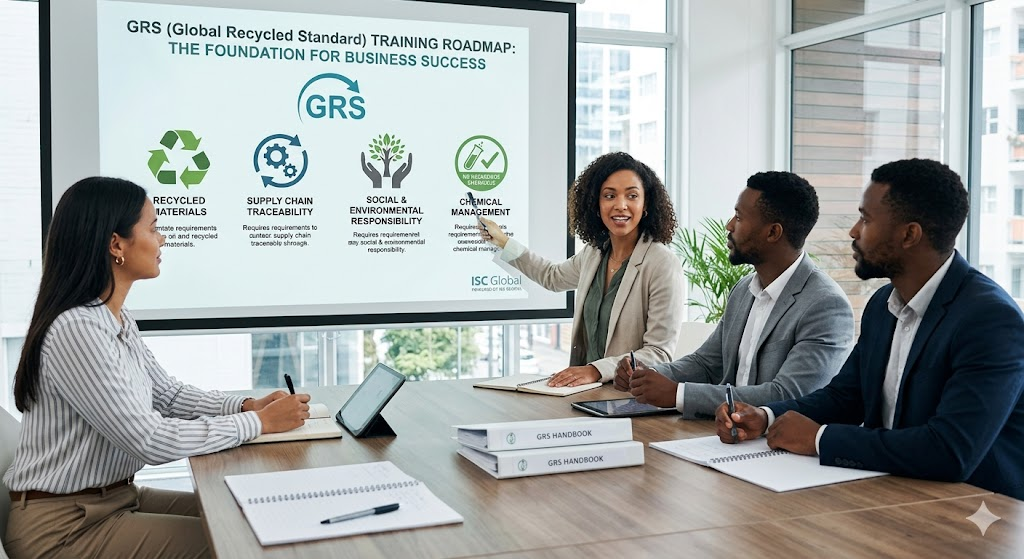
ISC Global offers an end-to-end solution covering training, consulting, and certification support for GRS, following a structured roadmap:
- Assess the current situation and perform a gap analysis against GRS 4.0 requirements.
- Deliver awareness training for the team on the standard’s requirements.
- Build the documentation system, control procedures, and Transaction Certificate system.
- Support real-world implementation, finalize on-site readiness, and record data.
- Conduct internal audits and address any non-conformities.
- Connect you with a reputable certification body and accompany you throughout the audit.
- Support maintenance and preparation for the transition to the Materials Matter Standard.
ISC Global’s key strength lies in staying continuously updated on the latest changes from Textile Exchange, helping your business stay proactive ahead of upcoming requirements and maintain uninterrupted capability to supply international markets.
Frequently asked questions
Is the GRS standard recognized globally? Yes. GRS is applied and recognized worldwide; the GRS logo can be used globally as long as the requirements are met.
What is the minimum recycled-content percentage? A minimum of 20% for B2B purposes, and a minimum of 50% to qualify for consumer-facing labeling.
Does GRS certification have an expiry? Certification must be maintained through periodic audits, and businesses should proactively prepare for the transition to the Materials Matter Standard.
Does GRS certification automatically include RCS? No, but RCS can be easily added since its requirements are largely covered by GRS. Applying for both at once is often the best option.
Contact ISC Global
ISC Global Co., Ltd.
- Hotline: +84 933 096 426 – +84 868 591 260
- Email: info@iscglobal.asia | van.pham@iscglobal.asia
- Website: https://iscglobal.asia/ | https://iscglobal.edu.vn/
Vietnam representative – Duc Luong Services
- Hotline: +84 933 096 426 – +84 868 591 260
- Email: ducluongservices@gmail.com | Website: https://ducluongservices.com
STC VN Co., Ltd.
- Hotline: +84 933 096 426 – +84 868 591 260
- Email: info@staunchlyservices.com.vn | Website: https://stauchlyservices.com.vn
Source: Textile Exchange.

No responses yet