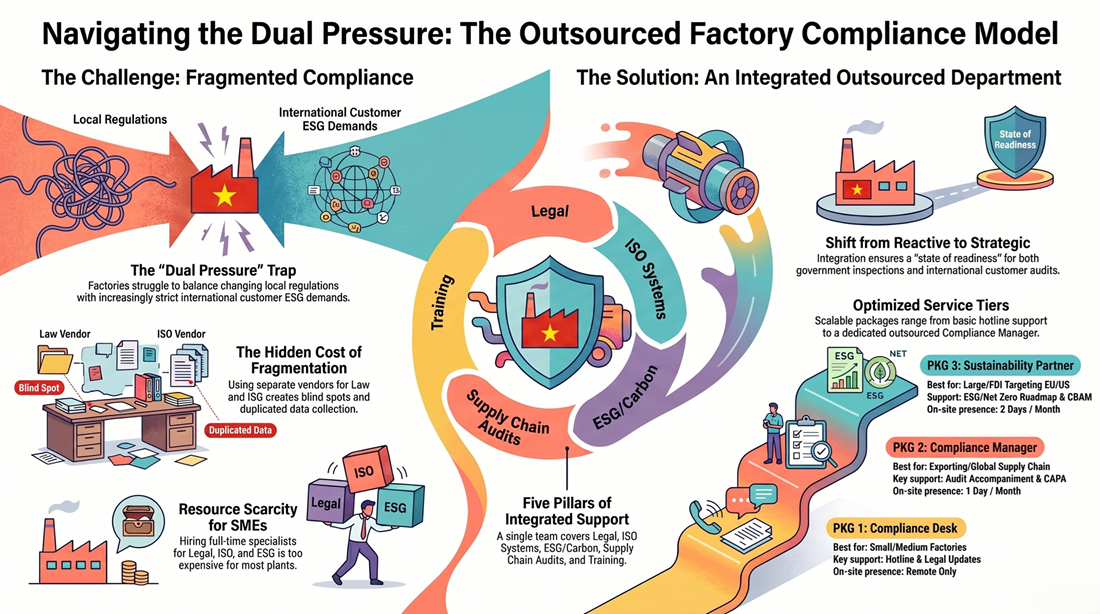
Factories operating in Vietnam face a dual pressure that grows heavier every year. On one side sits a fast-moving body of local regulation — labour, environment, fire safety, occupational health and safety, chemicals, energy and corporate law. On the other side sit international customers and partners whose purchasing decisions increasingly hinge on certifications, social-compliance audits and credible sustainability data. Factory compliance consulting in Vietnam has therefore shifted from a “nice to have” into a core operational function.
The problem for most plants is structural. Legal compliance and international-standards compliance are usually treated as two separate worlds, handled by two separate vendors — a law firm on one side, a certification consultant on the other. Yet on the factory floor these worlds overlap constantly: a customer’s social audit examines the same labour records that local labour inspectors do; environmental permits feed directly into ISO 14001 and customer ESG questionnaires; supplier contracts carry both legal risk and supply-chain-responsibility obligations. Splitting them across vendors creates gaps, duplicated work and slower response times.
This article explains a more effective model: an integrated, outsourced compliance and sustainability partner that covers both legal and standards work under a single point of contact.
The hidden cost of fragmented compliance
When compliance is fragmented, the factory absorbs the friction. A few common symptoms:
- Blind spots between vendors. Each consultant assumes the other is covering an issue, and something falls through — often surfacing only during an inspection or a failed customer audit.
- Duplicated effort. The same labour and environmental data is collected, formatted and explained twice, for two different audiences.
- Slow reaction time. When a customer sends a corrective-action request or an authority schedules an inspection, the factory must coordinate several external parties before it can respond.
- No single owner of risk. Nobody holds the complete picture, so strategic decisions — entering a new export market, preparing for CBAM, adopting a new standard — are made without a unified view.
For a small or mid-sized plant, building a full in-house team to solve this is rarely realistic. Qualified legal, ISO and ESG specialists are expensive and hard to recruit, and a single factory rarely has enough work to keep all of them busy full time.
The outsourced compliance department model
The alternative is to retain an external team that functions as the factory’s compliance and sustainability department — without the cost and overhead of full-time hiring. A good partner of this kind delivers across five connected areas:
1. Corporate and factory legal
Ongoing monitoring of new regulations; advisory on labour, environment, fire safety, occupational health and safety, chemicals, waste and energy; permit review; support during inspections; and drafting and review of commercial contracts, labour contracts and NDAs.
2. Management systems
Maintenance of ISO 9001, 14001, 45001, 50001, 37001/37301, 22000, HACCP, GMP, FSC CoC, PEFC, ISCC and SBP — including document control, internal audits and preparation for surveillance audits.
3. ESG and sustainability
Building an ESG roadmap, conducting greenhouse-gas (GHG) inventories, calculating product carbon footprints, preparing for CBAM, and supporting EcoVadis, CDP, SBTi and GRI-aligned reporting.
4. Supply chain and international customers
Preparing for and accompanying social-compliance and supply-chain audits — SMETA/Sedex, amfori BSCI, SLCP, Higg FEM, WRAP, RBA and C-TPAT — and responding to customer requirements.
5. Operational support
Internal audits, gap assessments, staff training, support in working with customers and certification bodies, CAR/NCR responses and SOP development.
Because one team owns all five, the work is coordinated rather than siloed. A labour-law update automatically flows into the next customer-audit preparation; an environmental permit renewal is reflected in the ISO 14001 file and the ESG report at the same time.
Why an integrated legal + ESG partner is rare — and valuable
Most firms in Vietnam specialise in either law or standards, not both. An integrated partner that genuinely understands the two domains — and how they intersect — is uncommon, which is precisely why it adds value for a manufacturer. The benefits are concrete:
- Cost efficiency: a far lower fixed cost than recruiting full-time legal and compliance staff.
- One point of contact: no juggling of separate vendors for legal, ISO, ESG and customer audits.
- Proactive prevention: continuous legal updates and risk alerts, instead of reacting after an incident or a penalty.
- Audit-readiness: the plant stays in a state of readiness for both authority inspections and international customer audits.
How a retainer engagement typically works
The most practical structure is a monthly retainer with a defined pool of expert hours, scaled to the factory’s size and compliance maturity. Smaller plants new to international standards start with a lighter package focused on hotline advisory, legal updates and basic system maintenance. Exporting factories that already hold certifications move to a package that adds monthly compliance checks, customer-audit support and an outsourced compliance-manager role. Larger and FDI-owned plants targeting demanding EU and US markets engage a strategic package that adds ESG and Net Zero roadmaps, GHG inventory and on-site support.
Across all tiers, set-up projects — building a new certification from scratch, a first GHG inventory or a first EcoVadis assessment — are scoped and quoted separately, while the retainer focuses on ongoing maintenance.
Frequently asked questions
What does factory compliance consulting cover?
It covers both legal compliance (labour, environment, fire safety, OHS, permits, contracts) and international-standards compliance (ISO systems, social-compliance audits, ESG and GHG), ideally under one integrated partner.
Is an outsourced compliance department cheaper than hiring?
For most small and mid-sized factories, yes. A retainer gives access to legal, ISO and ESG expertise at a fraction of the cost of recruiting and retaining all those specialists full time.
Can the service help us prepare for SMETA, EcoVadis or CBAM?
Yes. Preparation and accompaniment for customer audits such as SMETA and BSCI, EcoVadis scoring, GHG inventories and CBAM readiness are core parts of the model.
How quickly can support start?
After a short assessment of your current compliance status, an engagement can typically be tailored and started within a contract term that suits your plant.
Talk to an integrated compliance and sustainability partner
If your factory is carrying the dual burden of legal compliance and international-standards demands, a single integrated partner can reduce risk, save your internal team time and keep you audit-ready year-round.
Contact us for a free assessment and a tailored proposal:
Hotline: +84 933 096 426 – +84 868 591 260
Email: info@iscglobal.asia | van.pham@iscglobal.asia
Website: iscglobal.asia | iscglobal.edu.vn

No responses yet