As the European Union, Japan, South Korea and other major markets continuously tighten requirements for recycled content, sustainable traceability and Scope 3 emissions reporting, ISCC PLUS certification has become the “passport” enabling businesses to join global circular supply chains. This article provides an in-depth, up-to-date overview of ISCC PLUS, along with ISC Global’s end-to-end consulting, training and certification services.
1. What is ISCC PLUS?
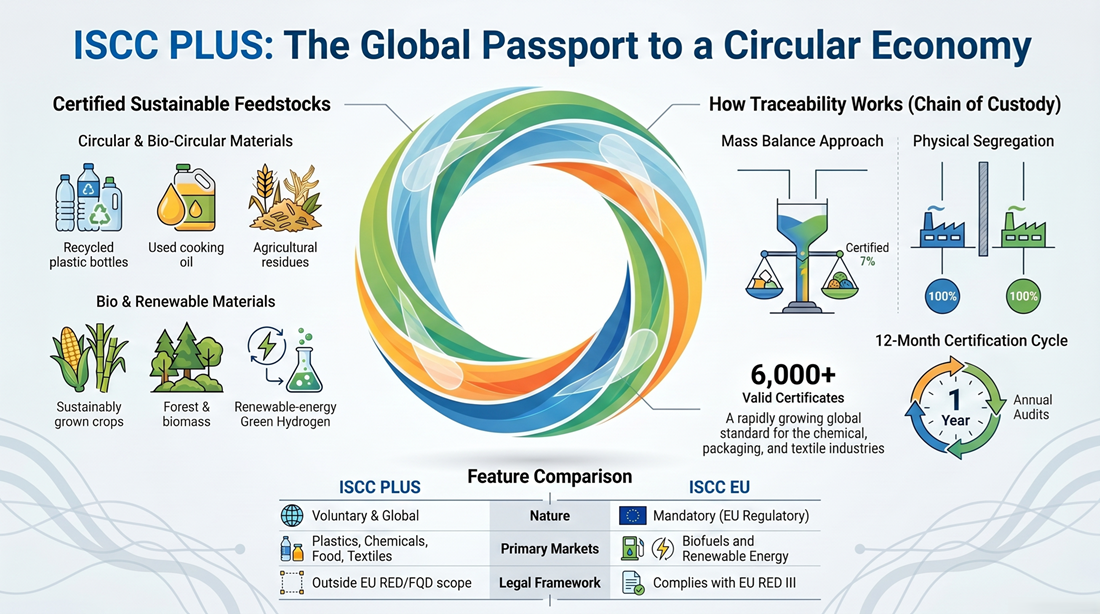
ISCC PLUS (International Sustainability and Carbon Certification PLUS) is a globally applicable voluntary certification scheme, developed by ISC System GmbH (headquartered in Cologne, Germany). The standard validates the sustainability characteristics of alternative feedstocks — including bio-based, recycled and circular materials — across the entire supply chain.
Unlike ISCC EU, which serves Europe’s regulatory framework for renewable fuels, ISCC PLUS is designed for a much broader scope of application, covering virtually every industry: plastics and packaging, chemicals, textiles, food and feed, energy, and alternative transport fuels (road, aviation, maritime, eFuels).
At its core, ISCC PLUS relies on a transparent Chain of Custody and traceability — from the farm or point of waste origin, all the way to the manufacturer and the final brand owner placing the product on the shelf.
2. Four categories of feedstock certified under ISCC PLUS
The foundation of every ISCC PLUS certification is the use of alternative feedstocks, classified into four categories:
- Circular materials: Derived from the mechanical or chemical recycling of fossil-based waste and residues — e.g. mixed plastic waste, waste textiles, end-of-life tires.
- Bio-circular materials: Derived from waste and residues of biological origin — e.g. used cooking oil (UCO), tall oil, food waste, agricultural or forestry residues.
- Bio materials: Sustainably grown agricultural feedstocks and sustainable forest biomass.
- Renewable-energy-derived materials: Power-to-X products that convert renewable electricity (wind, solar, hydro) into end products such as green hydrogen and eFuels.
Each material type carries a corresponding prefix on the certificate: “bio”, “circular”, “bio-circular” or “renewable-energy-derived” (e.g. Bio PET, Circular PP, Bio-circular PP).
3. Three Chain of Custody methods
ISCC PLUS offers three traceability methods, allowing businesses to choose flexibly according to their production characteristics:
- Physical Segregation: Certified and non-certified materials are kept completely separate throughout the supply chain.
- Controlled Blending: Materials are mixed in fixed, known proportions, ensuring the certified content of the product is constant and verifiable.
- Mass Balance: Certified and non-certified materials may be physically mixed but are separated in the bookkeeping. This is the most widely used method in the chemicals and recycled-plastics industries.
The Mass Balance method is especially important for petrochemical, chemical-recycling and polymer-manufacturing companies, where physical segregation is technically not feasible.
4. Supply chain structure & certification scopes
A core principle: every element of the supply chain must be certified. Each site handling alternative materials must hold its own ISCC PLUS certificate, valid for 12 months, with annual recertification required. (Transport operators are not required to be certified.)
A typical supply chain comprises seven steps:
- Farm / Plantation / Forest Sourcing Area or Point of Origin: Where biomass is produced or waste is generated (e.g. a restaurant producing used cooking oil).
- First Gathering Point / Central Office / Collecting Point: Raw materials are collected, aggregated and documented.
- Processing Unit: Converts raw materials into intermediate products.
- Trader (with Storage): Buys, sells and stores certified materials while ensuring traceability.
- Additional Processing Unit: Further refining or chemical conversion into higher-value intermediates.
- Final Product Refinement: Certified materials are incorporated into finished products (packaging, textiles, plastics, etc.).
- Market / Brand Owner: Products are placed on the market, and ISCC logos and claims are used for communication.
5. Key 2025–2026 updates businesses should know
- 6,000+ certificate milestone: As of 2025, ISCC PLUS surpassed over 6,000 valid certificates worldwide, most of them in the Processing Unit and Final Product Refinement scopes (mainly plastic components, packaging and films).
- EU regulatory pressure: From 2025, PET bottles must contain at least 25% recycled material, rising to 30% in subsequent years and expanding to other plastic products. This is a major driver pushing suppliers toward chain certification.
- Recognition in South Korea: ISCC PLUS has been recognized under Korea’s Post-consumer Plastic Recycled Content Labeling Policy, alongside a Memorandum of Understanding with the Korea Environment Corporation (K-eco).
- Amazon Climate Pledge Friendly partnership: ISCC PLUS–certified products can feature in Amazon’s programme, boosting credibility with end consumers.
- System document updates: The Chain of Custody document (ISCC PLUS 203-2) and the Mass Balance guidance were updated to new versions in late 2025, alongside the Regenerative Agriculture add-on launched in May 2026.
6. ISCC PLUS vs. ISCC EU — what’s the difference?
| Criteria | ISCC PLUS | ISCC EU |
|---|---|---|
| Nature | Voluntary, global | Mandatory under the EU framework |
| Product scope | Broad: plastics, chemicals, textiles, food, energy… | Focused on biofuels & renewable fuels |
| Legal framework | Outside the EU legal framework | Complies with the Renewable Energy Directive (RED III) |
| Target market | Global circular & bio economy | EU fuel markets |
Many businesses (especially exporters of UCO, recycled plastics and textiles) choose ISCC PLUS to access customers in Japan, South Korea and multinational corporations.
7. Core benefits of ISCC PLUS certification
- Unlock export markets: Become a qualified supplier within mass-balance chains required by many global brands and chemical producers.
- Enhanced credibility: ISCC PLUS is the leading certification system for the circular and bio economy.
- Verified sustainability claims: Use ISCC on-product logos and communicate transparently to consumers.
- Meet reporting obligations: Address expanding global requirements for recycled content, plastic taxes and Scope 3 disclosure.
- End-to-end traceability: Strengthen trust and long-term competitiveness.
8. Why businesses should act now
Vietnam is one of the leading exporters of used cooking oil (UCO), recycled plastics, textiles and agricultural products to Japan, the EU and South Korea. When partners such as Sumitomo, petrochemical groups and global brand owners require chain certification, not having ISCC PLUS means losing contracts.
Preparing for certification requires documentation systems, mass-balance bookkeeping, traceability procedures and well-trained personnel. This is where an experienced consulting partner makes the difference between passing your first audit and incurring costly repeat corrections.
9. ISC Global’s end-to-end ISCC PLUS consulting, training and certification services
With a team of ESG & ISO experts well-versed in both the technical aspects of certification and international legal frameworks, ISC Global provides A-to-Z support:
9.1. Certification consulting
- Gap analysis and identification of the appropriate scope for your business.
- Design of the Chain of Custody system and selection of the optimal method (Mass Balance / Segregation / Controlled Blending).
- Development of documentation, traceability procedures, mass-balance bookkeeping and conversion factors.
- Support with GHG emissions calculation and compliance with ISCC Principles 1–6.
- Accompaniment before, during and after the audit with the Certification Body.
9.2. Training
- ISCC PLUS awareness training for leadership and staff.
- In-depth training on Mass Balance, sustainability bookkeeping and traceability.
- Internal auditor training and preparation for the official audit.
- Professional bilingual (Vietnamese–English) materials, lectures and assessments.
9.3. Certification support
- Advice on selecting a reputable Certification Body and preparing documents on the ISCC HUB system.
- Support with annual recertification and updates to the latest ISCC system changes.
10. The ISCC PLUS certification roadmap with ISC Global
- Initial survey & consultation: Identify feedstock, scope and target markets.
- Gap analysis: Assess the current state against ISCC PLUS requirements.
- Documentation development: Procedures, bookkeeping and traceability templates.
- Training & trial run: Train personnel and pilot the mass-balance system.
- Internal audit: Review and remediate before applying for the audit.
- Certification audit: Accompany the business through the Certification Body’s assessment.
- Certificate issuance & maintenance: Receive the 12-month certificate and receive support for maintenance and recertification.
11. Frequently Asked Questions (FAQ)
How long is an ISCC PLUS certificate valid? Certificates are issued per site, valid for 12 months, and require annual recertification.
Do exporters of used cooking oil (UCO) need ISCC PLUS? Yes. Many customers in Japan and across Asia require UCO suppliers to hold chain certification (ISCC PLUS or ISCC EU depending on the market). ISC Global will advise on the most suitable scheme for your destination market.
ISCC PLUS or ISCC EU — which should I choose? It depends on the market and product type. ISCC EU serves renewable fuels under the EU framework (RED III); ISCC PLUS suits a broader scope and non-EU markets. ISC Global will help you determine the right choice.
How long does it take to get certified? Depending on scale and readiness, it typically takes 2–4 months per site with structured consulting support.
12. Contact us for ISCC PLUS consulting
Preparing to export recycled materials, UCO, plastics or sustainable agricultural products? Let our team of experts guide you to pass your first ISCC PLUS audit.
ISC Global Co., Ltd. 📞
Hotline: +84 933 096 426 – +84 868 591 260
✉️ Email: info@iscglobal.asia | van.pham@iscglobal.asia
🌐 Website: iscglobal.asia | iscglobal.edu.vn
Vietnam Representative Partner – Duc Luong Services
📞 Hotline: +84 933 096 426 – +84 868 591 260
✉️ Email: ducluongservices@gmail.com
🌐 Website: ducluongservices.com
STC VN Co., Ltd. (Staunchly Vietnam)
📞 Hotline: +84 933 096 426 – +84 868 591 260
✉️ Email: info@staunchlyservices.com.vn
🌐 Website: stauchlyservices.com.vn
Official reference: ISCC System (iscc-system.org). Information compiled and updated through 2026. This article is for reference only; please contact ISC Global for detailed advice tailored to your business.


No responses yet