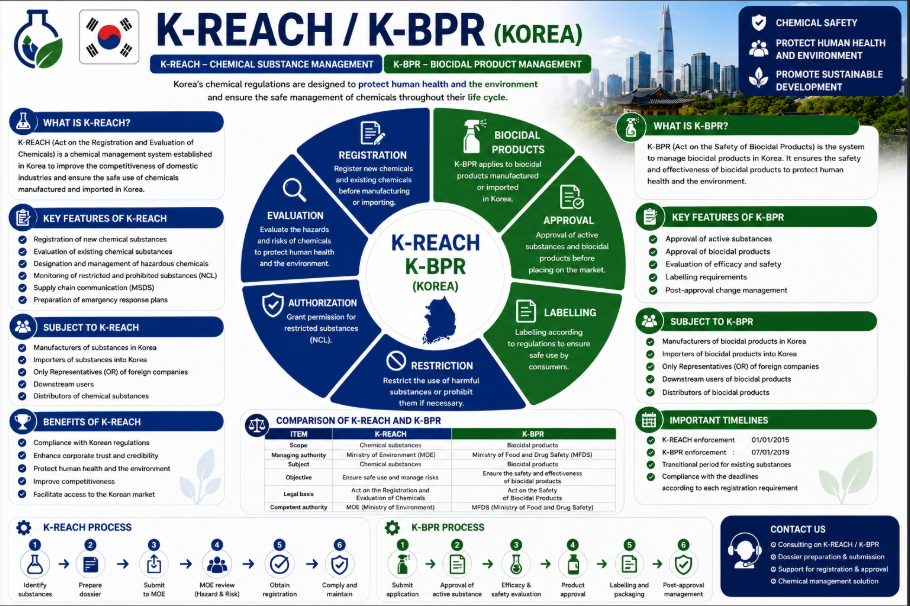
South Korea is not only a premier global technology and manufacturing powerhouse but also home to some of the most stringent chemical technical barriers to trade in Asia. Functioning as the continent’s unyielding counterpart to Europe’s regulatory model, the dual frameworks of K-REACH (Act on Registration and Evaluation of Chemicals) and K-BPR (Consumer Chemical Products and Biocides Safety Act) establish a comprehensive control mechanism over all imported chemicals, mixtures, and biocidal products. For exporting enterprises moving textiles, footwear, electronic components, polymers, or antimicrobial consumer goods into the Land of the Morning Calm at volumes exceeding 1 tonne per year, operating without valid registration is equivalent to shutting the door on this lucrative market. Our practical consulting services exist to help you decode the rules of engagement, optimize testing expenditures, and secure your cargo flows on an equal footing.
1. The Core of K-REACH/K-BPR: A Battle to Protect Trade Secrets and Optimize Data Costs
One of the steepest hurdles businesses face under K-REACH and K-BPR is the uncompromising demand for product formulation transparency from the South Korean Ministry of Environment (MoE). Many exporters face intense friction from upstream suppliers who flatly refuse to disclose detailed chemical compositions due to commercial trade secret protections. Conversely, failing to provide adequate toxicological data means your goods will be stopped dead at the ports of Busan or Incheon. Compounding this challenge, the K-BPR roadmap enforces strict approval tracks for products containing biocidal properties (such as antibacterial wet wipes, paint preservatives, or anti-mold carpets)—a historical regulatory grey zone that has eliminated major brands from the market.
The management mindset must shift: South Korea is a high-purchasing-power market, but it uses technical standards as a robust defensive filter. Proactively pursuing K-REACH/K-BPR compliance is not a reactive, defensive chore; it is a strategic move to formalize your chemical data assets, serving as an ironclad declaration of your technical capabilities to South Korea’s most demanding corporate buyers.
2. Four Practical Challenges Defused Through Our K-REACH / K-BPR Consulting Framework
Our advisory framework zeroes in on resolving four critical operational bottlenecks to minimize data-sharing expenses and secure your commercial footprint:
- Substance Screening and Inventory Identification: Auditing your chemical inventory against the Korean Existing Chemicals List (KECL) to determine whether your substances require full registration, a new chemical notification, or fall within a transitional phase-in timeline.
- Activating a South Korean Only Representative (OR) Solution: South Korean law mandates that foreign manufacturers cannot file dossiers directly and must appoint a legally recognized entity based in South Korea. We provide a reputable, highly secure OR solution to shield your proprietary formulas from both competitors and commercial buyers.
- Data Cost Negotiation within Consortiums (CICO): Representing your enterprise inside South Korean joint-registration consortiums to share testing costs equitably and negotiate the acquisition of Letters of Access (LoA) at the most optimized price point.
- Biocidal Standardization Under K-BPR: Evaluating active substances and biocidal products, while building safety risk assessments and efficacy reports that fully align with the technical criteria mandated by the MoE.
3. Direct Commercial Advantages: Translating Compliance into Exclusive Market Placement in South Korea
Overcoming the dual barriers of K-REACH and K-BPR equips your business with distinct economic leverage and unmatched market exclusivity:
| Strategic Axis | Real-World Operational Impact |
| Absolute Customs Clearance Assurance | Eradicates 100% of the risk of cargo being detained, penalized, or ordered for destruction at South Korean border entries due to chemical non-compliance. |
| Ironclad Trade Secret Protection | Through the OR filing mechanism, your enterprise fully satisfies South Korean statutory laws while completely safeguarding proprietary formulas from competitors. |
| Securing Premium Supplier Status | Holding a legitimate registration number instantly fast-tracks your enterprise onto the “approved vendor lists” of South Korea’s largest conglomerates. |
| Insuring Against Substance Ban Risks | Proactively monitors South Korea’s restricted and banned chemical inventories, allowing your R&D teams to reformulate ahead of time and avoid manufacturing pauses. |
4. Our Deployment Roadmap: Speed, Practicality, and Alignment Until Registration Success
We execute a streamlined, phased consulting roadmap to ensure that your shipping schedules and market entry timelines are never compromised:
- Step 1 – Inventory Audit & Obligation Analysis: Auditing your Material Safety Data Sheets (MSDS) and analyzing chemical compositions to determine precise obligations under K-REACH or K-BPR.
- Step 2 – OR Appointment & Consortium Onboarding: Finalizing the legal appointment of your South Korean Only Representative and initiating contact with joint registration groups to structure the LoA acquisition.
- Step 3 – Advanced Technical Dossier Construction: Compiling eco-toxicological and toxicological data profiles, and authoring chemical safety reports within the electronic K-REACH architecture.
- Step 4 – Successful Declaration & System Handover: Managing the evaluation process with the MoE until your official Registration Number is generated, followed by handing over data assets and training your staff on compliance maintenance.
5. Materializing ESG Standards Within Northeast Asian Supply Chains
Complying with K-REACH and K-BPR provides concrete evidence of your company’s capability to implement the E (Environmental – protecting ecosystems and health) and G (Governance – transparent regulatory administration) pillars of global ESG models:
- Eliminating “Greenwashing” Vulnerabilities: Your company backs up its environmental claims with scientific data validated by the South Korean government, establishing authentic trust with international investors and buyers.
- Upholding Consumer Safety Commitments: Tight controls over hazardous substances and biocides significantly mitigate toxic exposure risks for logistics personnel in the supply chain and end consumers in South Korea.
- Aligning with Pan-Asian Regulatory Tightening: Building structural capabilities early on ensures your business is fully prepared to adapt as other Asian nations continue to deploy REACH-style chemical regulations.
Conclusion:
Achieving K-REACH / K-BPR compliance is not an administrative cost incurred simply to appease border customs officials. It is a vital, strategic investment in your commercial longevity that allows your business to decode South Korea’s technical trade barriers, safeguard your export revenue, and confidently position yourself as a trusted, leading supplier in the green global supply chain.
Contact us today to receive dedicated advice and the most suitable solution for your business!
Hotline: +84 933096426 – +84 868 591 260
Email:
Website:
Partners in Vietnam:
Contact Vietnam representative: Duc Luong Services
Hotline: +84 933096426 – +84 868 591 260
Email: ducluongservices@gmail.com
Website:
STC VN Co., Ltd.
Hotline: +84 933096426 – +84 868 591 260
Email: info@staunchlyservices.com.vn
Website: https://stauchlyservices.com.vn

No responses yet