As multinational buyers increasingly require their suppliers to prove environmental and social responsibility, one question now appears in thousands of supplier onboarding forms: “What is your EcoVadis score?” For businesses in Vietnam, an EcoVadis rating has become a key to participating in global supply chains. This guide explains what EcoVadis is, how it works, and how to earn and improve your score.
What is EcoVadis?
EcoVadis is one of the world’s most trusted business sustainability rating platforms, having rated more than 130,000 companies globally. Rather than a simple pass/fail certification, EcoVadis provides a holistic assessment of a company’s CSR/ESG management system, expressed through a detailed scorecard.
In other words, EcoVadis doesn’t just measure what you do — it verifies how well you manage it, through your policies, actions, and reported results. Its results are used by many large brands and buyers to screen and select partners.
A note on terminology: People often say “EcoVadis certification,” but technically it is a sustainability rating with a scorecard and medals — not a pass/fail certificate like ISO 9001.
What EcoVadis assesses: four themes, 21 criteria
The EcoVadis methodology is built around four core themes, broken into 21 criteria:
| Theme | Typical areas assessed |
|---|---|
| Environment | Energy, emissions, waste, water, biodiversity |
| Labor & Human Rights | Working conditions, health & safety, diversity, training, human rights |
| Ethics | Anti-corruption, fair competition, responsible information management |
| Sustainable Procurement | Assessing, selecting, and monitoring suppliers’ sustainability |
The weighting of each theme is adjusted by industry, company size, and geography.
The P-A-R model: Policies, Actions, Results
This is the heart of the methodology. Each theme is evaluated across three layers:
- Policies — written commitments, policies, codes of conduct.
- Actions — measures, procedures, and programmes implemented in practice.
- Results — data, KPIs, and certifications demonstrating effectiveness over time.
EcoVadis analysts score based on the documents and evidence you submit, which is why well-prepared evidence is decisive.
Scoring, medals, and badges
- Overall score: 0–100, plus a score per theme.
- Medals: Bronze, Silver, Gold, and Platinum (the highest). For scorecards published from 1 January 2026, medal eligibility is primarily based on your percentile rank against all companies rated globally over the previous 12 months — with Gold roughly the top 5% and Platinum around the top 1%.
- Key rule: no theme may score below 30, or you become ineligible for a medal — even with a high overall score.
- Badges: “Committed” (score ≥ 45) and “Fast Mover” (score 34–44 with at least a 6-point improvement over 18 months) for companies not yet at medal level.
- Validity: scorecards and medals are valid for 12 months.
Why an EcoVadis score matters for businesses in Vietnam
- Supply chain access: many large corporations require an EcoVadis score or medal as a screening criterion.
- Tender advantage: a medal improves your supplier evaluation in bids.
- Credibility: a trusted way to demonstrate ESG commitment to customers, investors, and partners.
- Regulatory readiness: EcoVadis complements reporting requirements such as the CSRD and helps structure ESG data. The methodology also references international frameworks like GRI, the UN Global Compact, and ISO 26000.
Our EcoVadis services in Vietnam
We help businesses earn and improve their EcoVadis score systematically:
- Gap analysis against the EcoVadis methodology across all four themes.
- Building policies, procedures, and an evidence system structured around the P-A-R model.
- Pre-submission review of the questionnaire and evidence to avoid costly errors.
- Training your teams on the methodology and how to gather evidence.
- Score-improvement roadmaps toward your target medal level.
Frequently asked questions (FAQ)
1. Is EcoVadis a certification like ISO? Not exactly. It is a sustainability rating with a scorecard and medals, not a pass/fail certificate.
2. How long is the score valid? The scorecard and medal are valid for 12 months; annual reassessment is recommended.
3. Can small businesses do EcoVadis? Yes. Assessment is adjusted for company size, and smaller firms can score well with the right evidence.
4. How long until I get results? The scorecard is typically published around 6–8 weeks after submission.
Contact us for a business consultation
ISC Global Co., Ltd. Hotline: +84 933 096 426 – +84 868 591 260 Email: info@iscglobal.asia | van.pham@iscglobal.asia Website: iscglobal.asia | iscglobal.edu.vn
Representative partner in Vietnam – Duc Luong Services Hotline: +84 933 096 426 – +84 868 591 260 Email: ducluongservices@gmail.com Website: ducluongservices.com
STC VN Co., Ltd. (Staunchly Vietnam) Hotline: +84 933 096 426 – +84 868 591 260 Email: info@staunchlyservices.com.vn Website: staunchlyservices.com.vn
The “One Brain” Strategy: 6 Surprising Truths About Scaling Sustainability in the Global Supply Chain
It begins with a single inquiry from a Tier-1 client or a major global prospect that halts the standard procurement process: “What is your EcoVadis Score?”
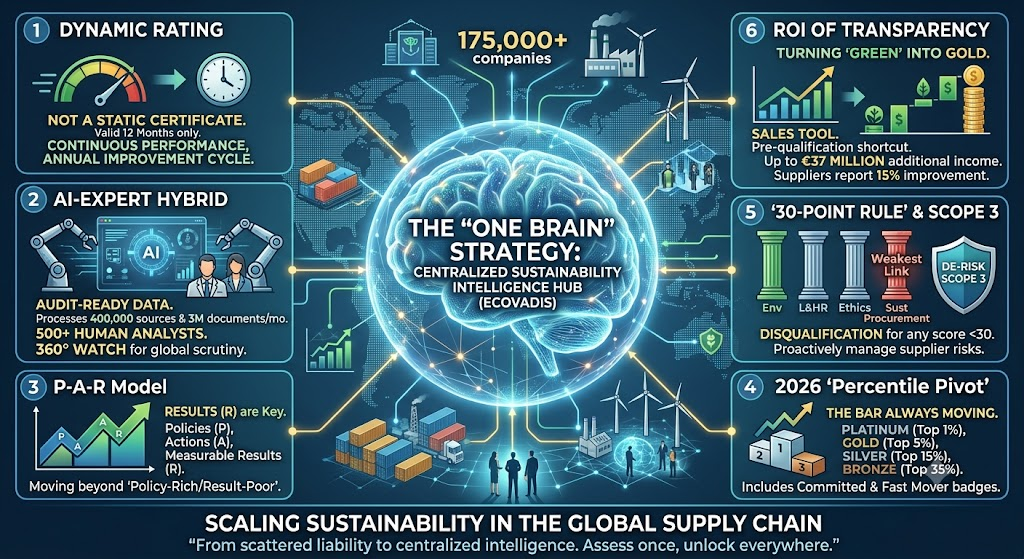
For the modern enterprise, this is no longer a peripheral request; it is a commercial gatekeeper. In an era where sustainability data is scattered across thousands of fragmented questionnaires and regional frameworks, EcoVadis has emerged as the “One Brain” for the global supply chain. It is a connected intelligence system that harmonizes data from 175,000+ rated companies into a single, trusted standard. To survive in today’s market, leadership must move beyond a “pass/fail” compliance mindset and embrace a strategy where sustainability performance is synonymous with competitive advantage.
Here are the six strategic truths about scaling sustainability in this high-stakes landscape.
1. It is a Dynamic Rating, Not a Static Certificate
The most common strategic error is treating EcoVadis like a static ISO certification. A certificate is a snapshot—a one-time “checkbox” exercise that proves compliance at a specific moment. In contrast, EcoVadis provides a dynamic sustainability rating valid for only 12 months.
This shift from static compliance to “continuous performance” creates a transparent, high-velocity marketplace. Because the bar for global trade is constantly rising, a rating forces your organization into a cycle of annual improvement. If your sustainability data isn’t moving forward, your business is effectively moving backward in the eyes of the 1,500+ global leaders who use this platform to select their partners.
2. The AI-Expert Hybrid Makes Your Score “Audit-Ready”
In the world of global supply chains, data is a liability if it cannot be defended. EcoVadis processes an unprecedented volume of intelligence—monitoring 400,000 sources and analyzing 3 million documents every month across eight languages.
However, the “One Brain” strategy relies on more than just algorithms. Every assessment is verified by a human expert validation layer of 500+ in-house analysts. Crucially, this includes the 360° Watch, a rigorous scan of external sources for legal fines, controversies, or environmental breaches. This synergy ensures that your score is not just a self-reported claim, but a “defendable” and audit-ready asset that stands up to the most intense scrutiny of enterprise customers and regulators.
3. The P-A-R Model: Why Intentions No Longer Count
Global strategists know that “good intentions” do not mitigate risk. EcoVadis evaluates management systems through the rigorous P-A-R Model:
- Policies (P): Your written commitments and codes of conduct.
- Actions (A): The practical measures and programs you have actually implemented.
- Results (R): The measurable KPIs, data, and third-party certifications that prove your impact.
Most companies fail because they are “Policy-rich and Result-poor.” High-performing organizations realize that without the “R,” the “P” is just paper.
“EcoVadis is there from the very beginning. From the initial supplier rating, to monitoring risk and capacity building. It meets all our ESG needs in one.” — Claudia Colpato, Sustainability and Risk Manager.
4. The 2026 “Percentile Pivot” Means the Bar is Always Moving
Starting in 2026, medal eligibility is shifting from fixed score thresholds to a percentile rank system. To earn a medal, you must outcompete your peers globally:
- Platinum: Top 1%
- Gold: Top 5%
- Silver: Top 15%
- Bronze: Top 35%
For those not yet in the top 35%, new entry-level recognitions like the “Committed” Badge (score ≥45) and the “Fast Mover” Badge (significant improvement over 18 months) have been introduced. This “Percentile Pivot” means that as the global market improves, staying in the top 5% becomes harder every year. It is a race toward excellence where the finish line is constantly advancing.
5. The “30-Point Rule” and the Scope 3 Strategic Opportunity
Under the “One Brain” strategy, a chain is only as strong as its weakest link. EcoVadis enforces a strict 30-Point Rule: if a company scores below 30 in any of the four pillars—Environment, Labor & Human Rights, Ethics, or Sustainable Procurement—they are disqualified from receiving a medal, regardless of how high their total score is.
Currently, Sustainable Procurement is the lowest-scoring pillar globally. This is a massive strategic blind spot, as it directly impacts Scope 3 Decarbonization and mandatory Human Rights Due Diligence (CS3D/LkSG). Companies that proactively manage their own supplier risks are not just avoiding the 30-point trap; they are de-risking their entire operation and positioning themselves as the elite partners that major enterprises are desperate to find.
6. The ROI of Transparency: Turning “Green” into Gold
Sustainability is no longer a cost center; it is a revenue driver. High-rated companies often use their Gold or Platinum status as a pre-qualification shortcut for Enterprise RFPs, effectively bypassing months of manual due diligence.
The financial impact is quantifiable: suppliers report an average 15% improvement after their first assessment, and top-tier performers have generated as much as €37 million in additional income specifically linked to their EcoVadis standing. When 75% of businesses use this data to guide their procurement decisions, a high rating becomes your most effective sales tool.
“92% of our raw materials spend is allocated to suppliers, and partners, who are joining our sustainability journey.” — Jacklin Wienczierz, Head of Supplier Sustainability and Climate Initiatives.
Conclusion: From Scattered Liability to Centralized Intelligence
The “One Brain” strategy is the end of fragmented reporting. The “Assess once, unlock everywhere” model allows you to share verified performance data across your entire customer network with a single click. It simplifies the complex and turns sustainability from a regulatory burden into a competitive edge.
As you look at your global operations, ask yourself: Is your supply chain data currently a scattered liability, or is it working as a “single brain” to drive your company’s growth?
No responses yet