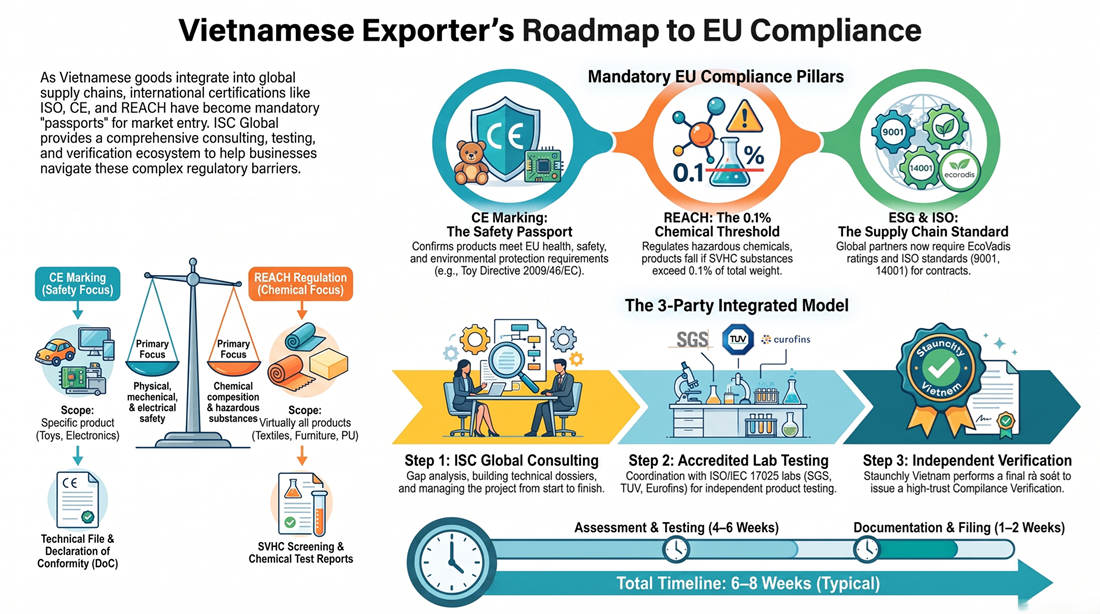
For Vietnamese manufacturers targeting the European Union market, two regulatory frameworks stand between a product and legal market access: CE Marking and the REACH Regulation (EC) No. 1907/2006. Whether you produce toys, PU/polyurethane materials, furniture, textiles or industrial components, understanding — and correctly documenting — compliance with both frameworks is essential to avoid shipment delays, customs holds, or costly product recalls. Drawing on hands-on project experience across multiple product categories, ISC Global outlines below what exporters need to know in 2026.
1. CE Marking: What It Is and Why It’s Non-Negotiable
CE Marking (Conformité Européenne) is a mandatory conformity mark confirming that a product meets EU health, safety and environmental protection requirements. The specific EU Directive or Regulation that applies depends on the product category — for toys, it is the Toy Safety Directive 2009/48/EC; for construction products, the Construction Products Regulation (CPR); for general consumer products, the General Product Safety Regulation (GPSR). A common mistake among first-time exporters is applying the wrong directive, which leads to incomplete or invalid technical documentation.
2. Harmonised Standards: The EN 71 Series for Toys
For toy products specifically, compliance is demonstrated through testing against the EN 71 series of harmonised standards:
- EN 71-1 — Mechanical & Physical Properties: sharp points, sharp edges, tension, torque, impact resistance, small parts (choking hazard). This is the most critical test category, particularly for toys with rigid internal components (e.g. a steel reinforcement rod inside a PU Skin Foam toy knife or sword).
- EN 71-2 — Flammability: assesses how quickly toy materials — especially foam, PU and textile components — ignite or propagate flame.
- EN 71-3 — Migration of Certain Elements: screens for heavy metal migration (lead, cadmium, mercury, chromium, arsenic, antimony, selenium, barium), typically originating from paint, coatings and plastic/PU materials.
Depending on material composition, additional chemical testing is often recommended: formaldehyde, phthalates, organotin compounds, azo dyes, and nickel release.
3. REACH: The Chemical Compliance Layer Most Exporters Underestimate
REACH is frequently confused with CE Marking, but the two serve different purposes. While CE Marking addresses mechanical, electrical and fire safety within a specific product category, REACH regulates hazardous chemical substances across virtually all product categories — toys, textiles, furniture, footwear, PU/polyurethane materials, plastics and rubber components. A product can pass all EN 71 tests and still fail to meet EU market expectations if its materials contain Substances of Very High Concern (SVHC) above the 0.1% w/w notification threshold defined in the current ECHA Candidate List.
Typical REACH assessment scope includes:
- SVHC Screening against the latest ECHA Candidate List (updated twice yearly, currently covering 240+ substances)
- Phthalates — mandatory for PVC or soft plastic components
- PAHs — relevant for rubber or dark-coloured polymer parts
- Nickel release — for metal accessories in prolonged skin contact
- Formaldehyde, organotin compounds, azo dyes — depending on material and manufacturing process
4. The Compliance Process: From Assessment to Market
ISC Global’s proven five-phase methodology for CE and REACH compliance projects covers:
- Compliance Assessment — product design review, Bill of Materials (BOM) analysis, applicable regulation determination, and gap analysis.
- Laboratory Testing Coordination — sample submission and testing coordination with ISO/IEC 17025 accredited laboratories (SGS, Intertek, TÜV, Eurofins, Bureau Veritas).
- Technical Documentation — Technical File, Product Risk Assessment, label/packaging/user instruction review, and preparation of the EU Declaration of Conformity (DoC).
- Compliance Verification — review of laboratory results against applicable standards, issuance of a Compliance Verification Report and Letter.
- Independent Compliance Verification — an independent technical review performed by a third party (such as Staunchly Vietnam), issuing an Independent Compliance Verification Certificate for added assurance to EU buyers.
Most manufacturers do not need to go through a Notified Body: for toys fully compliant with EN 71 harmonised standards, self-declaration of conformity is the standard route. A Notified Body is only required when harmonised standards are not applied, or when the product design carries unusual safety risk.
5. A Technical Insight From Real Project Experience
Through project work with PU Skin Foam toy manufacturers, ISC Global has observed a recurring risk pattern: toy knives and swords reinforced with an internal Ø8 steel rod and fiberglass core often struggle to pass EN 71-1 sharp-point and impact-resistance tests, despite a soft outer PU shell. Our recommendation to manufacturers is always the same — commission a pre-compliance sample assessment before scaling to mass production. This single step can prevent costly mould and material redesigns after formal accredited testing has already been completed.
6. Timeline and Cost Expectations
A combined CE + REACH compliance project typically spans 6–8 weeks, structured around three cost components: (1) professional consulting and technical documentation, (2) accredited laboratory testing, and (3) independent compliance verification and certification. Actual laboratory costs vary based on the number of SKUs, paint colours, and chemical testing scope — official laboratory quotations are always confirmed before testing begins.
7. Frequently Asked Questions
Do all toy exports to the EU require Notified Body certification? No. Most toys compliant with the full EN 71 harmonised standard series are self-declared by the manufacturer via the EU Declaration of Conformity.
Is REACH compliance mandatory even if a product already has CE Marking? Yes. CE Marking and REACH are separate legal frameworks. A product can be CE-compliant and still fail to meet EU market expectations without a REACH SVHC screening, especially for painted, plastic or PU-based components.
How long must technical documentation be retained? Manufacturers and importers must retain the Technical File and Declaration of Conformity for a minimum of 10 years from the date the product is placed on the EU market.
8. Why Work With ISC Global
ISC Global is a Vietnam-based international standards training, certification and ESG consulting organization with direct project experience supporting manufacturers of toys, PU/polyurethane materials, furniture and consumer goods through CE Marking and REACH compliance for the EU market. Our three-party delivery model — ISC Global for consulting and technical documentation, ISO/IEC 17025 accredited laboratories for testing, and Staunchly Vietnam for independent verification — gives exporters a defensible, high-confidence compliance file before products reach EU customs.
📞 Contact Us for Business Consulting
ISC Global
Hotline: +84 933 096 426 – +84 868 591 260
Email: info@iscglobal.asia | van.pham@iscglobal.asia
Website: iscglobal.asia | iscglobal.edu.vn
Navigating the 2026 European Gateway: GPSR, REACH, and the Strategic Evolution of Non-Tariff Barriers
As Vietnamese manufacturers integrate deeper into the global economy, the regulatory requirements for the European Union (EU) have evolved from simple quality benchmarks into complex “non-tariff barriers to trade” (NTBs). For 2026, compliance is no longer a localized checkbox but a high-stakes strategic mandate. Inadequacies in technical documentation or chemical transparency do not merely result in minor friction; they trigger total market exclusion through shipment seizures, customs holds, and the catastrophic brand damage of Market Surveillance Authority recalls.
Strategic compliance in this new era requires a sophisticated understanding of the shifting regulatory landscape. Drawing on the expert collaboration of ISC Global, Staunchly Vietnam (STC VN), and Duc Luong Services, this briefing decodes the critical technical nuances and the robust 3-party verification model essential for the modern “Made in Vietnam” label.
1. The REACH “Chemical Filter”: Beyond the Article Surface
A persistent and dangerous misconception among exporters is that the CE Marking covers all regulatory bases. While CE Marking addresses physical and mechanical safety, the REACH Regulation (EC) No. 1907/2006 operates as a separate, stringent chemical filter. REACH applies to the “article”—the finished product—and every individual component within it.
Strategic exporters must recognize that compliance is a moving target. The European Chemicals Agency (ECHA) updates its “Candidate List” of Substances of Very High Concern (SVHC) twice a year (every January and July). With the list now exceeding 240 substances, a product that was compliant six months ago may be illegal today.
“A product can pass all EN 71 tests and still fail to meet EU market expectations if its materials contain Substances of Very High Concern (SVHC) above the 0.1% w/w notification threshold.”
If any component of an article contains an SVHC above the 0.1% weight-by-weight (w/w) threshold, the manufacturer faces immediate notification obligations. Failure to monitor these semi-annual updates can result in immediate market withdrawal.
2. The “Self-Declaration” Paradox and the GPSR Shift
A common myth suggests that all products require a third-party “Notified Body” for EU entry. In reality, for the vast majority of consumer goods—including most toys—manufacturers can utilize the EU Declaration of Conformity (DoC) process if they apply harmonized EN 71 standards.
However, this “Self-Declaration” empowers the manufacturer while simultaneously concentrating 100% of the legal liability on their shoulders. For 2025 and 2026, this liability is intensified by the General Product Safety Regulation (GPSR). The GPSR expands the definition of safety, introduces stricter requirements for online marketplaces, and mandates a designated “Responsible Person” located within the EU.
The validity of the DoC rests entirely on the integrity of the Technical File. If the file is scientifically weak or administratively incomplete, the DoC is legally void. This is where the 3-party model becomes essential: ISC Global builds the technical dossier, Accredited Laboratories provide the raw scientific data, and Staunchly Vietnam provides the independent verification audit that ensures the file is defensible before EU customs.
3. The Steel Core Trap: Why Risk Assessment Must Precede Production
Technical failures often stem from a fundamental failure in the initial Risk Assessment process. A recurring industry example involves PU Skin Foam toys, such as simulation swords or knives.
While these products possess a soft exterior, they frequently utilize internal reinforcements—typically Ø8 steel rods or fiberglass cores—to maintain structural integrity. Under EN 71-1 (Mechanical and Physical Properties), these rigid cores often lead to failures during impact and tension testing, creating sharp points or protrusion hazards.
From a strategic standpoint, discovering this during formal certification is a failure of project management. The industry standard is shifting toward pre-compliance sample assessment. Identifying these structural risks during the prototype phase allows for the redesign of molds and materials, saving thousands of dollars in wasted mass-production costs and avoiding a failed Technical File.
4. The 10-Year Liability: Managing the “Long Shadow” of Compliance
EU export compliance is not a point-of-sale hurdle; it is a decade-long legal obligation. Exporters are required by law to retain the Technical File and DoC for 10 years after the final unit of a product is placed on the market.
During this period, a Market Surveillance Authority can demand the full documentation at any time. If a manufacturer’s internal record-keeping is disorganized or based on expired standards, they face retroactive penalties. This long-term liability makes “Independent Compliance Verification” (such as the certificates issued by Staunchly Vietnam) a critical insurance policy. It ensures that the documentation is not just present, but organized, accurate, and capable of withstanding scrutiny ten years into the future.
5. ESG and Carbon: The New “License to Operate”
The definition of a “compliant product” has expanded to include the “compliant corporation.” In the 2026 landscape, environmental and social ethics are mandatory conditions for supply chain participation.
Global buyers now demand high-confidence data on:
- Carbon Footprinting: Specifically ISO 14064 and ISO 14068-1 (Carbon Neutrality).
- Sustainability Ratings: Frameworks like EcoVadis have become the standard for vetting suppliers.
- The EUDR (EU Deforestation Regulation): This is a critical new barrier for products involving wood, rubber, and coffee, requiring strict traceability to ensure no forest degradation occurred during production.
Sustainability is no longer a voluntary “green” initiative; it is a core component of the technical dossier required to secure contracts with multinational corporations.
Conclusion: The 3-Party Model for Global Confidence
The future of the “Made in Vietnam” label depends on shifting from reactive testing to proactive compliance management. The most successful exporters are adopting the 3-party model to eliminate blind spots in their documentation:
- ISC Global (Consulting): Acts as the strategist, building the technical file, performing risk assessments, and managing the regulatory roadmap.
- Accredited Labs (Testing): ISO/IEC 17025 laboratories (e.g., SGS, Intertek, TÜV) provide the independent scientific verification of materials.
- Staunchly Vietnam (Verification): Provides the final independent audit and Compliance Verification Certificate, adding a definitive layer of trust for EU buyers and authorities.
As you prepare for the 2026 regulatory cycle, the critical question remains: Is your supply chain’s documentation robust enough to survive a Market Surveillance audit, or is your market access built on a fragile foundation?
Contact for Consultation
ISC Global (Consulting & Technical Documentation)
- Hotline: +84 933 096 426 | +84 868 591 260
- Email: info@iscglobal.asia
- Website: iscglobal.asia
Duc Luong Services (Representative Partner in Vietnam)
- Hotline: +84 933 096 426 | +84 868 591 260
- Email: ducluongservices@gmail.com
- Website: ducluongservices.com
STC VN Co., Ltd. (Staunchly Vietnam – Independent Verification)
- Hotline: +84 933 096 426 | +84 868 591 260
- Email: info@staunchlyservices.com.vn
- Website: staunchlyservices.com.vn
No responses yet