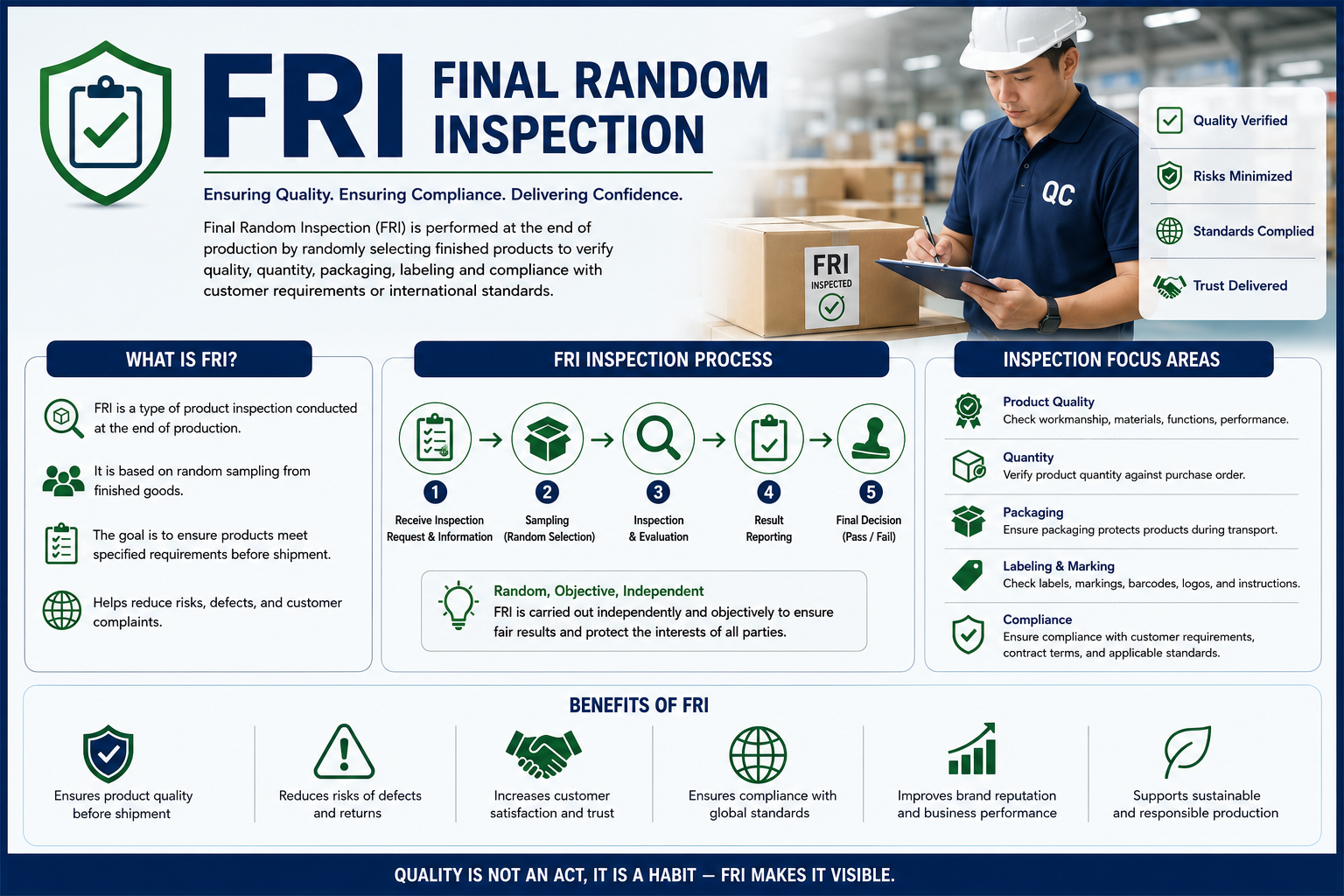
If corporate executives still view Final Random Inspection (FRI) as a passive compliance procedure imposed by international buyers or an inconvenient pitstop prior to shipment, your enterprise is missing a macro-level tool for strategic value positioning. In a flat world where global supply chains — spanning textiles, footwear, electronics, and home furnishings — demand absolute precision and flow velocity, quality consistency serves as a company’s true currency. The FRI process is the ultimate passport of commercial trust — a standardized universal language that enables manufacturers, international buyers, and financial institutions to establish total alignment and peace of mind across three dimensions: Scientific Sample Representation, Transparent Risk Classification, and Seamless Operational Assurance.
Mastering the FRI process is not a seasonal firefighting exercise; it is a journey toward building proactive quality governance capabilities. When control metrics are deeply integrated into the manufacturing culture, enterprises no longer find themselves caught off guard by third-party audits. Instead, they confidently turn compliance into a distinct competitive advantage, accelerating L/C cash flow releases and safeguarding long-term profit margins.
The Value-Creation Philosophy of the FRI Process (Collaborative Quality Frame): FRI was not engineered as a punitive mechanism to disrupt factory tempos. The essence of this framework is to establish a synchronized and predictive safety corridor to protect corporate assets. By applying statistical sampling theory , standardizing Acceptable Quality Limits ($AQL$), and field-testing packaging structural integrity, FRI helps supply chains pivot from “defect detection” to “proactive risk elimination.” This absolute alignment ensures your products remain the most dependable choice for global brands.
For modern supply chain managers and quality governance executives with a long-term vision, mastering the operational art of FRI is the golden key to optimizing rework costs, liberating cash flow, and consolidating brand reputation on a global scale.
1. System Architecture: Three Core Pillars Elevating the Safety Envelope of FRI
The FRI framework is designed as an internationally standardized matrix, enabling enterprises to manage product risk from factory floor to end consumers through three interconnected components:
Pillar 1: Scientific Sample Representation and Statistical Rules
- The 80/100 Readiness Prerequisite: Ensuring audit accuracy by initiating FRI only when 100% of the shipment is fully produced and a minimum of 80% is packed into Master Cartons. This guarantees that the drawn sample accurately reflects the true condition of the entire lot.
- ANSI/ASQ Z1.4 Statistical Random Sampling: Utilizing internationally recognized statistical tables to determine sample size ($Batch\ Size$). Multi-dimensional random sampling completely eliminates bias and subjective interference, establishing absolute transparency between seller and buyer.
Pillar 2: Transparent Defect Taxonomy and $AQL$ Risk Matrix
- Transparent Defect Classification: Clearly defining the severity of non-conformities: from safety/regulatory violations and functional/visual flaws to minor cosmetic variances
- Acceptable Quality Margin Guarantee: Establishing clear thresholds upfront empowers factory teams to align shop-floor standards, ensuring total detected defects remain well within the safe margin for clearance.
Pillar 3: On-Site Performance and Packaging Integrity
- Carton Drop Test: Simulating mechanical shocks encountered throughout international transit routes. Testing packaging endurance according to ISTA protocols guarantees that products are not only pristine at the factory gate, but arrive intact in the hands of the end consumer.
- Golden Sample & Technical Alignment: Directly cross-referencing physical production units against the approved ($Golden\ Sample$), Technical Packs ($Tech\ Pack$), and barcode readability ($Barcode\ Scan$). This technical audit trail serves as verifiable proof of product legitimacy.
2. Implementation Mechanisms: Converting FRI Standards into Intelligent Operational Drive
Rather than relying on passive inspections, the FRI framework provides intelligent data verification mechanisms, empowering manufacturers to master and optimize their own production quality:
- Internal Pre-FRI Screening Filters: Enterprises digitize internal inspection procedures by conducting a simulated mock FRI 48 hours before third-party inspectors arrive. This catches technical drift early, driving up the First-Time Pass Rate ($First\text{-}Time\ Pass\ Rate$).
- Quality Risk Optimization Models: Financial and logistics units utilize FRI metrics as a direct indicator of operational efficiency:$$\text{Delivery Safety Margin} = \frac{\text{Actual } AQL \text{ Performance}}{\text{Allowable Risk Threshold}}$$Consistently optimizing this index allows enterprises to negotiate for reduced inspection regimes ($Reduced\ Inspection$) or self-inspection status ($Self\text{-}Inspection$), drastically lowering third-party audit fees and speeding up dispatch times.
- Root Cause Analysis & Action Matrix: Should defects breach $AQL$ thresholds, FRI data is immediately converted into actionable corrective steps ($CAPA$). Root-cause algorithms help production teams pinpoint exact process bottlenecks, turning operational risk into a continuous quality upgrade.
3. Strategic Value: Transforming FRI Compliance into Competitive Differentiation and Brand Trust
Proactive implementation of the FRI process draws a clear line between top-tier strategic manufacturing partners and reactive operators:
| Strategic Growth Indicators | Enterprises Mastering FRI | Legacy and Reactive Operators |
| Cash Flow Velocity & Customs Clearance | Fully optimized. PASS reports release Inspection Certificates immediately, smoothing L/C liquidations and eliminating port storage fees. | Trapped in repeated FAIL reports; cargo is frozen, cash flow stalls, and compounding late delivery penalties accrue. |
| Global Client Retention & Affinity | Emerges as a Preferred Supplier due to consistent quality ratings; easily expands order volumes with tier-one retail groups. | Fragile market credibility; faces abrupt order reallocations to competitors when quality failures occur at the port of origin. |
| Safety Margins & Hidden Expenses | Proactively eliminates emergency rework costs, international return risks, and expensive overseas disposal liabilities. | Constantly reactive; incurs exorbitant remediation costs by resorting to rushed shop-floor re-sorting under tight deadlines. |
4. The 4-Step Transformation Roadmap: Cultivating an FRI Quality Culture from Shop Floor to Deep Sea
The implementation of the FRI framework follows a sequential rollout, fostering a sustainable shift in both corporate mindset and execution:
- Step 1 – Standard Alignment & Mapping: Harmonizing technical specifications, approved golden samples, and $AQL$ criteria between internal QA teams and global clients. Creating an ironclad “quality resume” before mass production begins.
- Step 2 – Packaging & Inspection Area Setup: Establishing an independent inspection zone equipped with standardized lighting, calibrated measuring tools, and temperature controls. Synchronizing packaging tempos with production rates for seamless random sampling.
- Step 3 – Simulation & Capacity Building: Training internal QA/QC staff on ANSI Z1.4 sampling protocols and functional testing methods. Running simulated audits to hone team sharpness and objectivity in defect classification.
- Step 4 – Digital Reporting & Kaizen Loop: Integrating FRI audit metrics directly into the Manufacturing Execution System (MES) and ERP architecture. Automating defect trend analysis to lock in a culture of “Right the First Time” across every assembly line.
Conclusion
Final Random Inspection (FRI) is far from a rigid technical roadblock or a bureaucratic hassle causing shipping delays. It is the ultimate bridge of quality confidence — the global benchmark of modern corporate operational governance.
Embracing the FRI matrix with an active, forward-looking mindset is how an enterprise builds world-class stature. It stands as the most authentic commitment to operational excellence, shielding corporate balance sheets from supply chain risks while granting the enterprise unfettered access to elite, sustainable global value chains.
CONCLUSION: A Living System, Not a Filing Cabinet
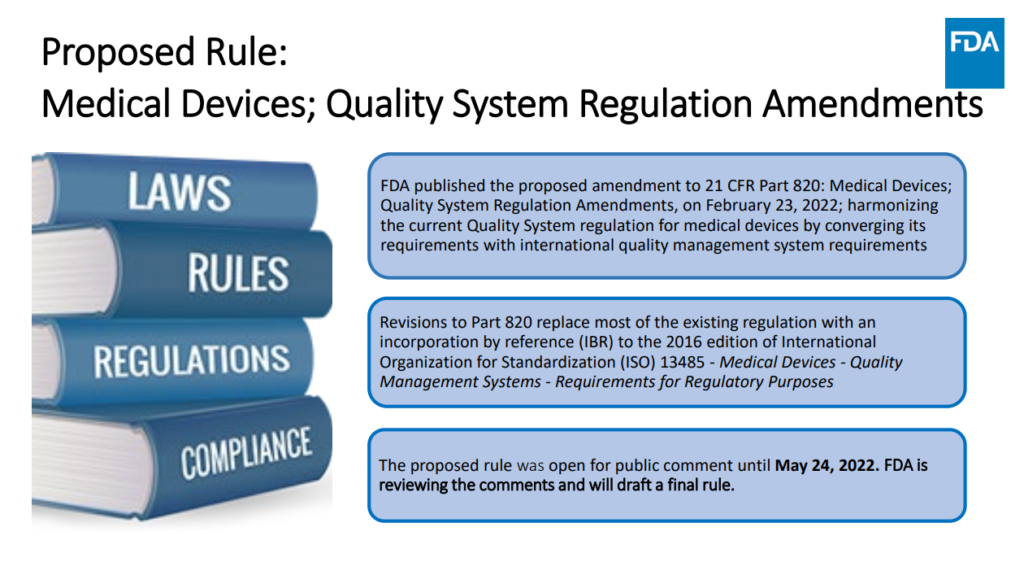
The move to QMSR represents a transition from reactive compliance to proactive, risk-based management. It is a realization that in a global MedTech market, quality cannot be siloed by geography or administrative legacy.
The heart of your regulatory operations is no longer a static filing cabinet filled with DHFs and DMRs; it is a living, connected system that integrates risk management across the entire product lifecycle. As the line between international standards and U.S. law vanishes, one question remains for leadership: Is your quality system a barrier to entry, or is it your most valuable commercial asset?
Contact us to download the bilingual English-Vietnamese PDF standard: from only $50
On the path toward integration and export, correctly understanding and applying international standards is essential. Yet language and technical terminology often pose real barriers. We are pleased to introduce our bilingual (English – Vietnamese) standards documentation service, translated by our own team of certification consultants.
What We Provide
• A clause-by-clause bilingual comparison, easy to consult and file.
• Professional Vietnamese translation in correct technical terminology, ready to use.
• Interpretation notes and application guidance from hands-on experts.
• Fast delivery in editable, easy-to-store PDF/Word format.
Standards Covered
ISO management systems (9001, 14001, 45001, 37001); sustainability certifications (ISCC, FSC, VFCS/PEFC); textiles and recycled materials (GRS, OCS, OEKO-TEX); social responsibility and ESG (SMETA, EcoVadis, Fairtrade), and many other industry standards upon request.
Why Choose Us
Our documents are translated by professionals who directly consult on and audit certifications, so the translation is accurate not only in language but also in real-world application — saving you time and reducing errors when preparing documentation.
Pricing
From only USD 50 per document, depending on length and complexity. Please send us the standard name to receive a free, accurate quotation.
How to Order
1. Contact us with the name of the standard you need.
2. Receive a quotation and delivery time.
3. Make payment and receive your document by email.
Payment
Bank transfer via QR code (provided with the quotation), or via PayPal: ducluongservices@gmail.com.
We look forward to accompanying you on your certification journey.
Best regards,
CONTACT INFORMATION
Hotline: +84 933096426 – +84 868 591 260
Email:
Website:

No responses yet