Vietnam has become one of Southeast Asia’s most attractive FDI destinations, backed by an expanding network of bilateral investment treaties (BITs) and new-generation trade and investment agreements — including the Comprehensive and Progressive Agreement for Trans-Pacific Partnership (CPTPP), the EU-Vietnam Free Trade Agreement (EVFTA), and the EU-Vietnam Investment Protection Agreement (EVIPA). Yet foreign investors who enter the Vietnamese market without a clear understanding of the applicable legal framework — and the specific investment protection standards available to them — routinely underestimate their legal risk exposure and, in some cases, forfeit rights they were never aware they held.
ISC Global provides comprehensive international investment law advisory services to help foreign investors structure cross-border transactions correctly, secure the highest available level of treaty protection, and prevent costly investment disputes before they arise.
1. Why International Investment Law Advisory Matters for Foreign Investors in Vietnam
Cross-border investment is governed simultaneously by multiple, overlapping layers of law: Vietnam’s domestic investment legislation, the specific international investment agreement applicable to the investor’s home country, and general principles and customary rules of international law. Without specialist legal guidance, foreign investors commonly face the following risks:
- Missed treaty benefits — failing to identify the most favourable applicable BIT or FTA investment chapter, and therefore missing higher market-access commitments or stronger protection standards;
- Regulatory and policy risk — abrupt legislative changes, licence non-renewal, arbitrary tax increases, or opaque administrative measures;
- Loss of dispute-resolution rights — failing to comply with strict procedural requirements and limitation periods under Investor-State Dispute Settlement (ISDS) mechanisms, thereby losing the right to bring a claim;
- Flawed investment structuring — choosing an investment vehicle or nationality structure that fails to qualify for protection under any applicable treaty.
2. Scope of ISC Global’s International Investment Law Advisory Services
2.1 Treaty Selection and Optimal Investment Structuring
We analyse the full landscape of bilateral investment treaties (BITs) and investment chapters within FTAs to which Vietnam is a party — including CPTPP, EVFTA/EVIPA, and RCEP — to identify the treaty offering the strongest protection and most favourable commitments for each specific transaction, and advise on lawful, tax- and legally-optimised cross-border investment structures.
2.2 Advisory on International Investment Protection Standards
- National Treatment (NT) and Most-Favoured-Nation Treatment (MFN);
- Fair and Equitable Treatment (FET) and Full Protection and Security (FPS);
- Protection against unlawful expropriation (direct and indirect);
- Guarantees on the free transfer of capital, profits, and returns;
- Prohibition of trade-distorting performance requirements;
- Umbrella clauses covering the State’s contractual commitments to investors.
2.3 Political and Regulatory Risk Assessment
We help investors assess the risk of policy change, nationalisation, and adverse regulatory measures, and design proactive risk-mitigation strategies from the earliest stages of the investment lifecycle.
2.4 Investment Dispute Advisory and ISDS Support
When disputes arise, our legal team advises on the investor’s right to bring a claim, the appropriate dispute-resolution forum (domestic courts, domestic arbitration, or international investment arbitration), applicable limitation periods, and mandatory pre-arbitration consultation procedures — while assisting with the preparation of legal submissions and supporting documentation.
2.5 Contract Drafting and Legal Documentation
Drafting and reviewing investment agreements, business cooperation contracts (BCC), shareholder agreements, and Investment Registration Certificate applications, ensuring full compliance with both Vietnamese domestic law and applicable international commitments.
3. Key Legal Update: Vietnam’s Investment Law 2025 (Law No. 143/2025/QH15)
Vietnam’s National Assembly passed the new Investment Law 2025 (Law No. 143/2025/QH15) on 11 December 2025, taking effect on 1 March 2026 and replacing the 2020 Investment Law and its subsequent amendments. Key changes foreign investors should be aware of include:
- A clarified definition of market-access conditions for foreign investors, tied to the List of Sectors Subject to Restricted Market Access;
- A streamlined and shortened list of conditional business sectors, simplifying administrative procedures;
- New provisions allowing certain investors to establish an economic organisation before completing the Investment Registration Certificate procedure;
- A dedicated, clearer legal framework for outbound investment by Vietnamese investors.
Foreign investors should cross-reference the new Restricted Market Access List under the 2025 Investment Law against the market-opening commitments in CPTPP and EVFTA/EVIPA to determine the actual, practical level of preferential treatment available for their sector.
4. Investment Protection Standards Foreign Investors Should Understand
| Standard | Nature | Key Treaties (Vietnam is a party) |
|---|---|---|
| National Treatment (NT) | Relative, comparative | CPTPP, EVIPA, most BITs |
| Most-Favoured-Nation (MFN) | Relative, comparative (excludes ISDS) | CPTPP, EVIPA |
| Fair and Equitable Treatment (FET) | Absolute, independent standard | CPTPP, EVIPA (detailed list) |
| Protection against Unlawful Expropriation | Absolute, 4 cumulative conditions | CPTPP, EVIPA (with annexes) |
| Free Transfer of Funds | Absolute, with limited safeguard exceptions | EVIPA (up to 1-year safeguard) |
| Prohibition of Performance Requirements | Absolute, narrow scope | CPTPP Art. 9.10; EVFTA Art. 8.8 |
5. When Should a Foreign Investor Seek Legal Advice on ISDS?
Not every dispute between a foreign investor and the Vietnamese State can be brought before international arbitration. An investor may only invoke ISDS where:
- The investor holds the nationality of a State that has concluded an investment treaty with Vietnam containing an ISDS mechanism;
- The investor strictly complies with applicable procedural requirements, limitation periods, and mandatory pre-claim consultation under that treaty;
- Under EVIPA, a claim already pending before domestic courts generally cannot be simultaneously pursued through treaty-based arbitration (a “fork in the road” restriction).
Early legal advice — well before a dispute crystallises — is critical to preserving these rights and building a strong evidentiary record of the investor’s legitimate expectations.
6. Why Choose ISC Global?
- A rare combination of deep expertise in international investment law, international trade law, and hands-on experience advising hundreds of FDI enterprises in Vietnam on ESG and international standards compliance;
- In-depth, continuously updated knowledge of Vietnam’s BIT network, CPTPP, EVFTA/EVIPA, and the newly enacted 2025 Investment Law;
- A partner network including Duc Luong Services and STC VN Co., Ltd. (Staunchly Vietnam), enabling end-to-end support from legal advisory through certification and international standards implementation;
- A strict commitment to confidentiality and objective, client-first legal advice.
Frequently Asked Questions
Does every foreign investor in Vietnam automatically enjoy treaty-based protection? No. Investment protection standards such as NT, MFN, FET, and protection against expropriation only apply where the investor holds the nationality of a State that has concluded an applicable investment treaty with Vietnam. Investors from States without such a treaty are still protected under Vietnamese domestic law, but cannot invoke these international protection standards or the ISDS mechanism.
Can a foreign-invested enterprise in Vietnam be treated as a “foreign investor” for outbound investment purposes? Under the 2025 Investment Law, an economic organisation in which foreign investors hold more than 50% of charter capital (or, for partnerships, where the majority of general partners are foreign individuals) may be treated as a foreign investor, subject to a case-by-case legal review.
Does Fair and Equitable Treatment (FET) prevent Vietnam from ever changing its laws or policies? No. FET protects an investor’s legitimate expectations based on specific commitments made at the time of investment, but it does not remove the State’s legitimate, non-discriminatory right to regulate in the public interest.
Contact Us For Business Advisory
ISC Global Co., Ltd.
Hotline: +84 933 096 426 – +84 868 591 260
Email: info@iscglobal.asia | van.pham@iscglobal.asia
Website: iscglobal.asia | iscglobal.edu.vn
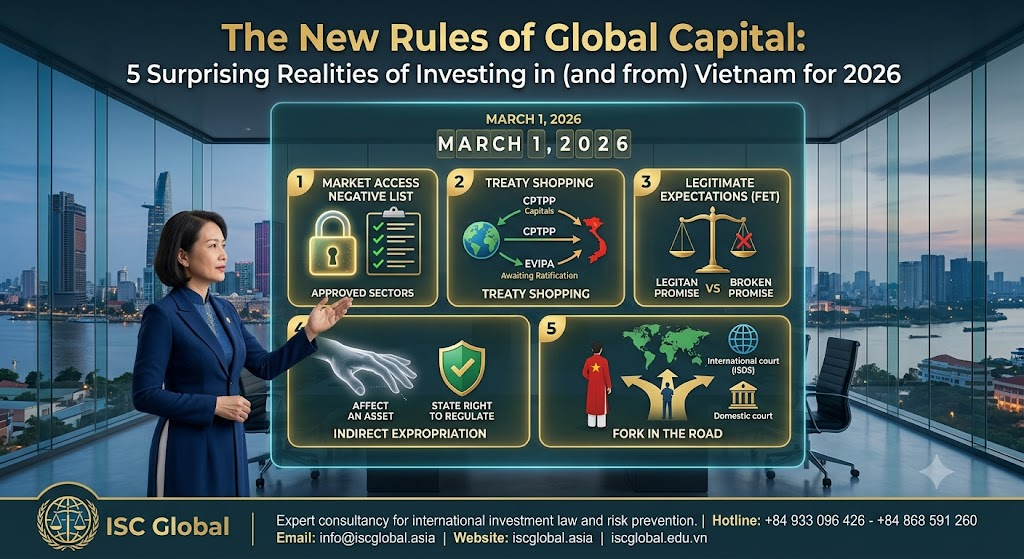
The New Rules of Global Capital: 5 Surprising Realities of Investing in (and from) Vietnam for 2026
Vietnam is entering a pivotal legal era. With the passage of the Law on Investment 2025 (No. 143/2025/QH15) and the rising influence of “new generation” treaties like the CPTPP and the pending EVIPA, the landscape for cross-border capital has undergone a tectonic shift.
Yet, as a counsel who has navigated these boardrooms for decades, a recurring question haunts the strategic planning phase: Why do seasoned investors still lose everything in markets that appear “safe”? The reality is that a brilliant business plan is worthless without a multi-layered legal shield. As we approach 2026, understanding the intersection of domestic law and international treaties is no longer a luxury—it is a survival requirement for any C-suite executive or fund manager.
1. The “March 2026” Countdown and the Strategic Value of “Negative Certainty”
The most significant shift in Vietnam’s domestic framework is the Law on Investment 2025, which officially takes effect on March 1, 2026. However, strategic planners must note a critical “grey zone”: while the Law is effective in March, the specific Conditional Business Line list does not take effect until July 1, 2026.
This Law introduces a “faster but stricter” environment:
- The Power of Negative Certainty: The new “Market Access Negative List” provides a massive win for transparency. If a sector is not on the list, the state cannot use “unwritten rules” to block access. This creates a baseline of legal certainty previously unavailable.
- The 50% Pivot Point: Under Article 20 of the LOI 2025, the threshold for determining “foreign investor” status is set at 50% of charter capital. This is the primary yardstick for corporate structuring. If your foreign ownership is 50.1%, you are tethered to the same conditions and procedures as a foreign entity.
2. The Strategic Art of “Treaty Shopping” and the 50% Paradox
Not all legal protections are equal. An investor’s rights are dictated by the specific Bilateral Investment Treaty (BIT) or Free Trade Agreement (FTA) applicable to their nationality. “Treaty Shopping”—structuring an investment through a specific jurisdiction to access superior protections—remains a legitimate strategy, provided it is executed with precision.
However, investors must avoid the “Denial of Benefits” trap. Modern treaties allow states to exclude “mailbox companies”—entities with no substantive business activity in their home country. Furthermore, a fascinating paradox exists: under Article 20, a Vietnamese firm with more than 50% foreign ownership is treated as a foreign investor. This status may actually unlock international treaty protections for that entity when it reinvests, provided the “mailbox” criteria are avoided.
“A decision… lacking a solid legal foundation can cause businesses to face risks of being denied incentives, being subjected to adverse administrative measures, or worse, becoming entangled in international investment disputes lasting many years.”
Crucial Note on EVIPA: While Vietnam has ratified the EU-Vietnam Investment Protection Agreement (EVIPA), it is not yet in effect, as it awaits ratification by all 27 EU member states. Currently, EU investors must rely on existing BITs with individual member states. Treating the EVIPA as a current shield is a high-stakes mistake.
3. Protection Beyond “Physical Safety”: The Battle of “Legitimate Expectations”
In international law, “security” is a dual concept. While Full Protection and Security (FPS) requires the state to protect your factory from physical harm (like riots), the modern legal battleground is Fair and Equitable Treatment (FET).
FET protects the “Legitimate Expectations” of an investor. These expectations are not based on hope, but on written commitments and Investment Registration Certificates (IRC). Paradoxically, because the 2025 Law allows economic organizations to form before an IRC is fully issued in some cases, investors risk weakening their FET claims if they move forward without securing formal, written state promises early. Specific violations of FET now include:
- Denial of Justice: Failures in criminal, civil, or administrative adjudicatory proceedings.
- Fundamental Breaches of Due Process: Lack of transparency in public administration.
- Arbitrary or Discriminatory Acts: Measures targeted at an investor based on gender, race, or religion.
- Coercive Abuse of Power: Harassment or abusive use of administrative authority.
4. The “Indirect Expropriation” Ghost
An investment can be “stolen” without a government ever seizing the deed. Indirect Expropriation occurs when administrative measures—such as sudden tax hikes or permit denials—render an investment worthless.
To determine if a state measure is a legal “taking” rather than a theft, treaties apply four cumulative conditions:
- The measure must serve a public purpose.
- It must be non-discriminatory.
- It must follow due process of law.
- It must be accompanied by adequate and timely compensation.
The “Right to Regulate” exception is the state’s shield. Legitimate, non-discriminatory measures for public welfare (environment, health, or safety) generally do not count as expropriation, provided they are proportionate.
5. The “Fork in the Road” for Outbound Investors
Vietnamese firms are increasingly aggressive in outbound investment, but many are walking into a “Legal Desert.” Under Articles 38 (Principles) and 39 (Forms) of the LOI 2025, outbound capital can take many forms: BCC contracts, equity acquisition, or ODA loans.
Two realities are paramount for Vietnamese capital abroad:
- The Treaty Gap: If no BIT or FTA exists between Vietnam and the host country, a Vietnamese business has zero right to sue that state in international court (ISDS). They are entirely at the mercy of the host country’s domestic courts.
- The Fork in the Road: Many modern treaties include a “Fork in the Road” provision. If you choose to sue a state in their local court first, you may be permanently barred from seeking international arbitration later. You must choose your battlefield wisely from day one.
Conclusion: The 2026 Horizon
As the March 1, 2026 effective date for the Law on Investment approaches, the need for “Legal Due Diligence” is absolute. You must ask: Does my “Capital Nationality” match my “Protective Treaty”? Are my expectations anchored in written commitments, or am I building on sand? In this new era, the most successful investors will be those who treat legal architecture as the foundation of their financial modeling.
ISC Global Co., Ltd.
Expert consultancy for international investment law and risk prevention.
Hotline: +84 933 096 426 – +84 868 591 260
Email: info@iscglobal.asia | van.pham@iscglobal.asia
Website: iscglobal.asia | iscglobal.edu.vn
No responses yet