As global protectionism intensifies and trade remedy investigations reach record numbers across key export markets — the United States, the European Union, India, Canada and Australia — Vietnamese exporters face growing exposure to anti-dumping (AD), countervailing duty (CVD), and safeguard (SG) investigations. This article provides an in-depth overview of trade remedies advisory services offered by ISC Global, together with its Vietnam-based partners, to help exporters and domestic manufacturers navigate this increasingly complex legal landscape.
1. What Are Trade Remedies?
Trade remedies are the set of legal instruments permitted under World Trade Organization (WTO) rules that allow member states to protect domestic industries from unfair trade practices or sudden import surges causing injury. Under Vietnam’s Law on Foreign Trade Management (2017) and its latest implementing regulations — Decree No. 86/2025/ND-CP and Circular No. 26/2025/TT-BCT, both effective from 1 July 2025 — Vietnam recognizes three principal trade remedy measures:
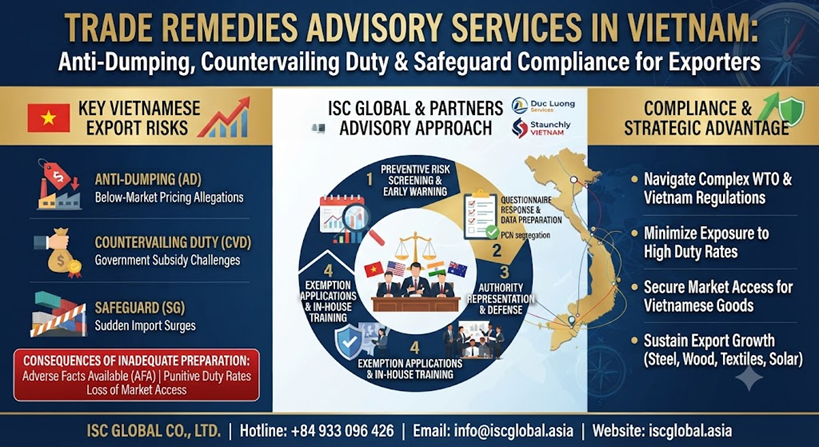
- Anti-Dumping (AD): imposed when imported goods are sold below their normal value in the exporting country’s home market, causing material injury to the domestic industry.
- Countervailing Duty (CVD): imposed when imported goods benefit from government financial contributions (tax incentives, preferential credit, below-market input pricing) in the exporting country, causing material injury.
- Safeguard Measures (SG): imposed when a sudden and significant surge in imports — regardless of origin — causes serious injury to the domestic industry.
In addition to these three traditional measures, Vietnamese law and most major export markets also maintain an anti-circumvention mechanism, targeting practices such as country-of-origin transshipment, minor product modification, or the use of intermediary exporters to evade existing trade remedy duties.
2. Why Vietnamese Exporters Are Increasingly Exposed
Several structural factors place Vietnam among the countries most frequently subject to foreign trade remedy investigations:
- Rapid export growth in sectors such as steel, wood products, solar cells and modules, electric bicycles, shrimp, and textiles, which can trigger petitions from competing domestic industries abroad alleging market-share erosion;
- Vietnam’s role as a regional manufacturing and transshipment hub, which increases scrutiny — particularly for products with raw material content sourced from countries already subject to AD/CVD orders (steel and aluminum being the most prominent examples);
- Investment incentive policies (preferential land lease rates, electricity pricing, tax holidays for industrial zones and FDI enterprises) that may be characterized as actionable subsidies under the WTO Agreement on Subsidies and Countervailing Measures (SCM Agreement), increasing the frequency of combined AD/CVD investigations.
3. Consequences of Inadequate Preparation
Companies that fail to prepare adequately for a trade remedy investigation typically face severe consequences:
- Missing the 30-day deadline (subject to limited extensions) to submit a complete Questionnaire Response, resulting in the application of adverse facts available (AFA) — a punitive, presumption-based duty rate typically far higher than a properly calculated company-specific rate;
- Inadequate accounting segregation by Product Control Number (PCN), preventing investigating authorities from verifying company-specific data and forcing reliance on less favorable methodologies;
- Loss of the right to comment on preliminary and final determinations, forfeiting the opportunity to present evidence and legal arguments before duties are finalized;
- Exposure to the “country-wide” or “all-others” rate, generally reserved for non-cooperating respondents and set substantially higher than individually calculated rates.
4. ISC Global’s Trade Remedies Advisory Services
Drawing on a combined expertise in international trade law and international standards/certification consulting, ISC Global — together with Duc Luong Services and STC VN Co., Ltd. (Staunchly Vietnam) — offers a comprehensive suite of trade remedies advisory services:
- Risk screening and early-warning monitoring of export volume trends, pricing behavior, and market share to detect investigation risk before a petition is filed;
- Questionnaire Response preparation, including PCN-level segregation of domestic and export sales data, normal value and export price determination in accordance with the applicable investigating authority’s methodology (5% representativeness test, 20/80 profitability test, level-of-trade and other adjustments);
- Representation in consultations and verifications with Vietnam’s Trade Remedies Authority (Ministry of Industry and Trade), the U.S. Department of Commerce (DOC), the European Commission’s Directorate-General for Trade (DG TRADE), and other foreign investigating authorities;
- Exclusion/exemption applications under Circular No. 26/2025/TT-BCT for qualifying importers;
- Petition support for domestic manufacturers seeking to initiate AD/CVD/SG investigations against injurious imports;
- In-house training for legal, compliance, and export teams on trade remedy risk identification and response protocols.
5. Advisory Process
- Initial risk assessment — analysis of export markets, product classification, and pricing structure;
- Strategy development tailored to the stage of exposure (pre-petition prevention, active investigation, or administrative/sunset review);
- Data and documentation preparation in strict compliance with statutory deadlines and the investigating authority’s questionnaire requirements;
- End-to-end representation through to final determination, including support for administrative reviews and sunset reviews.
6. Frequently Asked Questions
Do small and medium-sized exporters need trade remedies advisory services? Yes. Even exporters with modest export volumes can be named as mandatory or voluntary respondents once their product falls within the scope of an investigation. Non-cooperation, or incomplete cooperation, almost always results in a materially higher duty rate than would be achieved with professional representation.
How is the cost of trade remedies advisory determined? Fees depend on the scope of engagement — preventive risk screening, full case representation, or support for a specific procedural stage — and the complexity of the matter. ISC Global provides a free initial case assessment before issuing a formal quotation.
Contact Us for a Free Business Consultation
ISC Global Co., Ltd.
Hotline: +84 933 096 426 – +84 868 591 260
Email: info@iscglobal.asia | van.pham@iscglobal.asia
Website: iscglobal.asia | iscglobal.edu.vn
No responses yet