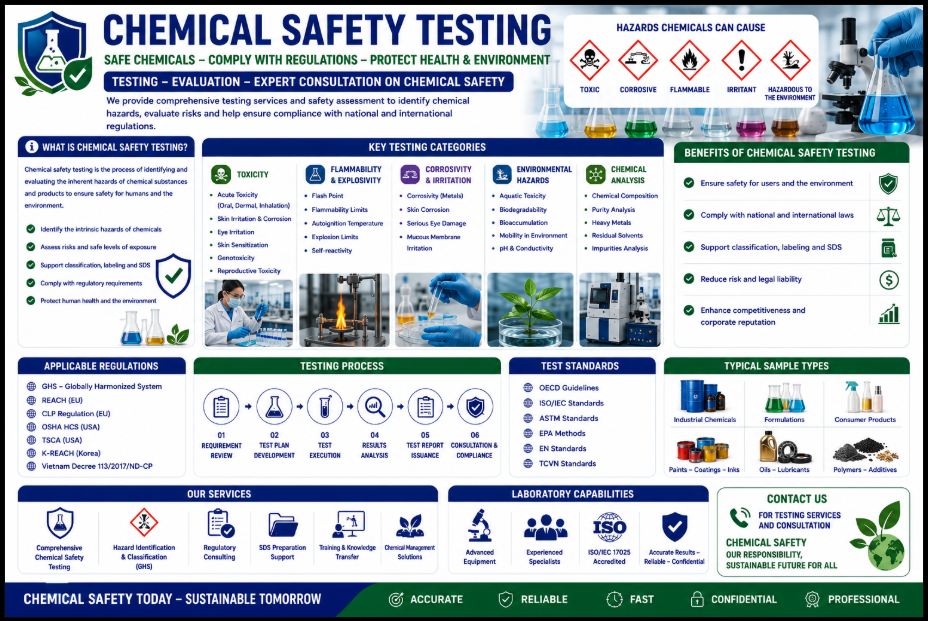
If your enterprise’s R&D and quality management departments still view chemical testing regulations as administrative declaration sheets or eco-certifications for marketing purposes, you are operating your factory with a massive risk liability. In the technocratic era, international customs authorities (such as the EU’s Safety Gate or the US EPA) do not care about paper commitments. They operate precision spectrometers at ports of entry to strip your products down to their atomic states.
Chemical compliance has no concept of “almost passed.” If a single restricted substance is detected exceeding the threshold by just one part per million ($1\text{ppm}$), your entire shipment transitions instantly from a commercial asset into hazardous waste slated for mandatory destruction.
The Industrial Toxicology Reference Frame: Modern chemical standards do not evaluate a device as a whole; they quantify parameters across each individual homogeneous material—meaning any plating layer, plastic fiber, solder joint, or adhesive droplet that cannot be mechanically detached. This demands the mastery of technical detection limits via chromatography matrices: from Inductively Coupled Plasma Mass Spectrometry (ICP-MS) to trace heavy metals, to Gas Chromatography-Mass Spectrometry (GC-MS) for fracturing organic compound structures. A minor scratch contaminated with process-induced short-chain chlorinated paraffins (SCCPs) from machining coolant is enough to trigger a comprehensive trade embargo.
For Chief Technology Officers (CTOs) and Raw Supply Chain Lead Engineers, mastering molecular toxicology analysis represents the only technical shield to eliminate asset seizure risks and insure global market access.
1. Molecular Bottlenecks: Hidden Contamination Mechanisms Destroying Product Legitimacy
Through physical-chemical failure analysis and toxicological debugging campaigns, we have isolated 3 prevalent cross-contamination mechanisms that convert high-tech products into illegal goods overnight:
- Short-Chain Plasticizer Delayed Migration (Phthalate Migration Delay): Utilizing low-cost plasticizing additives (such as DEHP or DBP) inside polyvinyl chloride (PVC) resin matrices creates unstable molecular bonds. Under the pressure of elevated temperatures and humidity during a 30-day ocean freight container voyage, these molecules migrate outward to the surface. This causes the measured concentration at destination ports to breach the $0.1\%$ regulatory ceiling, triggering red alerts across international customs systems.
- Process-Induced Cleaning Solvent Contamination: Factories run export lines on shared machinery or reuse cleaning tanks, lubricants, and cutting oils previously deployed for low-cost domestic goods. Polybrominated biphenyls/diphenyl ethers (PBBs/PBDEs) or organotin compounds left over from the prior batch diffuse into the polymer matrix of the export-bound product, pushing parts-per-million levels past the red line unintentionally.
- Surfactant Additive Blind Spots (“Forever Chemicals”): Hydrophobic coatings, logo inks, or component adhesives frequently contain active surface compounds belonging to the PFAS (Per- and Polyfluoroalkyl Substances) family. Due to the incredibly stable Carbon-Fluorine bond, these chemicals do not biodegrade and are aggressively targeted by new mandates like the US TSCA, wiping out unverified components right at the incoming raw material screening gate.
The consequence of loose chemical management is an immediate, enforceable global recall order, devastating civil fines from destination market regulators, and the permanent revocation of vendor status within global B2B supply chains.
2. Technocratic Solutions: Locking Chemical Tolerances via Multi-Tier Chromatography Filters
To neutralize toxicological variables, we establish a strict chemical defense network that intervenes directly at the particle level through 4 technical tollgates:
- Tier-1 High-Throughput XRF Spectral Screening: Deploying incoming quality control (IQC) stations armed with wide-dynamic-range XRF scanners to execute instantaneous spectral readouts, isolating raw resin lots, surface finishes, or electronic parts showing traces of Lead (Pb), Mercury (Hg), or Cadmium (Cd).
- Molecular Quantification via Analytical ICP-MS and GC-MS: Transferring homogeneous material samples to the destructive analysis cells of an ISO/IEC 17025 accredited laboratory. Utilizing ultrasonic extraction paired with ultra-pure solvents allows engineers to quantify restricted organic chains and halogenated flame retardants down to parts-per-billion ($ppb$) accuracy.
- In-House Restricted Substances List (RSL) Engineering: Implementing a rigorous chemical control protocol for all factory consumables—including assembly adhesives, structural tapes, and operators’ gloves—extinguishing any avenue for process-induced cross-contamination on the production floor.
- Centralized Digital Chemical Declaration (SCIP & REACH Integration): Packaging chemical-physical logs, digitized Safety Data Sheets (SDS), and Full Material Declarations (FMD) into an encrypted digital Technical File, automatically syncing the unique product identifiers to the European Chemicals Agency (ECHA) SCIP database.
3. Performance Analysis: Converting Compliance Margins into Clean-Tech Commercial Surplus
Mastering toxicological audits is not a passive regulatory overhead; it is an active financial lever to command premium value in the clean-tech market tier:
| Toxicological Risk Indicators | Saturated Chromatography Management | Operations Relying on Blind COA Trust |
| Demurrage Fees & Customs Bottlenecks | Secures a $100\%$ green-channel clearance rate, completely removing storage hold fees, yard penalties, and destructive customs sampling risks. | Trapped on automated customs inspection watchlists; shipments are frozen at ports for weeks or months awaiting lab analysis, fracturing the logistics pipeline. |
| B2B Supply Chain Margin Premium | Acquires verified “Halogen-Free” or “PFAS-Free” credentials, unlocking Tier-1 vendor preferences with global conglomerates and enabling up to a $20\%$ price premium. | Demoted to low-margin commoditized tiers, facing constant contract cancellation risks due to an inability to provide transparent molecular trace logs. |
| Defective Material Scrap & Destruction | Identifies and sequesters contaminated raw lots right at the IQC loading dock, zeroing out wasted machining hours on defective base materials. | Discovers chemical infractions late—after final packaging or export—forcing the total destruction of finished product assets and incurring double financial losses. |
4. Experimental Roadmap: Phasing Technical Chemical Controls from Cradle to Vendor Base
Our chemical risk management workflow is deployed via a phased, systematic framework to integrate forensic chemistry directly into factory operations:
- Step 1 – Chemical Inventory Auditing & Mapping: Auditing the complete catalog of raw resins, processing agents, and surface cleaners running through the plant to map local hot spots vulnerable to cross-contamination.
- Step 2 – Green Retrofitting & Formula Optimization: Collaborating with material vendors to alter molecular formulas; replacing legacy Phthalate plasticizers with bio-esters, and trading brominated flame retardants for eco-friendly phosphorus-based alternatives.
- Step 3 – Verification Testing at Accredited Strategic Labs: Submitting homogeneous materials to analytical testing cells via liquid/gas chromatography to generate legally binding RoHS/REACH compliance profiles that withstand global market surveillance scrutiny.
- Step 4 – Supply Chain Vendor Enforcement: Integrating chemical testing gates into the enterprise ERP system, requiring Tier-2 and Tier-3 sub-vendors to upload verified molecular data sets before freight trucks are cleared to enter the unloading zone.
5. Fulfilling Tangible ESG Metrics via Industrial Toxicology Frameworks
Surpassing chemical safety benchmarks serves as empirical verification that an enterprise is executing its ESG (Environmental, Social, Governance) mandates with data-driven transparency, eliminating greenwashing exposures:
- The Environmental Pillar (Environment): Eliminating Persistent Organic Pollutants (POPs) and forever chemicals prevents long-term toxic leaching into soil and groundwater systems during the post-lifecycle e-waste recycling phase.
- The Social Pillar (Social): Securing the endocrine and long-term biological safety of the end consumer, while establishing rigorous occupational health barriers (zero toxic vapor or heavy-metal exposure) for the shop-floor workforce on the thermal processing lines.
- The Governance Pillar (Governance): Replacing vague corporate marketing claims with unalterable chromatography logs, establishing trace transparency across the raw material chain, and driving up institutional compliance scores before global capital funds.
Conclusion
Chemical safety evaluation is no longer a simple bureaucratic verification step. It is an elite technocratic race centered on molecular-level purity control and raw supply chain isolation at the atomic scale.
Commanding a hardware portfolio that is structurally clean of chemical toxins and mastering precision chromatography validation provides your business with an ironclad passport across international borders. It insulates your export revenue from regulatory penalties and establishes your brand as a leading, sustainable technology vendor in the global value chain.
Contact us today to receive dedicated advice and the most suitable solution for your business!
Hotline: +84 933096426 – +84 868 591 260
Email:
Website:
Partners in Vietnam:
Contact Vietnam representative: Duc Luong Services
Hotline: +84 933096426 – +84 868 591 260
Email: ducluongservices@gmail.com
Website:
STC VN Co., Ltd.
Hotline: +84 933096426 – +84 868 591 260
Email: info@staunchlyservices.com.vn
Website: https://stauchlyservices.com.vn
No responses yet