
If your enterprise’s procurement department is still accepting batches of metal alloys, plastic resins, or polymer compounds based purely on paper Certificates of Analysis (COAs) provided by suppliers, you are gambling your factory’s future on pure guesswork. Within today’s complex global raw materials supply chain, the blending of degraded recycled resins, falsification of alloy grades, and deep-level contamination of restricted substances are harsh realities on the shop floor.
The physical structure of a product does not operate on written promises; it obeys mechanical and chemical laws at the molecular level.
The Material Forensics Philosophy: We do not conduct superficial mechanical inspections. The essence of a materials audit lies in microstructural extraction and quantitative spectrum analysis: from Fourier-Transform Infrared (FTIR) spectroscopy to expose polymer molecular bonds, to Thermogravimetric Analysis (TGA) for weight-loss thermal degradation mapping, and fracture analysis via Scanning Electron Microscopy (SEM). A discrepancy of just $0.05\%$ carbon content in an alloy or the presence of casting-induced micro-voids will convert an entire batch of hardware into legal scrap metal once subjected to dynamic field loads.
For Chief Technology Officers (CTOs) and Materials Failure Forensic Specialists, establishing an in-house material defense filter is the only technocratic measure to strip suppliers of their ability to commit quality fraud.
1. Structural Bottlenecks: Physical Degradation Mechanisms from a Failure Analysis Perspective
Through physical forensic investigations of real-world structural failures, we have isolated 3 core destruction mechanisms triggered by lax incoming raw material controls:
- Brittle Fracture via Structural Chain Degradation (Polymer Embrittlement): Suppliers blend low-grade, multi-cycled recycled plastics into virgin resin lots. This thermal over-processing cleaves macromolecular chains and drops cross-linking density, causing the product housing to undergo embrittlement, develop micro-fissures, and shatter under low-intensity mechanical impacts.
- Pitting and Intergranular Corrosion via Alloy Phase Disparity: Deviations in trace element distribution (such as Chromium, Nickel, or Carbon) or uneven billet heat treatment generate mismatched chemical potentials along crystal grain boundaries. Upon exposure to environmental humidity, microscopic galvanic cells are activated, eating away the metal structure from within.
- Restricted Chemical Contamination (RoHS/REACH Breaches): Batches of plasticizers, printing inks, or surface coatings become contaminated with hazardous heavy metals (Lead, Mercury) or restricted Phthalate groups (DEHP, DBP) due to substandard industrial purging of mixing vats in the raw supply chain. This results in products being found guilty of environmental violations and permanently banned from developed markets.
The consequence of lacking a material filter is a catastrophic wave of component fractures on the mass production line, driving up recall overheads and causing global buyers to blacklist the manufacturer from future contract tenders.
2. Solution Matrix: Establishing a 4-Tier Technical Barrier to Lock Down Material Tolerances
To completely eliminate risks stemming from raw inputs, our audit protocol intervenes via deep physical-chemical analysis, instantly classifying materials through 4 technical tollgates:
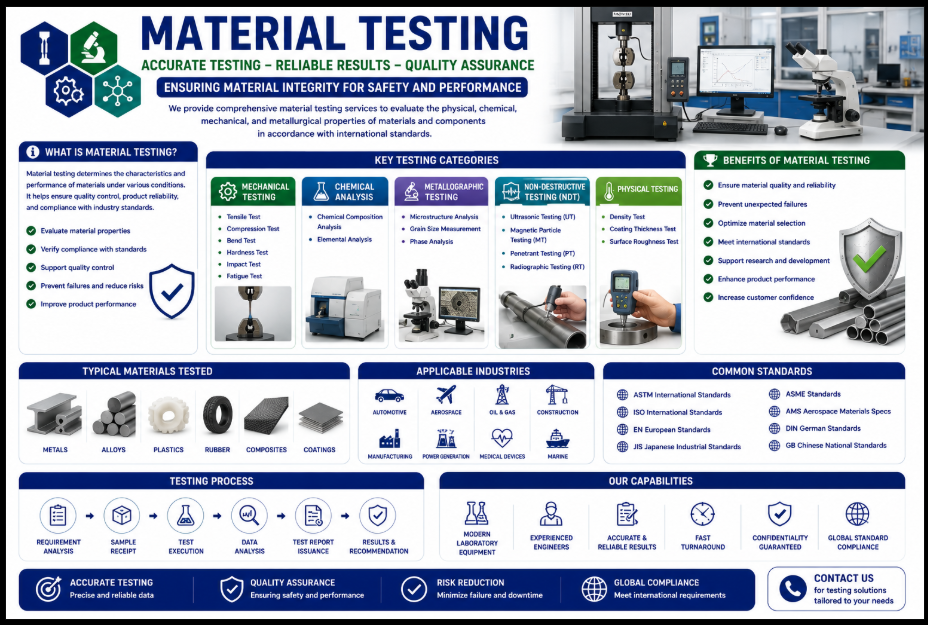
- Chemical Fingerprinting via FTIR and XRF Spectroscopy: Utilizing Fourier-Transform Infrared (FTIR) spectrometers to verify the molecular “fingerprints” of incoming polymer lots, alongside handheld X-ray Fluorescence (XRF) scanners to intercept heavy metal contamination directly at the loading dock.
- Quantitative Thermal Behavior Analysis (DSC/TGA): Deploying Differential Scanning Calorimetry (DSC) to pin down precise crystallinity and melting points, and Thermogravimetric Analysis (TGA) to isolate inorganic filler percentages, exposing any unapproved cuts to virgin resin content.
- Destructive Mechanics and Micro-hardness Evaluation (UTM & Vickers): Forcing materials to their ultimate load capacities on Universal Testing Machines (UTM) to plot empirical stress-strain curves, while measuring Vickers micro-hardness across critical load-bearing vectors to calculate fatigue limits.
- Digitization of the Digital Materials Passport: Compiling raw spectrum charts, dynamic load plots, and chemical restriction clearances into a centralized, searchable digital technical ledger compliant with international ASTM and ISO standards.
3. Materials Economics: Optimizing Production Cost Structures via Molecular Control
Setting up an in-house pre-compliance and forensics lab is not an administrative burden; it is an aggressive financial engine to protect your manufacturing profit margins:
| Risk Metric Indicators | Proactive Forensic Materials Governance | Operations Based on Trust and COA Papers |
| Tooling Efficiency & Scrap Rates | Drives raw material scrap below $0.3\%$ by rejecting resin lots with erratic Melt Flow Indexes (MFI) that cause short-molds or flash defects. | Factory molding/stamping defect rates fluctuate wildly between $4\%$ to $8\%$, wasting energy, draining labor hours, and accelerating tool wear. |
| Supply Chain Negotiation Leverage | Arms procurement teams with irrefutable empirical data to reject sub-par lots, enforce chargebacks, or penalize suppliers without leverage pushback. | Defenceless during technical disputes; forced to accept borderline-defective material lots just to keep production running, elevating system risks. |
| Field Warranty Safety Margins | Consistent material composition guarantees resilience against weather aging and UV degradation, driving field structural failure rates near $0\%$. | Products experience structural fracturing, fading, or mechanical distortion within months of reaching end-users, draining cash via warranty claims. |
4. 4-Step Action Roadmap: Integrating Lab Analysis onto the Production Floor
Our material forensics and verification workflow is deployed sequentially, embedding directly into the factory’s Incoming Quality Control (IQC) infrastructure:
- Step 1 – Mapping the Material Baseline Specification: Defining safe mechanical and chemical tolerance boundaries for each raw material SKU based on the environmental boundary conditions of the end product.
- Step 2 – Stationing Pre-compliance Tools and Statistical Sampling: Deploying handheld spectral tools to the warehouse floor and training QC operators in strict random sampling math, eliminating selective sampling habits that compromise measurement accuracy.
- Step 3 – Advanced Deep-Dive Audits via Strategic ISO 17025 Labs: Scheduling routine sample dispatches for Gas Chromatography-Mass Spectrometry (GC-MS) or SEM analysis to audit complex parameters that field tools cannot resolve.
- Step 4 – Batch Traceability and Automated Containment: Linking incoming material scan profiles to the factory’s serial barcode ledger. If a material flaw is flagged, the ERP system automatically freezes all related in-process sub-assemblies within minutes.
5. Driving Real ESG Metrics from the Molecule Up
Mastering microstructural material validation acts as empirical verification that an enterprise is running its ESG (Environmental, Social, Governance) directives with mathematical honesty, removing any risk of greenwashing:
- The Environmental Pillar (Environment): Strict screening for RoHS/REACH chemicals ensures that toxic components do not leak into landfills at the end of the product lifecycle, while creating a safe data foundation for integrating premium bio-plastics.
- The Social Pillar (Social): Eliminating consumer exposure to Volatile Organic Compounds (VOCs) or toxic plasticizers, while protecting the occupational health of shop-floor operators who process materials in thermal manufacturing zones.
- The Governance Pillar (Governance): Replacing qualitative quality claims with unalterable scientific proof, creating absolute visibility across the raw input chain and elevating the enterprise’s compliance ranking before institutional financial bodies.
Conclusion
Materials testing has evolved far beyond an academic exercise inside an isolated lab. It is the ultimate technocratic strategy that dictates cost control, foundational quality, and an enterprise’s right to survive in the global value chain.
When your business commands full visibility over the microstructural reality of its raw inputs, you do not just erect an unbreachable shield against supplier fraud; you secure the technical authority needed to command premium, high-margin market shares worldwide.
Contact us today to receive dedicated advice and the most suitable solution for your business!
Hotline: +84 933096426 – +84 868 591 260
Email:
Website:
Partners in Vietnam:
Contact Vietnam representative: Duc Luong Services
Hotline: +84 933096426 – +84 868 591 260
Email: ducluongservices@gmail.com
Website:
STC VN Co., Ltd.
Hotline: +84 933096426 – +84 868 591 260
Email: info@staunchlyservices.com.vn
Website: https://stauchlyservices.com.vn



No responses yet