
If your executive board and Environmental Health and Safety (EHS) department still view water and wastewater analysis as a static, seasonal sampling routine to satisfy regulatory inspections, you are operating a mass production line on the edge of a legal volcano. The wastewater treatment system (WWT-System) is not a passive civil engineering utility; it is a dynamic kinetic reaction facility that dictates your factory’s right to exist and its commercial manufacturing license.
A minor deviation in tracking pollutant loading—allowing trace heavy metals or hazardous organic loads to breach national regulatory limits—will instantly trigger emergency facility seals, civil compensation liabilities, and the erasure of your corporate reputation within the international supply chain.
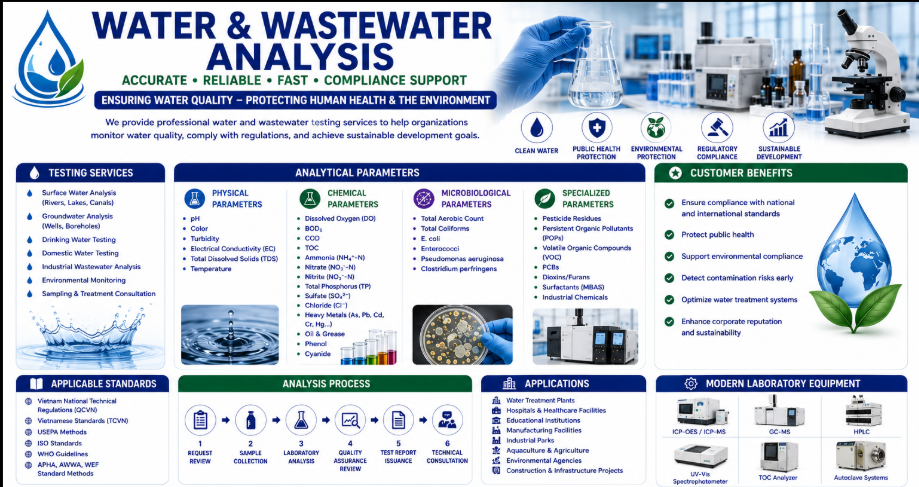
The Industrial Hydrological Forensics Reference Frame: Effluent discharge streams act as an unalterable logbook, exposing every chemical secret on the manufacturing floor. We analyze effluent dynamics through molecular quantification parameters: from Biochemical and Chemical Oxygen Demand (BOD5/COD) and Total Organic Carbon (TOC), to isolating narrow-band trace toxins via Flame Atomic Absorption Spectroscopy (AAS). An imbalance in alkalinity or a sudden accumulation of ammonium-base ions (NH4+) will immediately deactivate activated sludge biomass, collapsing the entire biological treatment architecture within a few discharge cycles.
For Chief Operating Officers (COOs) and EHS Optimization Specialists, commanding hydrological analytical data represents the ultimate technocratic capacity to control environmental tolerances at the source, eliminate structural OPEX waste, and build absolute legal shields before audit bodies.
1. Dynamic Bottlenecks: Kinetic Shock Mechanisms Quietly Crippling Wastewater Infrastructure
Through physical system failure forensics and structural optimizations of large-scale industrial wastewater plants, we have isolated 3 technical blind spots that frequently trigger catastrophic environmental crises:
- Kinetic Chemical Shock Loading: Production line purging cycles or boiler blowdowns release sudden effluent streams containing extreme acidic/alkaline concentrations or high Total Dissolved Solids (TDS) that overwhelm equalization tanks. This dynamic surge sweeps through the aeration tanks, killing the biological micelle matrix and causing output pollution indicators to skyrocket past parts-per-million (ppm) limits.
- Physical Membrane Fouling and Structural Layer Scaling: Within premium closed-loop recycling architectures (utilizing MBR and RO membrane sequences), a total lack of real-time analytical data regarding the Langelier Saturation Index (LSI) and Silica (SiO2) concentration leads to thick mineral scale crystallization across filter pores. This spikes pump operating pressures, drops permeate fluxes, and destroys expensive membrane modules prematurely.
- Heavy Metal Slippage via pH Setpoint Shifts: Effluent from metal cleaning, anodizing, or circuit board etching processes carries Chromium-6 (Cr6+), Copper (Cu), and Lead (Pb) ions. If the coagulation-flocculation reactions are not fine-tuned to their optimized pH points and cross-checked via spectroscopic trace metrics, the toxic flocs fail to settle, escaping past clarifiers directly into public water basins.
The consequence of these engineering bottlenecks is an immediate, mandatory factory shutdown to overhaul treatment biology, incurring massive costs to re-seed microbes, evacuate toxic sludge, and handle severe legal liabilities that fracture the global supply chain pipeline.
2. Solution Matrix: Engineering a 4-Tier Hydrological Protection Barrier via Technocratic Data
To completely command hydrological variables, our monitoring framework restructures analysis and operational workflows through 4 closed-loop technical barriers:
- Integration of Next-Gen Continuous Online IoT Monitoring: Deploying wide-dynamic-range sensor arrays at the final discharge gateway to scan pH, Temperature, COD, TSS, and Flow rates in real time, automatically triggering automated emergency shut-off valves if any metric approaches regulatory red lines.
- Analytical Physical-Chemical Characterization via Premium Spectroscopy (AAS & UV-Vis): Extracting flow-proportional composite samples for destructive validation inside ISO/IEC 17025 accredited laboratories. Utilizing Atomic Absorption Spectroscopy (AAS) to quantify trace heavy metals to parts-per-billion (ppb) accuracy, alongside UV-Vis spectrophotometers to isolate Total Nitrogen and Total Phosphorus.
- Microscopic Bio-Forensics and Sludge Biomass Diagnostics: Implementing high-resolution micro-imaging techniques to audit floc structure and identify indicator microorganism densities (such as Vorticella and Rotifers) inside aeration basins, forecasting bulking or biomass die-off risks 72 hours prior to failure to adjust dissolved oxygen (DO) levels proactively.
- Digitization of the Digital Water Technical Passport: Compiling real-time monitoring streams, analytical chemistry logs, and water quality credentials into a unified, digital technical passport, delivering unassailable scientific proof during green audits executed by global enterprise clients.
3. Hydrological Economics: Converting Compliance Costs into Manufacturing OPEX Surplus
Operating a wastewater facility backed by empirical chemical-physical data is not a negative administrative overhead; it is a direct financial lever to optimize factory OPEX:
| Hydrological Risk Indicators | Saturated Stream Analytics Governance | Operations Driven by Subjective Intuition |
|---|---|---|
| Chemical & Sludge Overhead (OPEX) | Cuts coagulant, caustic, and polymer costs by 18% to 30% via automated chemical dosing calibrated to empirical pollutant loading curves. | Executes blind chemical dosing based on historical habit, wasting corporate budgets and inflating hazardous sludge tonnage disposal fees. |
| Water Recycling Efficiency | Achieves internal effluent recycling rates between 65% and 85% for utility loops, cutting raw industrial intake water fees. | Flushes 100% of treated water out to sewers, remaining completely vulnerable to escalating municipal raw water utility rate brackets. |
| Electro-Mechanical Asset Depreciation | Extends electro-mechanical component lifespans twofold by eliminating pipeline galvanic corrosion and pump scaling via strict mineral saturation tracking. | Experiences chronic pump corrosion and membrane blowouts due to uncorrected pH shifts or excessive Total Suspended Solids (TSS) leakage. |
4. Experimental Roadmap: Phasing Technical Hydrological Controls from Lab Cells to Shop Floor
Our water risk management framework is integrated directly into the core operating sequence of the manufacturing facility through 4 deployment phases:
- Step 1 – Effluent Stream Mapping & Source Auditing: Isolating and auditing water quality metrics at individual manufacturing stations to bifurcate streams into heavy metal lines, high-organic loops, and greywater circuits, maximizing local pre-treatment yields.
- Step 2 – Advanced Jar-Testing and Biological Tuning: Conducting structured jar-test series on-site to pinpoint exact pH stabilization points for flocculation chemistry, while balancing Carbon:Nitrogen:Phosphorus (100:5:1) ratios to sustain peak aerobic biomass metabolism.
- Step 3 – Independent Validation via Accredited ISO 17025 Chambers: Processing output discharge cross-checks inside accredited laboratory environments to generate legal environmental compliance profiles, ensuring an operating safety margin at least 15% below regulatory ceilings.
- Step 4 – SOP Digital Locking and SCADA Automation: Digitalizing Standard Operating Procedures (SOPs), bridging laboratory analysis logs directly into automated SCADA chemical-feed arrays to neutralize human-error variables.
5. Fulfilling Tangible ESG Directives via Closed-Loop Hydrological Engineering
Mastering industrial wastewater optimization through transparent data streams serves as definitive technical proof of an enterprise’s execution of its ESG (Environmental, Social, Governance) mandates:
- The Environmental Pillar (Environment): Eliminating environmental pollutant discharge loads (COD, BOD, Heavy Metals) preserves aquatic ecosystems and biodiversity at the discharge source, while high water-recycling ratios actively protect regional groundwater reserves.
- The Social Pillar (Social): Eliminating zero-point leakage of toxins into neighboring aquifers protects the right of community populations to access safe drinking water, neutralizing local environmental friction.
- The Governance Pillar (Governance): Replacing reactive compliance filings with unalterable, automated continuous monitoring streams guarantees full alignment with domestic environmental mandates, driving up enterprise compliance valuations before global ESG investment funds.
Conclusion
Industrial water and wastewater analysis has evolved far beyond a routine environmental administrative item. It is a core technocratic competency that dictates financial margin safety, operational OPEX structures, and your legitimate right to participate in the global green supply chain.
Commanding an intelligent, data-driven water circulation architecture provides your enterprise with an unbreachable shield against legal liabilities. It optimizes resource allocation and firmly establishes your brand as a leading vendor of sustainable, world-class industrial technology on the global stage.
Contact us today to receive dedicated advice and the most suitable solution for your business!
Hotline: +84 933096426 – +84 868 591 260
Email:
Website:
Partners in Vietnam:
Contact Vietnam representative: Duc Luong Services
Hotline: +84 933096426 – +84 868 591 260
Email: ducluongservices@gmail.com
Website:
STC VN Co., Ltd.
Hotline: +84 933096426 – +84 868 591 260
Email: info@staunchlyservices.com.vn
Website: https://stauchlyservices.com.vn



No responses yet