Global buyers across manufacturing, textiles, electronics, chemicals, and logistics increasingly require their suppliers to complete an EcoVadis assessment before approving or renewing a purchasing contract. For companies unfamiliar with the process, this guide explains what EcoVadis is, how the 2026 methodology works, and what suppliers need to prepare to score competitively — and how our consulting team can support you end to end.
What Is EcoVadis?
EcoVadis is a global business sustainability rating platform, used by more than 150,000 companies across 220 industries and 180 countries. Rather than issuing a pass/fail management-system certificate like ISO bodies do, EcoVadis produces a Scorecard (0–100 points) that reflects the maturity of a company’s sustainability management system, based on documentation and evidence the company itself submits.
Multinational buyers — including many companies in consumer goods, chemicals, electronics, and apparel — use EcoVadis scores to screen, approve, and monitor suppliers as part of their sustainable procurement programs. A score below a buyer’s minimum threshold (commonly 45/100) can directly affect whether a Vietnamese supplier is approved to continue business with that customer.
The Assessment Structure: 4 Themes, 21 Criteria
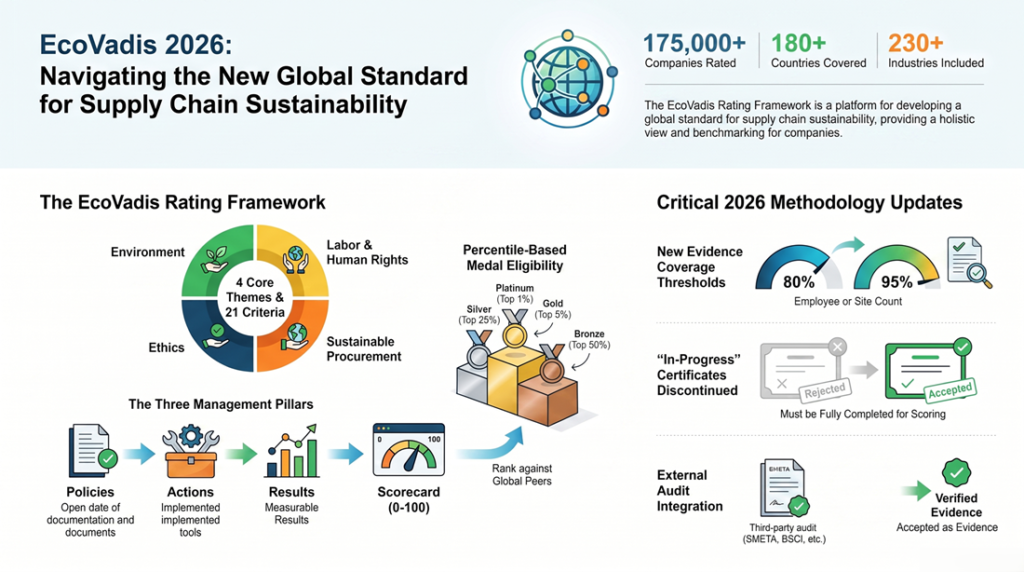
EcoVadis customizes its questionnaire for each company based on industry (ISIC code), size, and location, but every assessment covers four core themes across 21 sustainability criteria:
- Environment — energy management, GHG emissions, water, waste, biodiversity
- Labor & Human Rights — working conditions, health and safety, diversity, social dialogue
- Ethics — anti-corruption, fair business practices, information management
- Sustainable Procurement — how a company manages ESG risk in its own supply chain
These map onto three management pillars — Policies, Actions, and Results — broken into seven management indicators. Actions (Measures, Certifications, Coverage) typically carry the highest scoring weight, followed by Results (Reporting, 360° Watch), with Policies weighted somewhat lower. In practice, this means documented policy alone is rarely enough — assessors are looking for evidence of real-world implementation and measurable outcomes.
Scoring and Medals in 2026
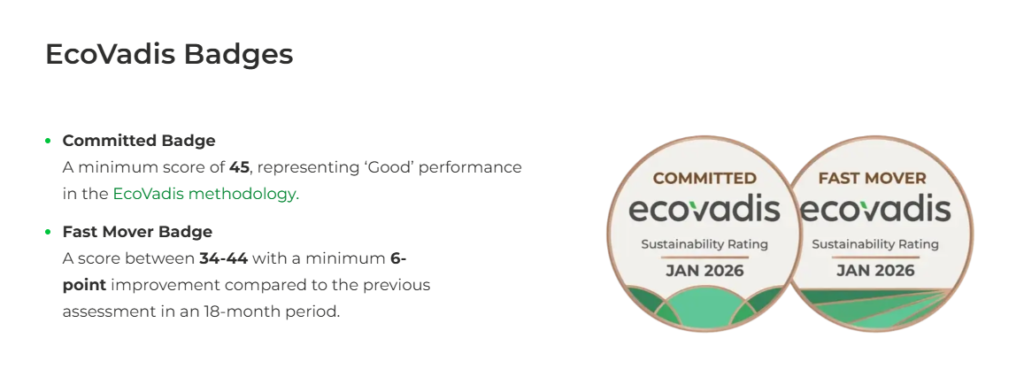
Scores range from 0 to 100. A score of 45 or above is generally considered “Good” and meets most buyers’ baseline requirement, while 65+ places a company in the “Advanced” performance band and opens eligibility for Bronze, Silver, Gold, or Platinum medals.
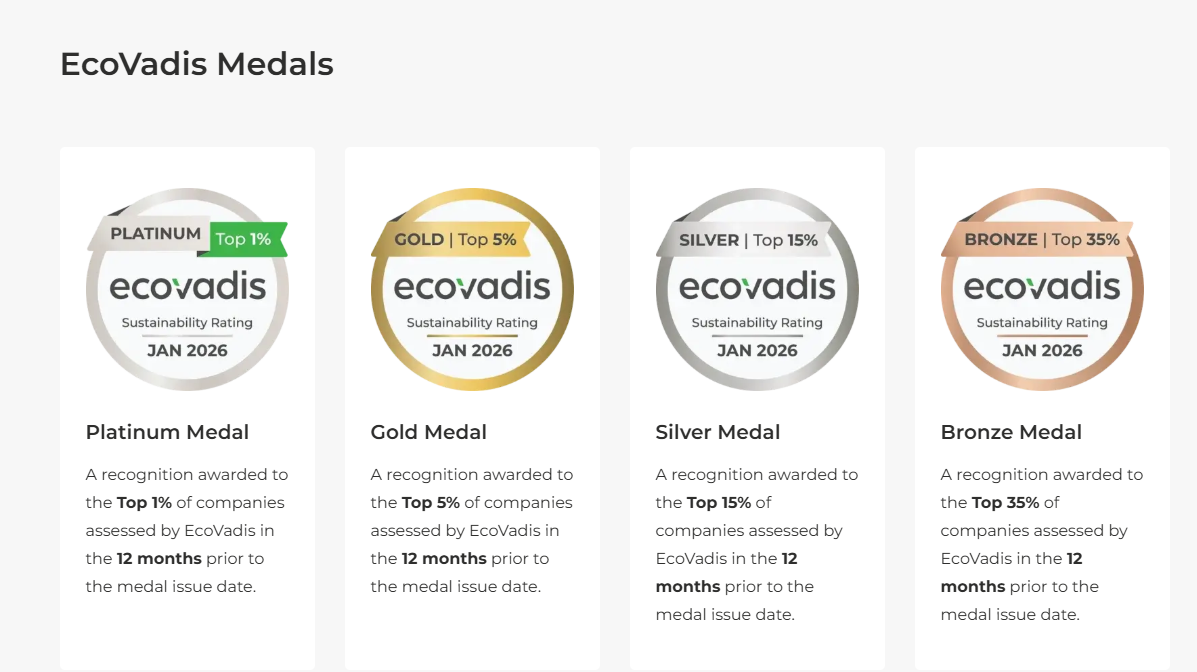
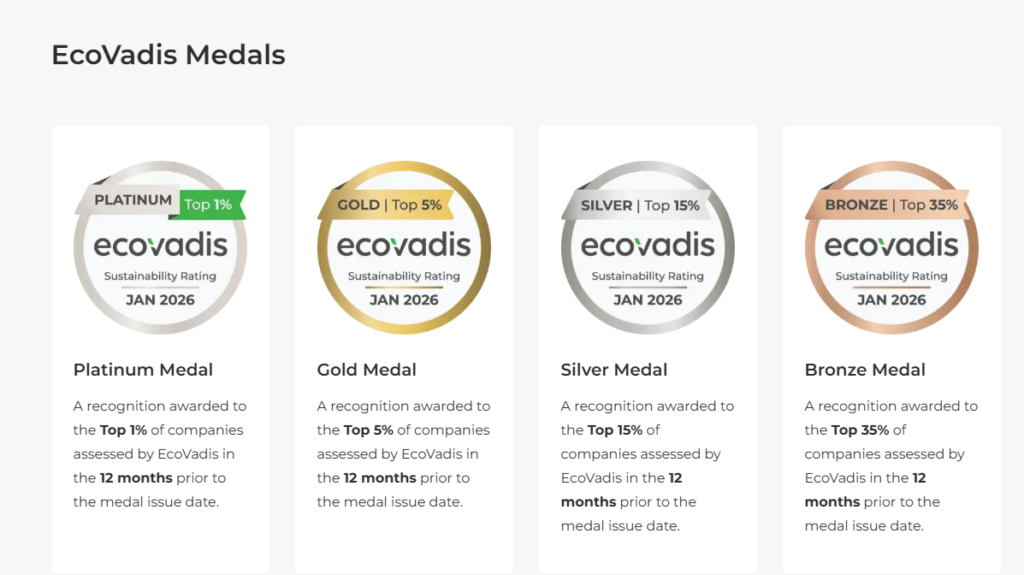
Since scorecards published from 2025 onward, medal eligibility is determined primarily by a company’s percentile ranking against all companies rated globally over the trailing 12 months — not a fixed score threshold. Gold, for example, is typically reserved for roughly the top 5% of companies assessed worldwide. This makes the competitive bar continuously rise as more companies improve their own scores. To qualify for any medal, no individual theme score can fall below 30, and companies with unresolved severe 360° Watch findings within the past 5–7 years are excluded from medal eligibility.
What Changed in the 2026 Methodology
Between April and May 2026, EcoVadis introduced several methodology updates, largely aligned with the EU’s ESG Rating Regulation transparency requirements:
- Coverage calculation: From April 15, 2026, the 80% and 95% coverage thresholds for policies and reporting indicators must be demonstrated using employee count or site count only — revenue-based coverage evidence is no longer accepted.
- External audit reports now count as evidence: Reports such as SMETA, amfori BSCI, TfS, or qualified customer audits can now support Policy, Action, and Reporting indicators.
- “In-progress” certificates no longer accepted: ISO 14001, ISO 45001, ISO 27001, and similar certificates marked as in-progress no longer receive scoring credit.
- GRI “with reference” reporting can now score up to 75 points in the Reporting indicator, provided other quality criteria are met.
- More diagnostic Improvement Area feedback on scorecards published after April 15, 2026, to help companies prioritize corrective actions.
Why Suppliers Often Score Lower Than Expected
Based on hands-on consulting work with manufacturing and export companies, the most common gaps we see are:
- Undocumented or informal policies — practices exist but are not formalized with dates, ownership, and approval signatures
- Lack of quantitative reporting — no time-series data on emissions, energy use, or safety incidents
- Weak sustainable procurement management — this is consistently the lowest-scoring theme, especially for OEM and contract manufacturers who have not yet built a supplier code of conduct or supplier assessment process
- Unmanaged 360° Watch exposure — negative media or regulatory mentions that are never formally addressed with corrective action evidence
How We Support Your EcoVadis Journey
Our consulting team provides end-to-end EcoVadis support for suppliers and manufacturers:
- Gap analysis against the current EcoVadis questionnaire and methodology version
- Policy and procedure development structured to meet EcoVadis evidence requirements
- Internal training for ESG and procurement teams on questionnaire strategy and documentation
- Pre-submission review to catch coverage, validity, and scope issues before submission
- Post-assessment corrective action planning (CAP) to build toward Bronze, Silver, or Gold in the next assessment cycle
Frequently Asked Questions
Is EcoVadis the same as an ISO certification? No. EcoVadis is a third-party rating, not a management-system certification. However, ISO certifications such as ISO 14001, ISO 45001, and ISO 37001 serve as strong supporting evidence within an EcoVadis submission.
Who pays for the EcoVadis assessment? The rated company (typically the supplier) pays the assessment fee, usually because it was requested by a customer or buyer.
How long is an EcoVadis scorecard valid? Scorecards are generally valid for 12 months, after which a re-assessment is required to maintain or improve the score.
Can a small or mid-sized supplier still score competitively? Yes. The questionnaire is tailored to company size, so smaller suppliers can achieve strong scores by focusing preparation on the highest-weighted theme for their industry.
Contact Our Consulting Team
ISC Global Co., Ltd.
Hotline: +84 933 096 426 – +84 868 591 260
Email: info@iscglobal.asia | van.pham@iscglobal.asia
Website: iscglobal.asia | iscglobal.edu.vn

The 2026 EcoVadis Shift: 5 Counter-Intuitive Truths Every Supplier Must Know
The New Era of Supply Chain Accountability
For global suppliers—particularly those in manufacturing powerhouses like Vietnam—the prerequisites for market access have undergone a seismic shift. In the electronics, textile, and chemical hubs of Southeast Asia, it is no longer sufficient to compete on lead times and price alone. As the EU’s Corporate Sustainability Due Diligence Directive (CSDDD) and the Corporate Sustainability Reporting Directive (CSRD) begin to bite, global buyers are demanding rigorous ESG credentials as a non-negotiable ticket to play.
In this landscape, EcoVadis has transformed. It is no longer a static “certificate” to be hung on a wall; it is a dynamic “sustainability brain”—a sophisticated intelligence platform that turns complex ESG data into trusted, comparable ratings. However, a major methodology overhaul, driven by the new EU ESG Rating Regulation, means the rules for 2026 have changed. Why is a high score from last year no longer a guarantee of a medal today? As a senior strategy consultant, I am seeing suppliers blindsided by five specific shifts in how EcoVadis now measures “good.”
1. Your Medal is a Moving Target (The Percentile Trap)
The most disruptive change in the 2026 methodology is the transition from fixed score thresholds to a 12-month trailing percentile ranking. Previously, hitting a specific number guaranteed a medal. Now, your eligibility for Bronze, Silver, Gold, or Platinum is relative to the performance of every other company rated globally over the last year.
This creates a “Red Queen” scenario: you must run just to stay in place. Even if your internal ESG performance remains stable, you could lose your medal if your global peers improve faster than you. Furthermore, EcoVadis has introduced a “30-point floor.” To qualify for any medal, you cannot score below 30 in any individual theme (Environment, Labor & Human Rights, Ethics, or Sustainable Procurement). One weak link now disqualifies the entire chain.
“Gold is typically reserved for roughly the top 5% of companies assessed worldwide.”
2. Revenue No Longer Validates Your Reach (The Coverage Pivot)
Effective April 15, 2026, EcoVadis is fundamentally changing how it calculates “Coverage.” For years, large-scale manufacturers used financial data—specifically revenue—to demonstrate that their sustainability policies covered the vast majority of their operations. This “Revenue Pivot” is officially over.
Under the new rules, policy and reporting coverage must be proven using employee count or site count only. For large manufacturers with complex, multi-site footprints, this is a significant hurdle. You can no longer rely on corporate financial weight to mask gaps in factory-level implementation.
The New Coverage Ledger:
- IN: Physical site counts and verified headcount.
- OUT: Revenue-based proportional evidence.
3. “Almost” Doesn’t Count (The Death of “In-Progress” Credits)
In the Vietnamese market, we frequently see a reliance on “informal policies”—practices that exist on the factory floor but lack the formal signatures, dates, and documentation required by international auditors. In the past, suppliers often bridged this gap by submitting evidence of “in-progress” management system certifications (such as ISO 14001 or ISO 45001) to gain partial credit.
EcoVadis has now officially stopped accepting “in-progress” certifications for scoring credit. This is a direct reality check: if the final audit isn’t closed and the certificate isn’t issued, it carries zero weight. For businesses prone to procrastination, this lack of “credit for effort” will result in a sharp, quantifiable drop in ESG ratings.
4. The 360° Watch is Your “Silent Disqualifier”
A high questionnaire score is now only half the battle. The “360° Watch” mechanism has been expanded into a massive surveillance tool, scanning over 100,000 public sources—including news media, NGOs, and regulatory bodies.
If this scan unearths negative findings, such as environmental violations or labor disputes, within the last 5 to 7 years, your company can be disqualified from medals regardless of your scorecard points. This makes proactive reputation management a technical requirement. In the 2026 landscape, a single unaddressed regulatory fine in a local jurisdiction can tank a multi-million dollar global contract.
“It’s not just about the recognition; it’s about fostering a culture of sustainability within the organization.”
5. External Audits and the 55-Document Ceiling
EcoVadis has introduced a major efficiency update: the acceptance of external sustainability audits (such as SMETA, amfori BSCI, and TfS) as valid evidence for Policy, Action, and Reporting themes. While this reduces “audit fatigue,” it is a double-edged sword. EcoVadis analysts now have direct visibility into the “major non-conformities” found in those third-party audits. If you haven’t addressed a finding in your SMETA report, it will now proactively lower your EcoVadis score.
To navigate this, suppliers must be more strategic than ever because EcoVadis has imposed a strict 55-document limit per assessment. You cannot simply “data dump”; every upload must be high-impact.
Pro-Consultant Tips for 2026:
- The GRI Bonus: Effective April 14, 2026, sustainability reports that are “GRI with reference” can now score up to 75 points—a significant jump that rewards suppliers for moving toward standardized reporting.
- Regulatory Disclosures: Look for the new “Major.Minor” versioning on your scorecard. This is part of the new “Regulatory Disclosures” system required by the EU, ensuring your score is traceable to the specific methodology version used during your audit.
Beyond the Scorecard
The 2026 EcoVadis ecosystem is no longer about checking boxes; it is about demonstrating a functional management system that can withstand global scrutiny. While the bar is higher, the rewards are tangible: on average, suppliers see a 15% improvement in their performance after their first assessment cycle as they adopt these more rigorous standards.
As we move toward a world of “Major.Minor” versioning and absolute transparency, the question for every supplier is no longer “How do we get the medal?” but rather: “Is our ESG documentation built for mere compliance, or is it a strategic asset designed for competitive advantage?” In 2026, the market will tell the difference.
Contact us to download the bilingual English-Vietnamese PDF standard: from only $50
On the path toward integration and export, correctly understanding and applying international standards is essential. Yet language and technical terminology often pose real barriers. We are pleased to introduce our bilingual (English – Vietnamese) standards documentation service, translated by our own team of certification consultants.
What We Provide
• A clause-by-clause bilingual comparison, easy to consult and file.
• Professional Vietnamese translation in correct technical terminology, ready to use.
• Interpretation notes and application guidance from hands-on experts.
• Fast delivery in editable, easy-to-store PDF/Word format.
Standards Covered
ISO management systems (9001, 14001, 45001, 37001); sustainability certifications (ISCC, FSC, VFCS/PEFC); textiles and recycled materials (GRS, OCS, OEKO-TEX); social responsibility and ESG (SMETA, EcoVadis, Fairtrade), and many other industry standards upon request.
Why Choose Us
Our documents are translated by professionals who directly consult on and audit certifications, so the translation is accurate not only in language but also in real-world application — saving you time and reducing errors when preparing documentation.
Pricing
From only USD 50 per document, depending on length and complexity. Please send us the standard name to receive a free, accurate quotation.
How to Order
1. Contact us with the name of the standard you need.
2. Receive a quotation and delivery time.
3. Make payment and receive your document by email.
Payment
Bank transfer via QR code (provided with the quotation), or via PayPal: ducluongservices@gmail.com.
We look forward to accompanying you on your certification journey.
Best regards,
CONTACT INFORMATION
Hotline: +84 933096426 – +84 868 591 260
Email:
Website:
No responses yet