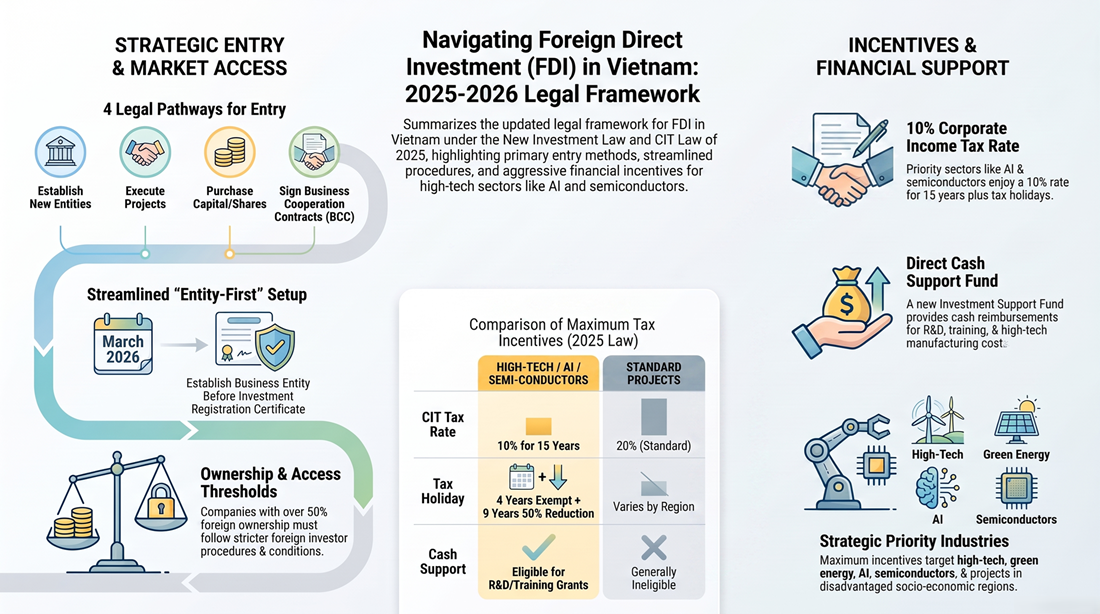
Vietnam is currently performing a mid-air engine swap on its Foreign Direct Investment (FDI) machinery. While the nation remains a top-tier destination for global capital, the Law on Investment 2025—effective March 1, 2026—rewrites the rules of engagement for venture tài chính and tech executives alike. Strategic investors must now look beyond traditional tax holidays to navigate a landscape defined by regulatory arbitrage, direct fiscal grants, and intensified security vetting.
The “Register First, Permission Later” Revolution
Article 19 of the Law on Investment 2025 and Decree 96/2026/NĐ-CP introduce a revolutionary flexibility: the ability to establish an enterprise (ERC) before obtaining an Investment Registration Certificate (IRC). This “register first” approach significantly reduces market-entry friction, allowing entities to plant their corporate flag before the heavy lifting of project licensing begins. However, this is a “ticking clock” maneuver; investors have a strict 12-month window to complete the IRC process or face mandatory project termination.
For those operating within specialized Industrial Zones, Article 28 of the Law on Investment 2025 offers a “Special Investment Procedure” designed to further accelerate speed-to-market through streamlined registration. This new sequence is a double-edged sword that rewards pre-emptive compliance with market-entry conditions. As the source notes: “Kể từ 01/3/2026, nhà đầu tư nước ngoài được thành lập tổ chức kinh tế thực hiện dự án đầu tư trước, sau đó mới thực hiện thủ tục cấp/điều chỉnh Giấy chứng nhận đăng ký đầu tư.”
Cash is the New Tax Break: The Rise of Direct Support
Vietnam is pivoting from passive tax exemptions toward active fiscal support through the Investment Support Fund established by Decree 182/2024. These direct cash grants—covering up to 50% of training costs and 30% of R&D—serve as “fiscal neutralizers” against the Qualified Domestic Minimum Top-up Tax (QDMTT). By providing cash rather than tax breaks, Vietnam effectively sidesteps the neutralizing impact of the Global Minimum Tax (Resolution 107/2023/QH15) for multinational giants.
However, this “cash-is-king” model is primarily reserved for “Mega-Projects” with capital exceeding 6,000 billion VND or annual revenues above 10,000 billion VND. Smaller semiconductor or AI projects are generally excluded from this fund unless they meet specific IC design niches with high-value engineering headcounts. For those who qualify, the support is substantial, including up to a 3% grant for manufacturing semiconductor products and 10% for fixed asset investments.
The “50% Threshold”: A New Line in the Sand
The distinction between “domestic” and “foreign” enterprises has been sharpened around a precise 50% ownership threshold. Under the 2025 regulations, a foreign-invested enterprise is treated as a “foreign investor” for procedural purposes only if foreign entities hold more than 50% of the charter capital. This “magic number” allows joint ventures with 50% or less foreign ownership to bypass the stricter market-access hurdles and Economic Needs Tests (ENT) reserved for foreign-majority firms.
Consultants must remain wary of the “other cases as prescribed by law” clause mentioned in Section 1.6(b), which serves as a catch-all for regulatory oversight. For international entrepreneurs, hitting exactly 50% or lower can be a strategic tool for faster scaling, especially when entering restricted sectors like distribution or logistics. This threshold is now the central pivot point for corporate structuring and acquisition strategies in the 2026 landscape.
The Red Carpet Meets the Security Screen
While Vietnam is aggressively courting high-tech investment, it is simultaneously implementing more rigorous security vetting for strategic industries. Projects in the semiconductor and electronic component sectors now face intensified scrutiny when located in sensitive “trigger points” such as border provinces or strategic northern regions. Proximity to the border is now considered a potential regulatory liability, particularly for investors from specific origins.
According to the 2026 vetting protocols, projects in these sensitive locations will require a special security appraisal involving the Ministry of Public Security and the Ministry of National Defense. This ensures that the push for high-value technology does not compromise national defense or internal security. Investors must now balance the logistical benefits of strategic industrial zones against the reality of more intensive background checks and potential project delays.
The “Hyper-Incentive” Sweet Spot: Semiconductors and AI
The Corporate Income Tax (CIT) Law 2025 (Law 67/2025/QH15) introduces a “Hyper-Incentive” formula specifically for the high-tech value chain. This “10-15-4-9” model offers a 10% tax rate for 15 years, with 4 years of total exemption and 9 years of 50% reduction. It is no longer a broad-based manufacturing incentive but is instead laser-focused on “New Projects” in chip design, packaging, testing, and AI data centers.
This vertical focus is meant to anchor Vietnam as a high-value technology partner rather than just a low-cost assembly hub. Success in claiming these incentives requires a sophisticated understanding of how to document R&D intensity and maintain the “high-tech” status throughout the project lifecycle. In an era of de-risking and supply chain diversification, this targeted fiscal regime represents Vietnam’s strongest bid for technological leadership.
Navigating the New Frontier
Vietnam’s evolution from a low-cost manufacturing hub to a high-value technology partner is officially encoded in the 2026 regulatory framework. The transition toward direct cash grants, security-conscious vetting, and streamlined registration marks a new era for international capital. Success in this new environment will require a sophisticated understanding of how these rules intersect.
In an era where cash grants and security screenings are the new normal, is your investment structure ready for the 2026 deadline?
The 2026 FDI Revolution: 5 Game-Changing Shifts in Vietnam’s Investment Landscape
For decades, international investors viewed Vietnam as a land of immense potential tethered to heavy bureaucratic anchors. Market entry often meant a “wait-and-see” game of paperwork before a single brick could be laid. However, we are entering a pivotal new era. With the full implementation of the 2025 Law on Investment and the 2026 regulatory framework, Vietnam is fundamentally flipping its procedural script.
The nation is transitioning from a passive recipient of low-cost manufacturing to an aggressive, strategic seeker of “High-Tech Sovereignty.” By streamlining entry for strategic entities and replacing traditional tax holidays with direct cash infusions, Vietnam is signaling to the world’s technology giants that the barriers of the past are being dismantled. For the savvy investor, understanding these five structural shifts is the new baseline for 2026 market strategy.
Takeaway 1: The “Establish First, License Later” Procedural Flip
Historically, the Investment Registration Certificate (IRC) was the bottleneck that halted progress before a company could even exist legally. Starting March 1, 2026, this sequence undergoes a revolutionary change. Under Article 72 of Decree 96/2026, foreign investors now have a strategic choice: the traditional path or the new “ERC-first” model.
This model allows investors to obtain their Enterprise Registration Certificate (ERC) and establish their legal entity before the IRC is finalized, provided they commit to meeting market access conditions. The investor then has a 12-month window to complete the IRC process. Furthermore, for projects located in High-Tech Zones or Industrial Parks, Article 28 of the 2025 Law on Investment introduces a “Special Investment Procedure” (Thủ tục đầu tư đặc biệt)—a registration-based, fast-track mechanism designed to maximize speed-to-market for high-value projects.
“Kể từ 01/3/2026, nhà đầu tư nước ngoài được thành lập tổ chức kinh tế thực hiện dự án đầu tư trước, sau đó mới thực hiện thủ tục cấp/điều chỉnh Giấy chứng nhận đăng ký đầu tư (khoản 2 Điều 19 Luật Đầu tư 2025).”
Takeaway 2: Direct Cash is the New Tax Break (The Investment Support Fund)
In response to global tax shifts, Vietnam is moving beyond traditional tax incentives. Under Decree 182/2024, the government has established the Investment Support Fund. This is a strategic pivot designed to provide direct monetary reimbursements for specific costs, ensuring that the benefit is not “taxed away” by the investor’s home jurisdiction.
The specific levels of annual support available to high-tech, semiconductor, and AI sectors include:
- Training and Human Resource Development: Support for up to 50% of costs.
- Research and Development (R&D): Support for up to 30% of costs.
- Social Infrastructure (Housing/Healthcare/Education): Support for up to 25% of costs.
- Fixed Asset Investment: Support for up to 10% of costs.
- High-tech Product Manufacturing: Support for up to 3% of costs.
- Initial R&D Center Investment: Direct support for up to 50% of initial investment costs.
Crucially, these cash supports are not included in the corporate income tax (CIT) calculation, making them a pure “neutralizer” for the pressures of the Global Minimum Tax.
Takeaway 3: The “Golden Ticket” Sectors and the Industrial Park Warning
Vietnam has identified Semiconductors (design, packaging, and testing) and Artificial Intelligence as its “Golden Ticket” industries. These fields are eligible for the highest incentive level (Mức ưu đãi cao nhất).
However, a critical “fine print” shift has occurred: Location in an Industrial Park (IP) no longer guarantees tax incentives. Under the 2025 Law on CIT, projects in IPs have been removed from the default incentive list. Incentives are now strictly tied to the specific sector or to projects located in socio-economically disadvantaged areas.
| Industry (Chip/AI) | Maximum Tax Incentives | Location Requirements |
| Preferential CIT Rate | 10% for 15 years | High-tech Zones, Economic Zones, or Specialized Digital Tech Zones |
| Tax Exemption Period | 4 years (from first taxable income) | Must meet High-Tech Law criteria or R&D thresholds |
| Tax Reduction Period | 50% reduction for the following 9 years | Strict R&D and local workforce commitments |
Takeaway 4: Security Scrutiny for Strategic and “Sensitive” Projects
While the door is opening wider for technology, it is closing tighter on projects that intersect with national security. The 2026 framework mandates a formal Security Appraisal (Thẩm định an ninh).
- Strategic Location: Projects in border provinces, coastal regions, or areas adjacent to defense installations—particularly in Northern Vietnam—will face heightened scrutiny. Geopolitical considerations are now a formal part of the approval process.
- Security Appraisal Authority: For investors from certain regions (notably projects involving Chinese capital in “dual-use” or strategic technologies), the government will seek formal appraisal opinions from the Ministry of Public Security and the Ministry of National Defense.
Legal consultants must now account for this appraisal timeline, as it can significantly impact the “Special Investment Procedure” or general licensing speeds for sensitive sectors.
Takeaway 5: The Global Minimum Tax “Neutralizer” (QDMTT)
With the implementation of the Qualified Domestic Minimum Top-up Tax (QDMTT) under Resolution 107/2023, Vietnam’s traditional low-tax strategy is being “neutralized” for large Multinational Corporations (MNCs) with consolidated revenues exceeding 750 million EUR. If the effective tax rate in Vietnam falls below 15%, the difference is captured by the QDMTT or the home country.
To counter this, Vietnam is using the Investment Support Fund as its primary strategic tool. By shifting the benefit from a lower tax rate to direct cash reimbursement for R&D, social infrastructure, and equipment, Vietnam ensures that the corporation receives financial value that does not lower their Effective Tax Rate (ETR) below the 15% threshold. This allows the value to remain with the corporation rather than being reclaimed by foreign tax authorities. Strategists must now think “beyond the tax code” and focus on CAPEX and OPEX offsets provided by the Fund.
A Forward-Looking Summary
The 2026 investment landscape reveals a Vietnam that is becoming more selective, more strategic, and far more supportive of high-value technology. By flipping the procedural order of business establishment and moving toward a cash-based support system, the government is modernizing its approach to compete in a world governed by the Global Minimum Tax.
As Vietnam pivots from passive tax breaks to direct cash support and high-tech sovereignty, is your investment strategy ready for the 2026 shift?
Contact us to download the bilingual English-Vietnamese PDF standard: from only $50
On the path toward integration and export, correctly understanding and applying international standards is essential. Yet language and technical terminology often pose real barriers. We are pleased to introduce our bilingual (English – Vietnamese) standards documentation service, translated by our own team of certification consultants.
What We Provide
• A clause-by-clause bilingual comparison, easy to consult and file.
• Professional Vietnamese translation in correct technical terminology, ready to use.
• Interpretation notes and application guidance from hands-on experts.
• Fast delivery in editable, easy-to-store PDF/Word format.
Standards Covered
ISO management systems (9001, 14001, 45001, 37001); sustainability certifications (ISCC, FSC, VFCS/PEFC); textiles and recycled materials (GRS, OCS, OEKO-TEX); social responsibility and ESG (SMETA, EcoVadis, Fairtrade), and many other industry standards upon request.
Why Choose Us
Our documents are translated by professionals who directly consult on and audit certifications, so the translation is accurate not only in language but also in real-world application — saving you time and reducing errors when preparing documentation.
Pricing
From only USD 50 per document, depending on length and complexity. Please send us the standard name to receive a free, accurate quotation.
How to Order
1. Contact us with the name of the standard you need.
2. Receive a quotation and delivery time.
3. Make payment and receive your document by email.
Payment
Bank transfer via QR code (provided with the quotation), or via PayPal: ducluongservices@gmail.com.
We look forward to accompanying you on your certification journey.
Best regards,
CONTACT INFORMATION
Hotline: +84 933096426 – +84 868 591 260
Email:
Website:
No responses yet