
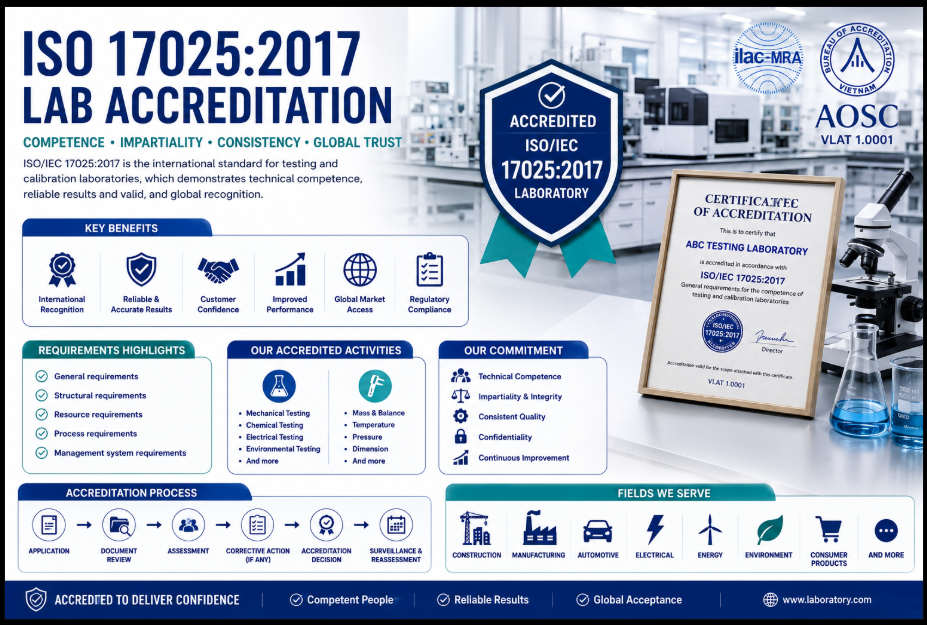
If your executive board, laboratory management cells, and compliance control department still perceive the ISO/IEC 17025 standard system as a mere administrative dossier, or a series of static templates established to display an accreditation certificate on the wall to satisfy clients, your enterprise is operating a data center over a legal and financial time bomb. In the era of technocratic economics and narrow-band technical protectionism, international inspection bodies, intellectual property courts, and Tier-1 corporations do not accept analytical results based on faith or brand reputation; they strip down your competence through the matrix of metrological traceability (Traceability), mathematical algorithms evaluating measurement uncertainty (Uncertainty), and rigid risk barriers controlling data objectivity.
The legitimacy of a Test Report (Test Report) or a Calibration Certificate (Calibration Certificate) tolerates zero behavioral margins. A single fractured link discovered within the metrological traceability chain, an operator whose empirical technical competence has not been quantified, or a Laboratory Information Management System (LIMS) revealing traces of data manipulation (Data Tampering) is enough to instantly declare your laboratory’s entire experimental data legally null and void. The cascading consequence is the immediate collapse of the supply chain, freight stranded at international borders, and multi-million dollar corporate liabilities for property damage.
The Clinical Laboratory Competence Evaluation Reference Frame: We do not operate laboratories through superficial administrative procedures. The core of enforcing ISO/IEC 17025 rests on the technocratic management of every variable capable of impacting the integrity of measurement results. This architecture demands absolute operational command from macro-systemic governance to deep empirical mathematical tools: from constructing narrow-band uncertainty budgets according to GUM guidelines, executing comprehensive method validation and verification (Method Validation/Verification) to isolate background matrix interferences, down to running proficiency testing schemes (PT/ILC) to prove inter-laboratory precision boundaries. A single micro-climatic deviation in laboratory environmental controls is enough to break measurement repeatability (Repeatability), transforming your entire analytical output into worthless technological noise.
For Laboratory Directors, Quality Managers (QMR), and Lead Metrology Engineers, mastering this ISO/IEC 17025 blueprint represents the ultimate legal armor, transforming the laboratory into a sharp technocratic weapon to dictate accuracy across technical disputes and insure global product circulation rights.
1. Systemic Bottlenecks: Competence Degradation and Data Contamination Kinetics Silently Demolishing Laboratories
Through metrological systems forensic audits (Metrological Systems Forensic Audit) and experimental data discrepancy interventions, we have isolated 3 structural blind spots that routinely fracture laboratory compliance margins:
- Metrological Traceability Breakage and Spontaneous Standard Drift: Occurs when primary reference standards and laboratory measurement instruments are calibrated by unaccredited facilities, or when the traceability chain back to national/international primary standards (SI) is fractured. This introduces hidden systematic errors, driving the laboratory to continuously output corrupted data that internal quality controls fail to detect.
- Method Blindness and Deficient Empirical Validation Frameworks: Failures triggered when a laboratory deploys a standard testing method (such as ASTM, ISO, AOAC) or an in-house procedure without executing rigorous method validation (Validation) or verification (Verification) on actual sample matrices. The absence of quantified limits of detection (LOD), limits of quantitation (LOQ), matrix recovery factors (Recovery), and linear ranges scale leads to catastrophic analytical failure when encountering complex background interferences.
- Data Integrity Collapse and Behavioral Data Manipulation: Occurs when raw data (Raw Data) is left unmanaged at the exact point of generation, characterized by manual logging without an automated audit trail (Audit Trail) or loose user-access permissions within laboratory software. This flaw allows technicians to selectively discard anomalous data points (Outliers) based on subjective preference to beautify reports, directly destroying objectivity and exposing the organization to fatal legal liabilities.
The consequence of loose ISO/IEC 17025 asset governance is the immediate emergency suspension of accreditation credentials, total rejection of experimental data across international export markets, and permanent blacklisting from global validation networks.
2. Solution Matrix: Locking Compliance Tolerances via 4-Tier Technocratic Quality Barriers
To completely eliminate systemic risk variables and ensure the absolute integrity of every decimal place on a test report, our ISO/IEC 17025 framework enforces 4 closed-loop technical checkpoints:
- Reference Asset Standardization and Absolute Metrological Traceability Validation: Mandating rigorous calibration schedules for 100% of measurement hardware impacting analytical results through Tier-1 ISO/IEC 17025 accredited calibration labs. Constructing an un-broken traceability map back to the SI unit system while strictly enforcing a Test Uncertainty Ratio (TUR≥4:1) to wipe out measurement blind spots.
- Empirical Method Validation and GUM Uncertainty Budget Audits: Executing multi-variable experimental testing blocks to quantify precision (Precision), trueness (Trueness), and analytical sensitivity across specific matrices. Simultaneously, developing mathematical models to isolate all component error sources according to GUM methodologies, outputting reports with expanded measurement uncertainty (U) at a 95% confidence interval.
- Data Protection Barriers and Automated Audit Trail Digitalization (LIMS): Implementing unified Laboratory Information Management Systems (LIMS) compliant with 21 CFR Part 11 mandates to automate direct data acquisition from analytical instruments (chromatography systems, universal testing machines, automated titrators). Locking data integrity via unalterable automated audit trails, completely removing manual human interference from raw data fields.
- Inter-Laboratory Capability Verification and Proficiency Testing Enforcement: Mandating continuous participation in international Proficiency Testing (Proficiency Testing) and Interlaboratory Comparison (Interlaboratory Comparison) schemes. Utilizing the standardized Z-score parameter (∣Z∣≤2) as the ultimate metric to validate laboratory testing accuracy before global technical tribunals.
3. Performance Metrics: Converting System Compliance Margins into Operating Capital Surplus (OPEX Optimization)
Operating an testing infrastructure backed by technocratic governance and empirical mathematics is a high-return financial strategy to protect corporate cash flow and eliminate downstream product liabilities:
| Operational Risk Indicators | Saturated Technocratic Laboratory Governance (ISO/IEC 17025) | Passive Laboratory Operations Reliant on Nominal Paper Portfolios |
|---|---|---|
| Global Data Acceptance Velocity | Secures a 100% mutual recognition rate worldwide under the ILAC-MRA accord. Tested once, cleared across all premier international customs zones. | Analytical data is flatly rejected by foreign buyers, forcing the enterprise to spend thousands of dollars on third-party verification labs to re-test cargo from scratch. |
| Data Defect Rates and Batch Rework (OPEX Loss) | Employs rigid internal quality controls via Shewhart charts to intercept instrument drift early, dropping data variance rates below 0.01%. | Suffers from border-line measurement errors (False Accept/False Reject), releasing out-of-specification batches or rejecting conforming production lots. |
| B2B Procurement Value and Bid Superiority | Transforms the laboratory into an elite nuclear verification center capable of commercial testing, opening new high-margin revenue streams. | Functions purely as a low-credibility internal cost center; possesses zero technical leverage when resolving raw material quality disputes with vendors. |
4. Technical Action Roadmap: Phasing Technocratic ISO/IEC 17025 Architecture from Core Structures to Accreditation
Our laboratory competence deployment protocol is executed sequentially, embedding directly into physical engineering controls and quality management workflows:
- Step 1 – Gap Analysis and Hardware Infrastructure Assessment: Auditing the full laboratory architectural layout, cross-contamination barrier schematics, micro-climatic environmental parameters, and instrument configurations to map and seal technical vulnerability gaps.
- Step 2 – Document Matrix Standardization and Clinical Metrology Training: Constructing the full quality management framework (Quality Manual, Standard Operating Procedures, Technical Work Instructions) mapped directly to ISO/IEC 17025 clauses. Conducting advanced technical training on uncertainty budgets and precise hardware operation for testing personnel.
- Step 3 – System Flashing and Internal Blind Testing Audits: Activating all internal quality control loops, routing blind samples (Blind Samples) and Certified Reference Materials (CRM) through the workflow to map technician proficiency, followed by rigorous internal audits and management reviews to stress-test the entire ecosystem.
- Step 4 – Official Accreditation via International Signatory Bodies: Passing the on-site physical audit executed by an ILAC-MRA signatory accreditation body to finalize and publish the formal Scope of Accreditation (Scope of Accreditation), legalizing the international accreditation stamp on all outgoing Test Reports.
5. Driving Verifiable ESG Milestones via High-Fidelity Laboratory Quality Technocracy
Controlling analytical and calibration integrity through unalterable data models represents definitive proof of an enterprise’s execution of its ESG (Environmental, Social, Governance) mandates with scientific honesty:
- The Environmental Pillar (Environment): Precision in measuring chemical matrices and environmental eco-toxicity profiles allows the corporation to manage actual discharge compliance, preventing ecosystem contamination while ensuring laboratory chemical waste follows green lifecycle mandates.
- The Social Pillar (Social): Protects the end consumer through 100% accurate biosecurity and mechanical safety testing data, while enforcing strict hazardous material handling protocols to guarantee occupational health for laboratory personnel.
- The Governance Pillar (Governance): Establishes a transparent corporate governance architecture where scientific data is shielded from commercial or financial duress, building an absolute data integrity (Data Integrity) baseline across the enterprise structure.
Conclusion
ISO/IEC 17025 is no longer an optional system certificate designed to beautify a corporate marketing portfolio. It is the core technocratic competency that dictates the legal sovereignty of your data, the financial safety of your operating margins, and the scientific validity of every experimental result released into the global industrial ecosystem.
Commanding an ISO/IEC 17025 accredited facility provides your business with an internal supreme technical court. It insulates your export revenue from technical trade barriers, protects trade thặng dư, and positions your brand as an elite benchmark of absolute quality and precision on the global stage.
Contact us to download the bilingual English-Vietnamese PDF standard: from only $50
On the path toward integration and export, correctly understanding and applying international standards is essential. Yet language and technical terminology often pose real barriers. We are pleased to introduce our bilingual (English – Vietnamese) standards documentation service, translated by our own team of certification consultants.
What We Provide
• A clause-by-clause bilingual comparison, easy to consult and file.
• Professional Vietnamese translation in correct technical terminology, ready to use.
• Interpretation notes and application guidance from hands-on experts.
• Fast delivery in editable, easy-to-store PDF/Word format.
Standards Covered
ISO management systems (9001, 14001, 45001, 37001); sustainability certifications (ISCC, FSC, VFCS/PEFC); textiles and recycled materials (GRS, OCS, OEKO-TEX); social responsibility and ESG (SMETA, EcoVadis, Fairtrade), and many other industry standards upon request.
Why Choose Us
Our documents are translated by professionals who directly consult on and audit certifications, so the translation is accurate not only in language but also in real-world application — saving you time and reducing errors when preparing documentation.
Pricing
From only USD 50 per document, depending on length and complexity. Please send us the standard name to receive a free, accurate quotation.
How to Order
1. Contact us with the name of the standard you need.
2. Receive a quotation and delivery time.
3. Make payment and receive your document by email.
Payment
Bank transfer via QR code (provided with the quotation), or via PayPal: ducluongservices@gmail.com.
We look forward to accompanying you on your certification journey.
Best regards,
CONTACT INFORMATION
Hotline: +84 933096426 – +84 868 591 260
Email:
Website:


No responses yet