The Hook: Why Your U.S. Market Entry Might Be Built on a Myth
As of February 2, 2026, the regulatory landscape for entering the United States has transitioned into a “new world order.” For years, Vietnamese manufacturers have chased a phantom: the “FDA certificate.” This single misunderstanding consistently triggers catastrophic delays and results in high-value shipments being seized at the port of entry. In this post-grace-period reality, relying on outdated compliance myths isn’t just a mistake—it is a direct threat to your balance sheet.
1. The “FDA Certificate” is a Ghost
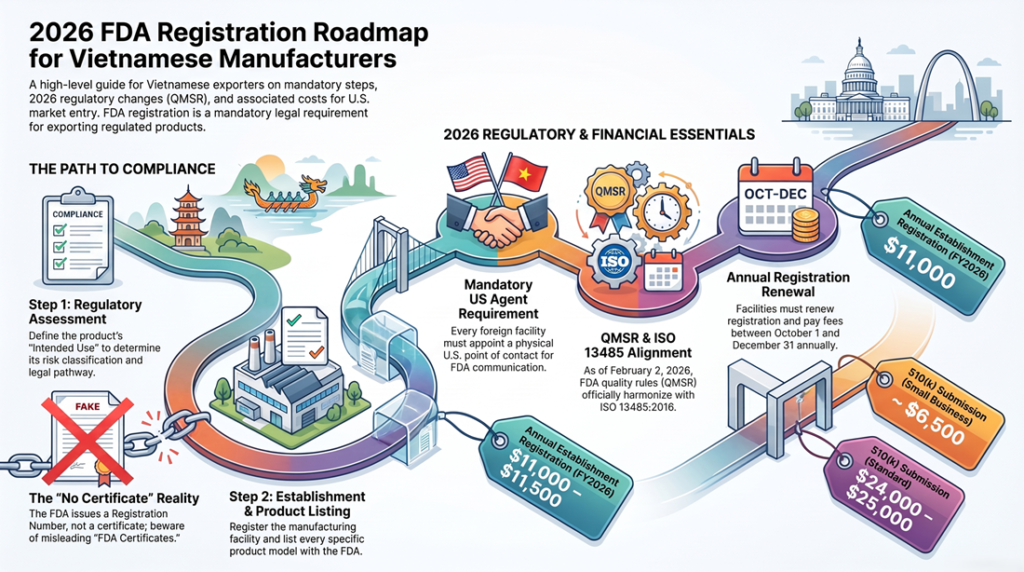
The most pervasive and expensive misconception among international executives is the belief that the FDA issues a certificate of compliance. Let be me clear: The FDA does not issue certificates.
Many third-party vendors sell “FDA Certificates” that function as nothing more than marketing props. These documents provide zero legal cover when a U.S. Customs and Border Protection (CBP) officer demands proof of entry. Legitimate compliance results in only two things: an Establishment Registration Number and a Device/Product Listing. Without both, your goods will be flagged for “Import Alert” or “Detention,” leaving your inventory rotting in a warehouse at Long Beach while your contracts dissolve.
“The FDA does not issue certificates. Any document claiming to be an official FDA certificate is a fabrication by third parties and holds no legal standing with U.S. federal authorities.”
2. Your Marketing Claims, Not Your Product, Define Your Fate
In the eyes of the FDA, your product’s technical specifications are secondary to its “Intended Use” and “Indications for Use.” This distinction is the North Star of your entire U.S. budget.
- Intended Use: The general purpose of the device (e.g., a radar sensor designed to detect motion).
- Indications for Use: The specific clinical circumstances or populations the device targets (e.g., a radar sensor marketed to detect and alert nursing staff of falls in elderly patients).
Consider the radar sensor example: Marketed for “smart home security,” it is a consumer electronic. Marketed for “elderly fall detection,” it is a regulated medical device. A single line of marketing copy can move your product from an unregulated category to a high-risk Class II device requiring a 510(k) submission. A formal Regulatory Assessment is not a suggestion—it is a mandatory strategic audit to prevent your marketing team from accidentally triggering millions of dollars in unforeseen compliance costs.
3. The 2026 QMSR Revolution: The Grace Period is Over
February 2, 2026, marked the end of the two-year transition into the most significant regulatory overhaul in thirty years. The FDA has officially retired the legacy 1996 Quality System Regulation (QSR) and replaced it with the Quality Management System Regulation (QMSR).
This is more than a name change; the QMSR incorporates the international standard ISO 13485:2016 directly into U.S. federal law. However, having an ISO 13485 certificate does not grant you an “automatic pass.” The FDA has added “supplemental requirements” that an ISO audit may ignore, specifically regarding labeling, packaging, and complaint handling. Furthermore, an ISO certificate does not exempt your Vietnamese facility from a direct, risk-based FDA inspection.
“The QMSR replaces the legacy 1996 QSR, incorporating ISO 13485:2016 by reference. This harmonization makes ISO 13485 the de facto force of law in the United States.”
4. The US Agent: Your Mandatory Legal Bridge
The FDA explicitly rejects a “virtual” presence. For foreign manufacturers, the US Agent is a mandatory legal bridge, not a paperwork formality. This individual or entity must have a physical presence in the United States and be capable of responding to high-stakes inquiries from the FDA in real-time.
A P.O. Box is legally insufficient. Your US Agent is the person the FDA calls to schedule an unannounced inspection or to discuss a safety recall. If the FDA cannot reach a physical representative at the address provided in your registration, your registration is deemed invalid, and your products are immediately barred from the U.S. market.
5. FDA Compliance is a Subscription, Not a One-Time Fee
Executives often fail to budget for the fact that FDA compliance is an annual “subscription” to the U.S. market. The most critical period of the year is the renewal window: October 1 through December 31.
If you miss this window, your registration status becomes “Invalid” on January 1st. There is no grace period. Shipments arriving in January with an invalid registration will be automatically detained. Furthermore, 510(k) submissions require a “Small Business Determination” (SBD) to access reduced rates; without this advance certification, you will be forced to pay the standard “Standard” fee, which can be nearly four times higher.
| Fee Category (FY2026) | Reference Cost (USD) | Strategic Note |
| Annual Establishment Registration | ~$11,000 – $11,500 | Must be paid annually (Oct 1 – Dec 31) to avoid detention. |
| 510(k) Submission (Small Business) | ~$6,500 | Requires a valid Small Business Determination (SBD) from the FDA. |
| US Agent Service | $800 – $2,000 / year | Market reference for mandatory physical representation. |
The Forward-Looking Wrap-Up
Winning in the U.S. market in 2026 requires Dual Expertise. Technical manufacturing skill is no longer enough. You must operate at the intersection of Regulatory Affairs—navigating the specific 510(k) or De Novo pathways—and ISO Management Systems—ensuring your facility meets the QMSR requirements that now hold the force of U.S. law.
As you finalize your 2026 export strategy, you must ask: In a landscape where ISO 13485 is now the U.S. law, is your quality system a shield for your market access, or a liability waiting to be inspected?
FDA Registration Consulting for Vietnamese Manufacturers: A Complete 2026 Guide
For Vietnamese manufacturers targeting the United States market — particularly in medical devices, electronics with health applications, food, and cosmetics — registering with the U.S. Food and Drug Administration (FDA) is a mandatory legal step, not an optional certification. Yet the process is frequently misunderstood, leading to delays, rejected shipments, or wasted budget on the wrong scope of work. This guide, prepared by the Regulatory Affairs team at ISC Global, walks through what FDA registration actually involves, the latest 2026 regulatory changes, and how to plan a realistic budget and timeline.
What the FDA Regulates, and Why It Matters for Vietnamese Exporters
The FDA is the U.S. federal agency responsible for the safety of food, drugs, medical devices, cosmetics, radiation-emitting electronic products, and certain tobacco products. Any foreign manufacturer — including those based in Vietnam — that intends to export products falling under these categories into the United States must comply with FDA registration requirements under the Federal Food, Drug, and Cosmetic Act (FD&C Act) and 21 CFR.
Non-compliance carries real commercial consequences: shipments can be detained at the U.S. port of entry (Import Alert/Detention), refused entry altogether, or the manufacturer can be placed on an FDA warning list — with lasting damage to the company’s ability to export.
The First Myth to Clear Up: The FDA Does Not Issue a “Certificate”
One of the most common misunderstandings among Vietnamese manufacturers is asking for an “FDA Certificate.” The FDA does not issue certificates. Depending on the product category, the actual compliance pathway consists of:
- Establishment Registration — registering the manufacturing facility
- Device Listing / Food Facility Registration — registering each specific product or model
- Risk classification (for medical devices: Class I, II, or III)
- A premarket submission, if required — 510(k), De Novo, or PMA for medical devices
- An appropriate quality management system — ISO 13485/QMSR for medical devices, HACCP/FSVP for food
Understanding this distinction early prevents wasted time searching for a document that does not exist, and ensures the right documentation is prepared from day one.
The FDA Registration Process, Step by Step
1. FDA Regulatory Assessment
The critical first step is determining exactly how the FDA classifies the product, based on its Intended Use and Indications for Use. This single determination shapes the entire regulatory pathway that follows — including cost, timeline, and required technical documentation.
2. FDA Establishment Registration
Mandatory for nearly all foreign facilities manufacturing, processing, packing, or labeling FDA-regulated products intended for the U.S. market. This registration must be renewed annually.
3. Device / Product Listing
Each specific product model manufactured at a registered facility must be individually listed, linked to the appropriate Product Code and Regulation Number.
4. Device Classification and Premarket Pathway
For medical devices, once Class I/II/III is determined, the manufacturer may need to file a 510(k), De Novo, or PMA submission depending on risk level and the availability of a comparable device already on the market (a “Predicate Device”).
5. Quality Management System — QMSR Now in Effect
As of February 2, 2026, the FDA’s new Quality Management System Regulation (QMSR) is fully in effect, replacing the legacy Quality System Regulation (QSR) that had remained largely unchanged since 1996. QMSR incorporates ISO 13485:2016 directly by reference into U.S. federal regulation — a historic harmonization move. Manufacturers that already hold ISO 13485 certification are in a significantly stronger position, since most of the QMSR’s structure mirrors ISO 13485 requirements. However, ISO 13485 certification does not automatically satisfy QMSR — the FDA has added supplemental requirements, and an ISO 13485 certificate does not exempt a manufacturer from direct FDA inspection.
Who Needs FDA Registration?
- Manufacturers of medical devices — from simple instruments to diagnostic and patient-monitoring devices
- Food, beverage, and dietary supplement manufacturers exporting to the U.S.
- Cosmetics manufacturers (under MoCRA requirements)
- Manufacturers of radiation-emitting electronic products
- Pharmaceutical and drug manufacturers
The US Agent Requirement — Not Optional for Foreign Facilities
Under federal law, every foreign establishment registering with the FDA must designate a US Agent — a person or entity with a physical U.S. address that serves as the official point of contact between the FDA and the foreign manufacturer. The US Agent does not assume legal responsibility for product safety or quality, but a valid US Agent designation is a mandatory condition for the registration to be accepted. Companies without a U.S. presence typically engage a third-party US Agent service.
2026 FDA Fee Reference Table (Medical Devices)
Based on the FDA’s published Medical Device User Fee rates for fiscal year FY2026 (October 1, 2025 – September 30, 2026):
| Item | Reference Cost (FY2026) |
|---|---|
| Annual Establishment Registration Fee | ~USD 11,000 – 11,500 |
| 510(k) fee — Small Business | ~USD 6,500 |
| 510(k) fee — Standard | ~USD 24,000 – 25,000 |
| De Novo fee | From ~USD 40,000 (lower for qualified small businesses) |
| PMA fee | From ~USD 100,000, excluding clinical trial costs |
| US Agent service (market reference) | USD 800 – 2,000/year |
| Technical testing (if required) | USD 3,000 – 30,000 per test (EMC, electrical safety, biocompatibility, etc.) |
FDA fees are published annually and adjusted for inflation and total revenue targets under MDUFA. Manufacturers should confirm the official rate at the time of submission, as fees change between fiscal years.
Why Work With ISC Global
- A single point of contact: ISC Global coordinates the entire process — regulatory assessment, documentation, Establishment Registration, Device Listing, and US Agent services through our U.S. partner — so clients are not left coordinating multiple vendors.
- Dual expertise in Regulatory Affairs and ISO management systems: Our team includes Lead Auditors for ISO 9001, ISO 13485, ISO 14001, ISO 45001, and ISO 37001, combined with hands-on FDA regulatory experience for electronics, optical equipment, and medical device manufacturers.
- Transparent pricing: A fixed-scope quotation with no hidden consulting fees within the agreed scope of work.
- Long-term support: 12 months of post-registration support, including guidance on Annual Registration and Device Listing updates.
Our Engagement Process
- Initial product review and preliminary FDA scope assessment
- Detailed FDA Regulatory Assessment — classification, Product Code, Regulation Number, and pathway determination
- Preparation and review of company and product documentation
- FDA Establishment Registration and Device/Product Listing
- Activation of US Agent service through our U.S. partner
- Client training on the FDA Portal and ongoing compliance requirements
- 12 months of post-registration support
Frequently Asked Questions
Does the FDA issue a certificate for compliant companies? No. The FDA does not issue certificates. Companies complete Establishment Registration and Device/Product Listing, and where required, a premarket submission (510(k)/De Novo/PMA). The result is a Registration Number, not a certificate.
How long does FDA registration take? Establishment Registration and Device Listing typically take 2–4 weeks with complete documentation. If a 510(k) is required, FDA review averages 3–9 months; De Novo, 6–12 months; PMA can take 1–3 years or longer.
Is a US Agent mandatory? Yes. It is a mandatory requirement under federal law for every foreign establishment registering with the FDA.
If we already have ISO 13485, do we still need to do anything else for FDA compliance? Yes. ISO 13485 provides a strong foundation and is now a significant advantage under the new QMSR (effective February 2, 2026), but the FDA has supplemental requirements beyond ISO 13485 and conducts independent inspections — ISO 13485 certification alone does not exempt a manufacturer from FDA oversight.
Contact Us for a Consultation
ISC Global Co., Ltd.
Hotline: +84 933 096 426 – +84 868 591 260
Email: info@iscglobal.asia | van.pham@iscglobal.asia
Website: iscglobal.asia | iscglobal.edu.vn
No responses yet