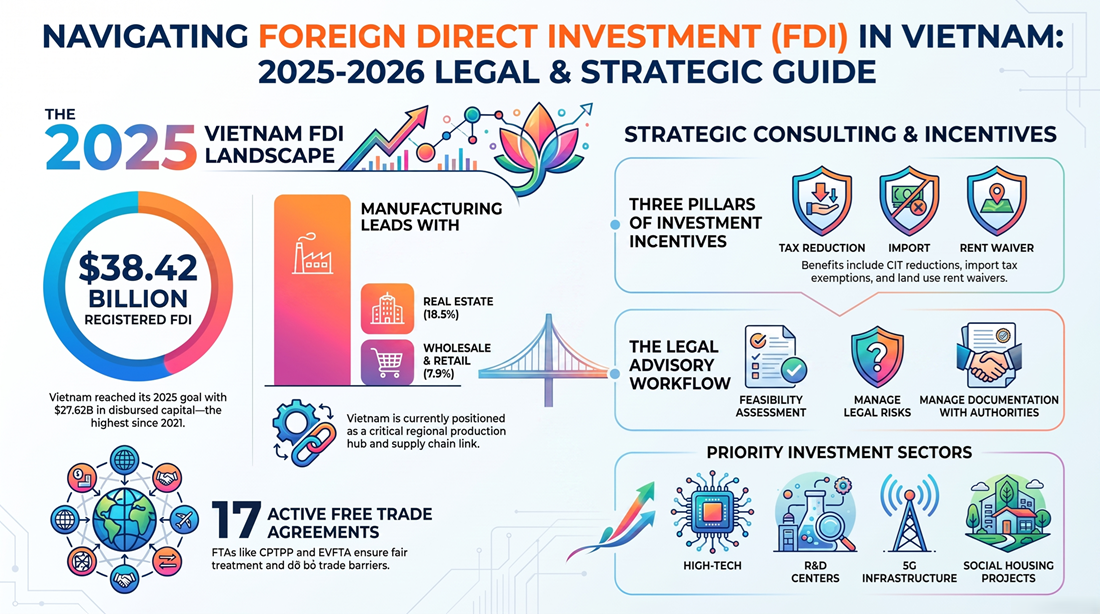
Vietnam remains one of the most attractive foreign direct investment (FDI) destinations in Southeast Asia. As of 31 December 2025, total registered FDI capital in Vietnam reached USD 38.42 billion, with disbursed FDI hitting a five-year high of USD 27.62 billion for the 2021–2025 period. Manufacturing continues to dominate registered capital (54.7%), followed by real estate (18.5%), reflecting Vietnam’s positioning as a strategic manufacturing and supply-chain hub rather than merely a low-cost production base.
Behind these impressive figures, however, lies a legal framework that is continuously evolving — most recently under the 2025 Investment Law and its implementing decrees, Decree No. 96/2026/ND-CP and Decree No. 103/2026/ND-CP. For foreign investors, navigating market-access conditions, investment registration procedures, and sector-specific compliance requirements without experienced local counsel is a costly gamble. This is where a dedicated foreign investment legal advisory partner becomes indispensable.
Why Foreign Investors Need Local Legal Advisory In Vietnam
Foreign investors entering the Vietnamese market face a distinct set of legal hurdles that domestic investors do not:
- Market access conditions (Article 8, Investment Law 2025) — not every sector permits 100% foreign ownership; conditional sectors require careful screening against the applicable negative list and Vietnam’s WTO/FTA commitments;
- Multi-tiered investment approval authority — depending on project scale and nature, approval may sit with the National Assembly, the Prime Minister, or the Provincial People’s Committee;
- Investment Registration Certificate (IRC) procedures, requiring precisely prepared documentation, with foreign-issued papers subject to consular legalization and certified translation;
- Overlapping sector-specific regulations covering land, construction, environment, labor, foreign exchange, and taxation, layered on top of Vietnam’s commitments under free trade agreements (FTAs) such as the CPTPP, EVFTA, RCEP, and UKVFTA.
A single procedural misstep can delay a project by months or even result in rejection at the in-principle approval stage — which is why leading multinationals and investment funds engage specialized legal advisors from the feasibility-study stage onward.
Scope Of Foreign Investment Legal Advisory Services At ISC Global
ISC Global, together with its partner brands STC VN Co., Ltd. (Staunchly Vietnam) and Duc Luong Services, provides end-to-end legal advisory for foreign investors, covering:
1. Pre-Investment Advisory
- Feasibility assessment of the proposed sector, location, and investment structure;
- Market-access screening under Vietnam’s conditional business lines and international commitments;
- Advisory on the optimal investment vehicle: wholly foreign-owned entity, capital contribution/share acquisition, Business Cooperation Contract (BCC), or investor-selection bidding;
- Ownership and capital structuring to align with commercial objectives and available tax incentives.
2. In-Principle Investment Approval
- Determining the correct approving authority based on project scale and nature;
- Drafting a compelling, compliant investment project proposal;
- Direct liaison with government agencies to accelerate processing timelines.
3. Investment Registration Certificate (IRC)
- Preparing and reviewing the full application dossier under Decree No. 96/2026/ND-CP;
- Managing consular legalization and certified translation of foreign corporate documents;
- Tracking application status and promptly responding to requests for clarification.
4. Company Establishment And Post-Licensing Procedures
- Business registration, tax code registration, company seal, and direct investment capital account opening;
- Obtaining sub-licenses specific to the industry (fire safety, environmental permits, food safety, work permits for foreign experts, etc.);
- Ongoing compliance advisory: investment monitoring reports, financial statements, and tax obligations.
5. Investment Incentives Advisory
- Determining eligibility for corporate income tax (CIT) incentives, import duty exemptions, and land-rent reductions;
- Handling incentive-application procedures with tax, customs, and land authorities.
6. Legal Risk Management Throughout The Project Lifecycle
- Monitoring regulatory changes affecting the investment;
- Dispute resolution advisory involving local partners or government agencies;
- Support for conversion of investment forms, project transfers, and corporate restructuring.
Our 4-Step Advisory Process
- Initial Consultation: understanding your investment objectives, sector, capital scale, and target location;
- Legal Due Diligence & Structuring: analyzing market-access conditions and proposing the optimal investment form, procedural roadmap, and available incentives;
- Application & Government Liaison: preparing, filing, and following up on all required applications through to final approval;
- Post-Licensing Support: ongoing compliance and expansion advisory as your business scales in Vietnam.
Why Choose ISC Global
- A multidisciplinary team combining legal, ESG, and financial expertise, continuously tracking Vietnam’s evolving investment framework (Investment Law 2025 and its implementing decrees);
- Cross-sector experience: manufacturing, renewable energy, real estate, technology, agriculture, and financial services;
- Established working relationships with licensing authorities across multiple provinces, helping reduce processing time;
- Bilingual Vietnamese–English service delivery, tailored to investors from Japan, South Korea, Singapore, Europe, and the United States;
- Transparent fee structures, periodic progress reporting, and long-term post-licensing partnership.
Frequently Asked Questions (FAQ)
How long does it take to obtain an Investment Registration Certificate in Vietnam? For projects not subject to in-principle approval, the IRC is typically issued within 10 working days of a valid application. For projects requiring in-principle investment approval, the overall timeline can range from several weeks to a few months, depending on the approving authority and project complexity.
Can foreign investors own 100% of a company in Vietnam? In most sectors, yes. However, certain conditional sectors (financial services, telecommunications, logistics, education, etc.) are subject to foreign ownership caps under Vietnam’s WTO and FTA commitments, which must be checked on a sector-by-sector basis.
What is the difference between setting up a new entity and acquiring an existing Vietnamese company? Establishing a new wholly foreign-owned entity offers full control but takes longer and requires more upfront capital. Acquiring shares or capital contributions in an existing company (M&A) allows faster market entry and leverages existing licenses, infrastructure, and customer relationships, but requires thorough legal due diligence to inherit only known, manageable risks.
How is the advisory fee determined? Fees depend on project scale, complexity of the required licenses, and the scope of services engaged. ISC Global provides a transparent quotation after an initial assessment of your investment objectives and documentation.
Contact Us For Foreign Investment Legal Advisory In Vietnam
ISC Global Co., Ltd.
Hotline: +84 933 096 426 – +84 868 591 260
Email: info@iscglobal.asia | van.pham@iscglobal.asia
Website: iscglobal.asia | iscglobal.edu.vn
Vietnam’s $38 Billion Peak: Why the 2026 “Quality Shift” is Leaving Unprepared Investors Behind
In the world of high-stakes capital, numbers often hide as much as they reveal. By December 31, 2025, Vietnam reached a watershed moment: $38.42 billion in registered Foreign Direct Investment (FDI), marking the definitive peak of the 2021–2025 period. Yet, for the sophisticated investor, this headline figure is not a signal to rush in blindly; it is a summons to master a “New Era” of regulatory complexity. As we navigate the early months of 2026, the game has changed. Success no longer depends solely on capital, but on navigating the precision-engineered requirements of the Law on Investment 2025 and its nascent decrees.
Takeaway 1: Vietnam is a Factory, Not (Yet) a Think Tank
The sector breakdown of 2025 exposes a stark, counter-intuitive reality for those betting on a “Silicon Delta.” Despite the narrative of digital transformation, 54.7% of FDI remains locked in Manufacturing and Processing. More telling is the hierarchy of what follows: Real Estate commands 18.5% of the pie, while knowledge-intensive sectors like Professional Scientific and Technical Activities languish at a mere 5.1%.
Vietnam remains optimized as a hardware-first economy—a vital link in the physical supply chain rather than a service hub. As the analysis in the legal framework notes:
“Vietnam is currently positioned primarily as a production base and a link in the regional supply chain, rather than a prominent destination for knowledge-intensive service industries.”
For the 2026 strategist, the opportunity lies in leveraging Vietnam’s capacity for tangible assets and industrial growth, while recognizing that the “software” of the economy is still in a nascent, albeit high-potential, stage.
Takeaway 2: The Magic Number is 6,000 Billion VND
Under the Law on Investment 2025, project sizing is a legal maneuver, not just a budgetary one. The threshold of 6,000 billion VND (approximately $250 million USD) is the “all or nothing” gatekeeper for “Special” investment incentives. Falling short by even a small margin can mean the difference between standard treatment and a superior tier of fiscal and land-use benefits.
This threshold forces investors to be hyper-strategic regarding project phasing. To unlock these high-tier incentives, the following project types are now the primary targets of government favor:
- High-Tech Enterprises: Including science and technology projects and technology transfer.
- Innovation Hubs: Startup ecosystems and dedicated Research & Development (R&D) Centers.
- Social Housing: Targeted urban development and worker accommodation.
- Rural Development: Projects in rural areas employing 500 or more workers.
- SME Support Projects: Initiatives specifically designed to bolster small and medium enterprises.
Takeaway 3: The 17-Layer Safety Net (The FTA Advantage)
By February 2026, Vietnam’s trade network reached an unprecedented density with 17 active Free Trade Agreements (FTAs). This includes the heavyweights—CPTPP, EVFTA, and RCEP—alongside the strategically vital Vietnam-UAE FTA signed in late 2024.
In this landscape, “nationality” is a strategic asset. Because these treaties often provide market access and protections—such as investor-state dispute settlement mechanisms—that local laws may not yet reflect, an investor’s home country acts as a regulatory shield. The most successful firms are now selecting their entry entities based on which FTA provides the most robust override to domestic limitations.
Takeaway 4: Investing Without an Office—The BCC Power Move
For investors prioritizing speed over structure, the Business Cooperation Contract (BCC) remains a potent, if frequently misunderstood, tool. A BCC allows foreign investors to collaborate with local partners and share profits without the administrative burden of forming a new legal entity. However, a common misconception is that this “entity-free” approach bypasses all red tape; in reality, foreign investors still require an Investment Registration Certificate (IRC) to operate legally.
The Strategic Balance of BCCs:
- The Pros: Unmatched speed of implementation, lower initial overhead, and immediate access to a local partner’s existing infrastructure.
- The Cons: Total dependency on the local partner’s operational capacity and a high risk of complex internal disputes over management control and profit distribution.
Takeaway 5: Why “Policy Volatility” is the New Primary Risk
The era of “market risk” has been superseded by “legal risk.” The primary threat to a 2026 project is not consumer demand, but “Policy Volatility”—the rapid-fire evolution of the Law on Investment 2025 and its critical 2026 implementing decrees, specifically Decree 96/2026/ND-CP and Decree 103/2026/ND-CP, both issued on March 31, 2026.
These regulations introduce tighter market access conditions and stricter compliance benchmarks for maintaining incentives. In this climate, the lawyer’s role has fundamentally shifted:
“A lawyer is no longer just a ‘permit fetcher’ but must serve as a ‘strategic policy tracker,’ constantly monitoring regulatory shifts to ensure a project’s long-term viability.”
The record-breaking FDI of 2025 signals that Vietnam is moving beyond the “Gold Rush” phase and into a period of disciplined, quality-driven growth. The government’s shift from “quantity” to “quality” means they are no longer just looking for any capital—they are looking for the right capital.
As you look toward the remainder of 2026, the question is no longer whether you should invest in Vietnam, but whether you have the right legal architecture to survive its maturity. Is your project phased to hit the 6,000 billion VND tier? Have you leveraged your home country’s FTA? In this new regulatory climate, comprehensive Due Diligence (DD)—covering everything from land-use rights to real-time policy tracking—is the only path to a successful M&A or greenfield project. The “New Era” is here; make sure you aren’t navigating it with an old map.
No responses yet