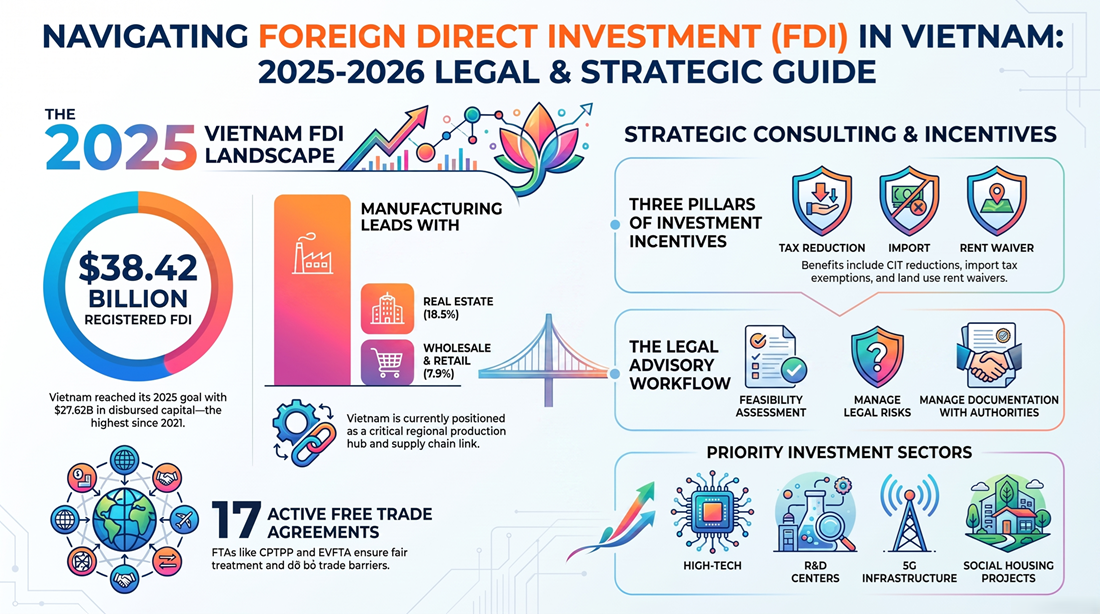
Vietnam continues to rank among the most attractive M&A destinations in Southeast Asia, driven by its position in regional supply chains, a competitive labor cost base, and an expanding network of free trade agreements. At the same time, 2026 has brought the most significant overhaul of Vietnam’s investment framework in years — a new Investment Law, a new implementing decree, and a temporary liberalization of merger-control notification thresholds. For foreign investors, this combination of opportunity and regulatory change makes qualified Vietnam M&A legal advisory essential from the earliest stage of deal planning.
Why foreign investors need specialized M&A legal advisory in Vietnam
An M&A transaction involving a foreign element in Vietnam sits at the intersection of several overlapping legal regimes: international commitments (WTO, CPTPP, EVFTA), the Law on Investment, the Law on Enterprises, the Competition Law, the Securities Law, and sector-specific regulations for industries such as pharmaceuticals, education, energy, real estate and finance. Deals commonly stall or lose value at three points:
- Market access restrictions — not every sector permits 100% foreign ownership; many are subject to ownership caps or scope-of-business limitations for foreign-invested enterprises (FIEs).
- Incomplete legal due diligence — leading to late discovery of unpaid charter capital, expired or non-transferable licenses, undisclosed litigation, or ownership arrangements that Vietnamese law does not recognize (e.g., nominee structures).
- Underestimated regulatory approval timelines — M&A Approval, merger control filings, and Investment/Enterprise Registration Certificate amendments each carry statutory deadlines that rarely match real-world processing times.
An experienced advisory team helps identify these issues early, materially reducing execution risk and total deal timeline.
Key regulatory developments foreign investors should know in 2026
The Law on Investment No. 143/2025/QH15 (“LOI 2025”), passed by the National Assembly on 11 December 2025, took effect on 1 March 2026 (with provisions on conditional business lines effective from 1 July 2026), replacing the 2020 Investment Law. Notable reforms include:
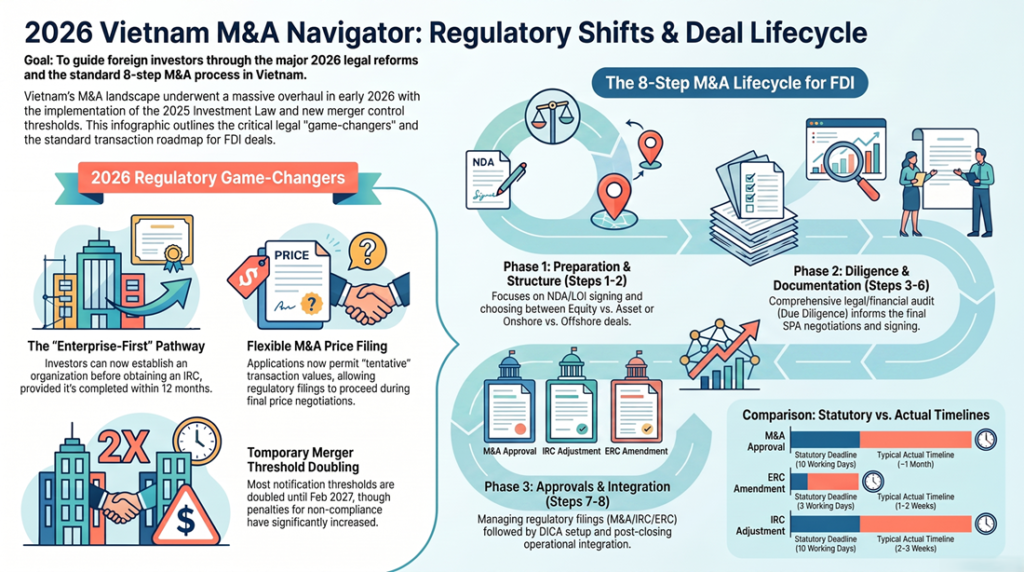
- A new “enterprise-first, IRC-later” pathway: foreign investors may now establish an economic organization before completing the Investment Registration Certificate (IRC) procedure, provided the IRC is obtained within 12 months, under Article 19.2 of the LOI 2025 and Article 72 of Decree 96/2026/ND-CP.
- Removal of 38 conditional business lines and adjustment of the scope of 20 others, shifting regulatory emphasis from pre-licensing toward post-inspection supervision.
- A narrower, clearly enumerated list of 20 project categories requiring investment policy approval (Article 24), with approval authority decentralized across the National Assembly, the Prime Minister, and provincial People’s Committees.
- Under Decree 96/2026/ND-CP, M&A approval applications now disclose an estimated/tentative transaction value rather than the final actual value (per Circular 55/2026/TT-BTC, 15 May 2026) — giving deal teams more flexibility to file while pricing negotiations continue.
Merger control reform: Resolution No. 66.18/2026/NQ-CP (18 May 2026) temporarily doubles three of the four non-sector-specific merger notification thresholds under Decree 35/2020/ND-CP, effective from 1 July 2026 to 28 February 2027 — while the 20% combined market-share threshold remains unchanged. At the same time, Decree No. 102/2026/ND-CP (20 May 2026) substantially raises penalties for failure to file, gun-jumping, and violations of information obligations during National Competition Commission review. In short: fewer deals will trigger mandatory filing during this window, but the consequences of getting it wrong have increased.
Scope of ISC Global’s Vietnam M&A legal advisory services
ISC Global supports foreign investors across the full M&A lifecycle:
- Market access analysis — assessing target sectors against WTO/CPTPP/EVFTA commitments and domestic law to confirm foreign ownership caps and licensing conditions.
- Legal due diligence — comprehensive review of corporate ownership, regulatory permits, material contracts, loans and security, real estate, employment, IP, and litigation exposure.
- Deal structuring advice — equity deal vs. asset deal, onshore vs. offshore structuring, tailored to commercial objectives and sector-specific restrictions.
- Transaction documentation — drafting and negotiating share purchase agreements (SPAs), shareholders’/members’ agreements, representations and warranties, and indemnity mechanisms.
- Regulatory approval execution — M&A Approval, merger control notification, IRC/ERC amendment, and sector-specific licensing.
- Post-closing support — direct investment capital account (DICA) setup, legal representative changes, and post-acquisition compliance integration.
Why work with ISC Global
Vietnam’s regulatory environment is evolving faster than most foreign investors can track from abroad. ISC Global’s advisory team monitors legislative developments in real time and works directly with licensing and sector-specific authorities to translate a fast-changing legal framework into a clear, realistic transaction roadmap — from initial target screening through to post-acquisition integration.
Contact us for enterprise advisory
ISC Global Co., Ltd.
Hotline: +84 933 096 426 – +84 868 591 260
Email: info@iscglobal.asia | van.pham@iscglobal.asia
Website: iscglobal.asia | iscglobal.edu.vn
Navigating Vietnam’s New M&A Frontier: 5 Game-Changing Shifts for Foreign Investors in 2026
1. Introduction: The Complexity of the “New Normal”
Vietnam’s status as a premier Southeast Asian M&A destination is no longer a secret. Driven by its pivotal role in global supply chains and a robust network of FTAs (CPTPP, EVFTA), the nation has long been a magnet for foreign capital. However, we have reached a critical inflection point. The 2026 regulatory overhaul—anchored by the Law on Investment 2025—represents the most significant shift in Vietnam’s investment framework in over a decade.
For international C-suite executives, the “old” playbook is now obsolete. The transition from a pre-licensing gatekeeping model to a “post-inspection” supervision regime creates both unprecedented speed and heightened liability. This briefing distills the core changes from Law No. 143/2025/QH15 and the 2026 implementing decrees into a strategic roadmap for the year ahead.
2. The “Start Now, License Later” Revolution: Optimizing Deal IRR
The traditional sequence of foreign investment—obtaining an Investment Registration Certificate (IRC) before establishing a legal entity—has been fundamentally disrupted. Under Article 19.2 of the Law on Investment 2025 and Decree 96/2026/ND-CP, foreign investors can now choose an “enterprise-first” pathway.
This allows investors to establish an economic organization and obtain an Enterprise Registration Certificate (ERC) before the IRC. For deal teams, this is a financial game-changer:
- Reduced “Dead Time”: Boards can now authorize the opening of bank accounts and the hiring of key personnel immediately upon ERC issuance, slashing the operational lag that typically erodes IRR.
- The 12-Month Grace Period: Investors have a strict 12-month window from the entity’s establishment to obtain the IRC.
“The shift toward post-inspection supervision allows for faster market entry but demands a higher level of internal compliance, as the regulatory emphasis has moved from the gate to the operation itself.”
3. A Golden Window: Temporary Relief for Mid-Market Mergers
Strategic timing is currently the most effective tool for bypassing regulatory friction. Resolution No. 66.18/2026/NQ-CP has introduced a temporary liberalization of merger notification (merger filing) thresholds.
Between July 1, 2026, and February 28, 2027, many mid-sized deals that previously required a mandatory filing with the National Competition Commission (NCC) can now proceed without this administrative hurdle.
- The Liberalization: The resolution doubles three out of the four non-sector-specific financial thresholds.
- The Exception: The 20% combined market-share threshold remains unchanged and strictly enforced.
- The Advisory Takeaway: Investors should capitalize on this eight-month window to close mid-market transactions that would otherwise be delayed by a Phase 1 or Phase 2 merger review.
4. Decoupling Price from Procedure: Administrative Filing Flexibility
Historically, the requirement to disclose final transaction values in regulatory filings created a “negotiation trap,” where administrative delays stalled commercial closings. Decree 96/2026/ND-CP and Circular 55/2026/TT-BTC have decoupled these processes.
Foreign investors are now permitted to submit M&A Approval applications based on estimated or tentative transaction values. This allows the administrative “heavy lifting” to happen in parallel with final price negotiations.
“Allowing for tentative value disclosure enables deal teams to run the administrative filing and the commercial price-locking on parallel tracks, materially reducing execution risk and preventing regulatory timelines from dictating commercial outcomes.”
5. The “Regulatory Trap”: Decentralization and Higher Stakes
While the government has removed 38 conditional business lines, the 2026 regime is not a “free-for-all.” It is a shift in complexity. Investors must navigate a new decentralized authority structure for investment policy approvals (Article 24, LOI 2025), narrowed to 20 project groups:
- National Assembly: 1 group (High-level strategic projects).
- Prime Minister: 8 groups.
- Provincial People’s Committees: 13 groups.
Understanding who signs off is now as critical as what is being signed. However, the true “Regulatory Trap” lies in Decree No. 102/2026/ND-CP, which has significantly raised penalties for “gun-jumping” (closing before approval) and information non-disclosure. Compliance is no longer a box-ticking exercise; it is the primary defense against doubled fines and potential deal reversals.
6. The “Hidden” Roadblocks: Market Access and Due Diligence
Success in the 2026 landscape requires an “insider” view of friction points that statutory laws often gloss over. We identify three major failure points for foreign investors:
- Market Access Restrictions: WTO, CPTPP, and EVFTA commitments often conflict with domestic law. Not every sector permits 100% foreign ownership, and “scope-of-business” limitations can still cripple an FIE’s operations post-closing.
- The 90-Day Capital Trap: Legal due diligence must prioritize verifying charter capital. If the target company failed to fully contribute capital within the 90-day statutory limit post-incorporation, the entire deal may be legally voidable.
- The Reality Gap: Boards must budget for the discrepancy between law and local practice.
Statutory vs. Reality: Regulatory Timelines (2026)
| Procedure | Statutory Deadline | Typical Reality |
| M&A Approval | 10 Working Days | ~1 Month |
| Merger Control Filing | 30 Days (Phase 1) | Varies by complexity |
| ERC Adjustment | 3 Working Days | 1 – 2 Weeks |
| IRC Adjustment | 10 Working Days | 2 – 3 Weeks |
7. Conclusion: The Roadmap to 2027
To navigate this frontier, C-suite executives must view the M&A lifecycle as a single, integrated flow. Fragmenting these tasks across disconnected legal and tax providers is the fastest way to trigger a “post-inspection” audit.
The 8-Step Integrated Lifecycle:
- Target Screening & NDA/LOI
- Preliminary Market Access & Structure Analysis
- Comprehensive Due Diligence (Prioritizing the 90-day capital rule)
- Transaction Documentation (SPA/SHA)
- Signing & Parallel Regulatory Filings (Using tentative values)
- Regulatory Approvals (M&A Approval, Merger Filing)
- Closing & DICA Account Setup
- Post-Closing Integration & Compliance Audit
As we move toward 2027, the focus of Vietnamese authorities has shifted from gatekeeping to auditing. Is your current deal structure robust enough to withstand the “post-inspection” scrutiny of this new legal regime? In a world where rules are fewer but penalties are higher, your strategic roadmap is your only protection.

No responses yet