Vietnam remains one of Southeast Asia’s most active M&A markets, drawing sustained interest from manufacturing, energy, industrial real estate and services investors. Yet foreign buyers and sellers entering the Vietnamese market frequently underestimate one thing: the tax exposure attached to cross-border capital transfers is materially different from what applies to a purely domestic deal, and it has just changed again. Between late 2025 and mid-2026, Vietnam overhauled its corporate and personal income tax framework governing capital transfers — changes that directly affect how any cross-border M&A transaction involving a Vietnamese target should be structured, priced and documented.
This guide summarizes what foreign investors, legal counsel and deal teams need to know before signing a term sheet for a Vietnamese target.
Why Cross-Border M&A Tax Is Different
Unlike a domestic transaction, a cross-border deal touching Vietnam typically involves several layers of tax risk at once:
- Multiple jurisdictions may claim taxing rights over the same gain, particularly when the buyer, seller and any intermediate holding companies sit in different countries.
- Vietnam does not distinguish between direct and indirect transfers based on legal form. Where a share sale is executed offshore (for example, between two non-Vietnamese holding companies) but the underlying value and assets sit in Vietnam, Vietnamese tax authorities have grounds to assert taxing rights regardless of where the contract was signed.
- The legal framework itself is moving fast. Since mid-2025, Vietnam has enacted a new Law on Corporate Income Tax (No. 67/2025/QH15), its implementing Decree No. 320/2025/ND-CP, guiding Circular No. 20/2026/TT-BTC, and a new Law on Personal Income Tax (No. 109/2025/QH15) effective from 1 July 2026. Deals structured under the old rules may no longer reflect current tax exposure.
- Double Tax Agreement (DTA) relief is not automatic. Whether a foreign seller qualifies for exemption or reduced tax under a treaty depends on a technical, fact-specific test — most commonly whether the target company’s assets are predominantly real property.
Given this complexity, foreign investors on either side of a Vietnamese M&A transaction benefit from specialist tax and legal advice engaged early — ideally before commercial terms are finalized.
What Changed: Corporate Income Tax on Capital Transfers (2025–2026)
Before 1 October 2025, a foreign corporate seller transferring capital in a Vietnamese company was taxed at 20% on taxable gain (sale price minus cost base and transfer expenses) — broadly similar to how a domestic seller is taxed.
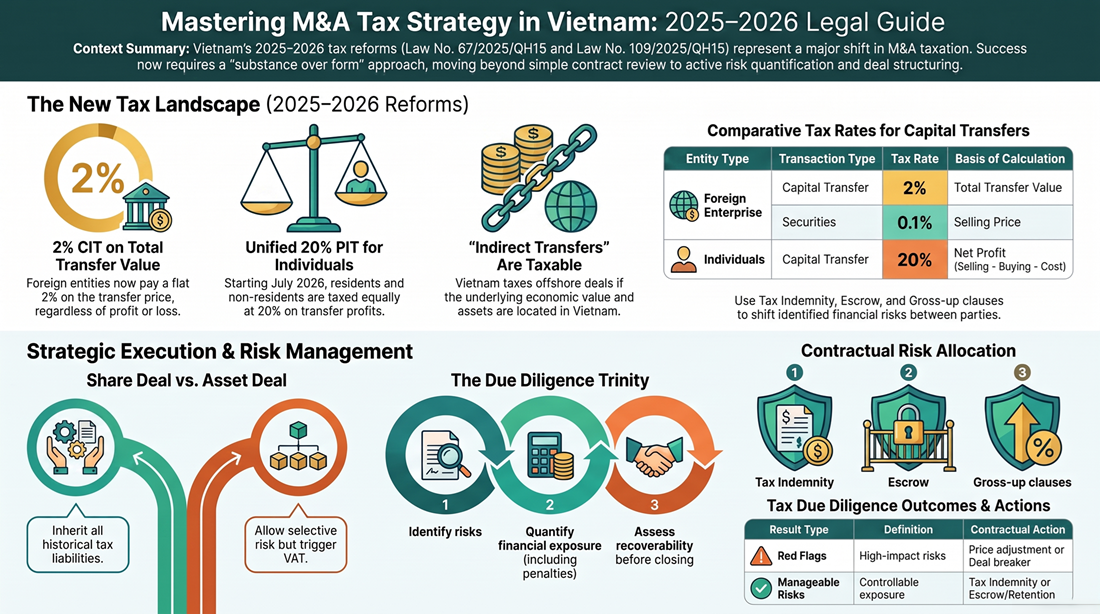
From 1 October 2025, under the new CIT Law and its implementing Decree 320/2025/ND-CP, foreign enterprises transferring capital in a Vietnamese entity — whether directly or indirectly — are instead taxed at a flat 2% on the total transfer value, irrespective of whether the transaction produces a gain or a loss. This is a fundamental shift from a profit-based tax to a transaction-value-based tax, and it changes how net proceeds should be modeled in any deal involving a foreign corporate seller.
Current Tax Rates at a Glance
| Seller | Transaction type | Tax rate | Tax base |
|---|---|---|---|
| Vietnamese enterprise | Capital/securities transfer | 20% | Taxable gain (sale price – cost base – transfer expenses) |
| Foreign enterprise | Capital transfer (direct or indirect) | 2% | Total transfer value, regardless of gain or loss |
| Foreign enterprise | Listed securities transfer | 0.1% | Sale price |
| Individual (resident or non-resident) | Capital transfer | 20% (or 2% on sale price if cost base cannot be determined) | Under the new PIT Law No. 109/2025/QH15, effective 1 July 2026 |
Indirect Transfers: Offshore Signing Does Not Put a Deal Outside Vietnam’s Reach
A common misconception among foreign investors is that structuring a sale at the holding-company level offshore — for instance, a European fund selling shares in a Singapore holding company that in turn wholly owns a Vietnamese subsidiary — keeps the transaction outside Vietnam’s tax net.
In practice, Vietnamese tax law looks past the legal form of the transaction to its economic substance. If the underlying value and assets being transferred are located in Vietnam, Vietnamese authorities have a legal basis to assess tax on the transaction, even though the contract is executed abroad between two non-Vietnamese entities. Investors designing holding structures for Vietnamese investments should treat this as a baseline planning assumption, not an edge case.
Exemption for Genuine Intra-Group Restructuring
Not every cross-border ownership change triggers Vietnamese tax. Current law exempts intra-group restructuring transactions provided all of the following conditions are met simultaneously:
- The transaction does not change the ultimate parent company of the ownership chain;
- The transfer is purely an internal reallocation within the group; and
- No actual income accrues to the transferring entity.
To rely on this exemption, the group should be prepared to produce supporting documentation: pre- and post-restructuring ownership charts, evidence that the ultimate parent is unchanged, and internal resolutions confirming the restructuring rationale. Missing documentation is the most common reason tax authorities decline to apply the exemption even where the transaction substantively qualifies.
Double Tax Agreement Relief: The Real Property Test
Foreign investors resident in a country that has signed a DTA with Vietnam may be exempt from, or entitled to reduced, Vietnamese tax on capital gains — but the outcome depends entirely on the specific treaty article and the asset composition of the target company. Most of Vietnam’s DTAs apply a predominantly-immovable-property test: if the target company’s assets consist mainly of real property (commonly, above a 50% threshold), gains from transferring shares in that company may still be taxable in Vietnam, even for a non-resident seller.
The relevant ratio is typically calculated as the simple average of the real-property-to-total-assets ratio at three points in time: the transfer date, the start of the tax year, and the end of the preceding tax year, based on audited financial statements. The burden of proof sits with the taxpayer — investors seeking treaty relief must proactively assemble this evidence and file the appropriate exemption or reduction request with the relevant tax authority; relief is not granted automatically.
Personal Income Tax: What Individual Foreign Sellers Should Know
From 1 July 2026, Vietnam’s new Personal Income Tax Law No. 109/2025/QH15 took effect, replacing the prior framework in full. For M&A purposes, the most significant change is that a single rate structure now applies uniformly to both resident and non-resident individuals: 20% on taxable gain, or 2% on the transfer price where cost base and expenses cannot be substantiated — removing the previous distinction between the two categories of taxpayer.
The new law also expands the categories of taxable income to cover newer asset classes, including gains from transferring Vietnam’s national “.vn” domain names, carbon credits, digital assets, and gold bars — relevant wherever a cross-border deal involves these less conventional asset types.
Practical Recommendations for Foreign Investors
- Model the 2% transfer-value tax explicitly in any deal where the seller is a foreign corporate entity — it applies regardless of whether the deal is profitable, which changes net-proceeds calculations compared with a profit-based tax.
- Assume Vietnamese tax exposure on indirect transfers by default, and build treaty analysis and restructuring exemptions into the deal timetable early rather than as an afterthought.
- Document cost basis and acquisition expenses from day one of any Vietnamese investment, so that a future exit can rely on actual-gain taxation rather than the higher default rate applied when cost base cannot be proven.
- Assess DTA eligibility and the real-property test before signing, and start assembling audited financial statements at the relevant measurement dates well ahead of closing.
- Run a formal tax due diligence process on the Vietnamese target before finalizing commercial terms, so that any pre-existing tax exposure can be reflected in price adjustments, escrow arrangements, or tax indemnity clauses rather than left unallocated.
- Engage Vietnamese tax and legal counsel early — given how recently these rules changed, deal teams relying on pre-2025 assumptions about Vietnamese capital gains tax are working from an outdated model.
Frequently Asked Questions
Does the 2% tax on foreign enterprises apply even if the deal is at a loss? Yes. Unlike the prior profit-based regime, the 2% rate applies to the gross transfer value, regardless of whether the transaction results in an economic gain or loss.
Can an indirect transfer executed entirely outside Vietnam still be taxed in Vietnam? Yes, where the underlying assets and economic value are located in Vietnam. Vietnamese tax law assesses substance over form.
Is DTA relief automatic for investors from treaty countries? No. Relief depends on the specific treaty provisions and the target company’s asset composition (particularly the real-property ratio), and must be actively claimed with supporting evidence.
Get in Touch
Our team advises foreign investors and Vietnamese businesses throughout the full lifecycle of cross-border M&A transactions — from deal structuring and tax due diligence to DTA analysis and contract negotiation.
Contact us for corporate advisory:
Hotline: +84 933 096 426 – +84 868 591 260
Email: info@iscglobal.asia | van.pham@iscglobal.asia
Website: iscglobal.asia | iscglobal.edu.vn
The 2026 Vietnamese M&A Tax Reform: 5 Surprising Realities for Foreign Investors
Imagine exiting a Vietnamese subsidiary at a significant loss on paper, only to be met by a tax bill for millions of dollars. For seasoned investors, this scenario is no longer a hypothetical risk—it is the new regulatory reality.
The implementation of Law No. 67/2025/QH15 and Law No. 109/2025/QH15 marks the most aggressive overhaul of Vietnam’s Mergers and Acquisitions (M&A) tax landscape in a decade. The “old rules” of profit-based taxation are being dismantled in favor of a regime that prioritizes economic substance and administrative simplicity. To navigate the 2026 landscape, investors must move beyond clinical compliance and master these five strategic shifts—or ignore them at their peril.
1. Profit is Irrelevant: The Shift to a Flat 2% Tax on Value
The most disruptive change for foreign enterprises is the total abandonment of the profit-based tax model for capital transfers. Previously, foreign sellers paid 20% Corporate Income Tax (CIT) on net profit—the delta between selling price and investment cost.
Effective from October 1, 2025, for the 2025 tax period, Law No. 67/2025/QH15 and Circular No. 20/2026/TT-BTC mandate that foreign enterprises transferring capital now face a flat 2% tax rate on the total transaction value. This applies regardless of whether the seller realizes a gain or exits at a crushing loss. Furthermore, the reform tightens for individuals on July 1, 2026, when the new Personal Income Tax (PIT) framework aligns resident and non-resident individual rates at 20% on profit, or a 2% “trap” on value if the original cost base cannot be verified.
“Doanh nghiệp nước ngoài chuyển nhượng vốn… chịu thuế theo tỷ lệ cố định 2% trên tổng giá trị chuyển nhượng, không phụ thuộc vào việc giao dịch có phát sinh lãi hay lỗ.”
2. The Offshore Myth: Why Your Singapore Holding Company Won’t Protect You
For years, investors relied on offshore “indirect transfers”—such as a Singaporean holding company selling shares to a European buyer—to remain outside the Vietnamese tax net. The 2026 reality check is simple: Vietnamese authorities now look through legal form to tax Economic Substance.
If the underlying value is derived from Vietnamese assets, the transaction is taxable in Vietnam. As a strategist, you must evaluate your structure through the “Three Core Questions” currently utilized by Vietnamese tax inspectors to identify the economic nature of a deal:
- Who actually bears the tax burden?
- Where does the actual cash flow originate and terminate?
- Where is the economic value and asset base physically located?
“Nếu tài sản và giá trị kinh tế thực chất của giao dịch nằm tại Việt Nam, Việt Nam vẫn có cơ sở pháp lý để xem xét đánh thuế.”
3. The DTA Real Estate Threshold: When Treaties Suddenly Expire
Double Taxation Agreements (DTAs) are often viewed as a “get out of tax free” card, but the “Predominantly Immovable Property Test” is a hidden deal-killer. If more than 50% of your target’s value is derived from real estate, DTA protections are voided, and Vietnam retains full taxing rights.
The critical nuance in 2026 is the “Simple Average” (số bình quân đơn giản) calculation. The 50% threshold isn’t just checked on the day of the deal; it is the average of the real estate ratio at three mandatory time-points:
- The date of the capital transfer.
- The beginning of the current tax year.
- The end of the previous tax year.
If your average hits 51%, even if you are at 40% on the closing date, the exemption vanishes. The burden of proof lies entirely with the taxpayer, making audited financial reports for all three periods non-negotiable.
4. The “Ultimate Parent” Clause: The Secret to Tax-Free Internal Moves
While the new laws are rigid, they offer a sophisticated “safe harbor” for genuine internal restructuring. You can relocate ownership within a group without triggering a tax bill, provided you satisfy the “Ultimate Parent” test.
To leverage this exemption, your restructuring must simultaneously satisfy these three conditions:
- [ ] No change in the Ultimate Parent: The highest-level entity in the ownership chain must remain identical before and after the move.
- [ ] Internal adjustment only: The transfer must be a strictly internal relocation of equity within the existing group.
- [ ] No actual income generated: The transferring entity must not receive any real economic gain or income; the move must be a zero-sum accounting adjustment.
5. Due Diligence is a Weapon, Not a Bureaucracy
In the post-reform environment, Tax Due Diligence (TDD) has evolved. It is no longer about identifying errors; it is about quantifying the “Price of Risk” to weaponize your position at the negotiation table.
A strategist’s TDD must measure the total exposure, which includes tax arrears, late payment interest, and administrative fines. These hidden costs are often high enough to fundamentally alter the deal’s valuation. Once quantified, you must mitigate these risks through aggressive contractual mechanisms:
- Price Adjustment: Direct reduction of the purchase price based on the quantified risk.
- Escrow/Retention: Holding funds in a blocked account until specific tax risks are cleared.
- Tax Indemnity: Contractual commitment from the seller to compensate for pre-closing liabilities.
- Deal Breaker: Walking away if the quantified risk, interest, and fines render the ROI unfeasible.
“Due diligence không chỉ tìm lỗi mà phải đo được ‘giá’ của rủi ro.”
Looking Ahead
The 2026 landscape favors substance over complex legal layering. The Vietnamese government has simplified the math with the 2% flat rate, but it has simultaneously expanded its reach into indirect transfers and tightened DTA eligibility.
As you audit your portfolio, ask one critical question: Is your current offshore structure a strategic asset, or a hidden tax liability waiting to be discovered at the exit?
For any transactions slated for 2025–2026, reviewing financial plans against Law No. 67/2025/QH15 is no longer a matter of best practice—it is a prerequisite for a successful exit.


No responses yet