Vietnam’s position as a manufacturing and export hub continues to strengthen, but with that growth comes increasing exposure to the legal framework of the World Trade Organization (WTO) — a framework that governs everything from the tariff rate a foreign customs authority applies to your goods, to whether your shipment can be held for failing a technical regulation, to whether your company becomes the subject of an anti-dumping investigation. For manufacturers, FDI enterprises, and exporters operating out of Vietnam, understanding WTO principles is no longer optional legal background — it is a operational necessity that directly affects cost, market access, and business continuity.
This article, prepared by the trade law and compliance team at ISC Global, explains the core WTO principles every export-oriented business should understand, and introduces our WTO Compliance & International Trade Law Advisory service line for companies manufacturing in or trading with Vietnam.
1. Why WTO Principles Matter to Your Business
Since Vietnam’s WTO accession in 2007, every tariff schedule, customs procedure, sanitary/phytosanitary requirement, and trade remedy measure — whether issued by Vietnam or applied to Vietnamese-origin goods by a trading partner — must operate within the WTO’s rules-based framework. For a business, this cuts both ways:
- Opportunity: preferential tariff treatment negotiated between WTO members, protection against arbitrary discrimination in export markets, and access to a structured, rules-based dispute settlement system.
- Risk: companies that misunderstand the framework are more likely to face anti-dumping or countervailing duty investigations, safeguard measures, customs delays over rules-of-origin disputes, or shipments rejected at the border for non-compliance with technical barriers to trade (TBT) or sanitary and phytosanitary (SPS) requirements.
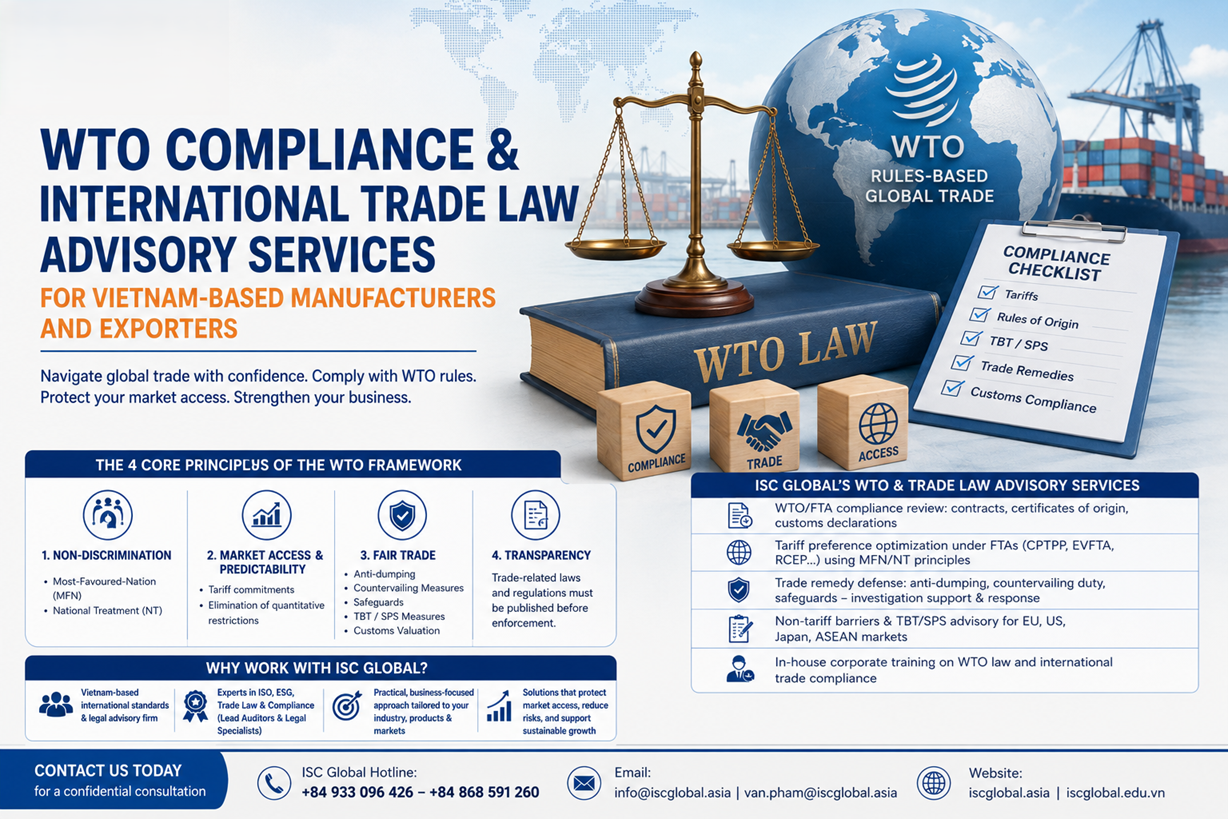
2. The Four Core Principles of the WTO Framework
2.1 Non-Discrimination
This principle rests on two pillars:
- Most-Favoured-Nation Treatment (MFN – Article I GATT): any advantage a WTO member grants to a product originating in or destined for any country must be extended immediately and unconditionally to the like product of all other WTO members. Understanding MFN allows exporters to identify and leverage preferential tariff treatment that an importing country has already committed to other trading partners.
- National Treatment (NT – Article III GATT): once imported goods have cleared customs, they must be treated no less favourably than like domestic products — covering internal taxes, distribution regulations, and sale conditions.
2.2 Market Access and Predictability
This principle governs tariff reduction commitments under each member’s Schedule of Concessions, sets bound tariff ceilings, and generally prohibits arbitrary quantitative restrictions (import licensing requirements, unpublished quotas, and similar measures). Businesses need to understand the gap between the bound rate and the applied rate to plan pricing strategy and contract negotiations with confidence.
2.3 Fair Trade
This covers anti-dumping, countervailing measures, safeguards, customs valuation, technical barriers to trade (TBT), and sanitary and phytosanitary measures (SPS) — the exact category of rules most frequently triggered against Vietnamese exports in markets such as the United States, the European Union, and India.
2.4 Transparency
Under Article X GATT, trade-related laws and regulations must be published before enforcement. This is a critical legal basis for challenging retroactive or opaque measures imposed by an importing country’s authorities.
3. ISC Global’s WTO & International Trade Law Advisory Services
Drawing on a team with combined expertise in international trade law and international standards/ESG consulting, ISC Global supports manufacturers, exporters, and FDI enterprises with:
- WTO/FTA compliance review of international trade contracts, certificates of origin, and customs declarations;
- Tariff preference optimization under Vietnam’s network of Free Trade Agreements (CPTPP, EVFTA, RCEP, and others), applying MFN/NT principles to identify unused preferential opportunities;
- Trade remedy defense support — assisting companies facing anti-dumping, countervailing duty, or safeguard investigations in export markets, including questionnaire responses and evidentiary preparation;
- Non-tariff barrier and TBT/SPS advisory for market entry into the EU, United States, Japan, and ASEAN markets;
- In-house corporate training on WTO law and international trade compliance for legal, customs, and export teams.
4. Why Work With ISC Global
ISC Global is a Vietnam-based international standards, training, and certification consultancy whose team holds Lead Auditor credentials across major ISO management systems (ISO 9001, 14001, 45001, and others), EcoVadis-recognized sustainability expertise, and specialized legal training in international trade and ESG compliance. We understand that every business has a distinct product profile, export destination, and risk exposure — our advisory approach is built around your specific commercial situation rather than a generic compliance template.
5. Frequently Asked Questions
Does WTO compliance advisory apply to small and mid-sized exporters, not just large manufacturers? Yes. Any company exporting directly or supplying into an export-oriented supply chain is affected by WTO/FTA rules on origin, tariffs, and technical barriers. Early-stage advisory is typically far less costly than remediation after a shipment is held or an investigation is opened.
Can ISC Global support a company already facing an anti-dumping or safeguard investigation? Yes. We work alongside a network of international trade counsel to help companies prepare cost and pricing documentation, respond to investigating authorities, and build the legal arguments needed during trade remedy proceedings.
How is the scope and cost of advisory determined? Scope depends on whether the engagement is a one-time contract/compliance review, an ongoing advisory retainer, or investigation-specific support. ISC Global provides a transparent, needs-based quotation after an initial consultation.
Contact Us for Corporate Advisory
ISC Global
Hotline: +84 933 096 426 – +84 868 591 260
Email: info@iscglobal.asia | van.pham@iscglobal.asia
Website: iscglobal.asia | iscglobal.edu.vn
No responses yet