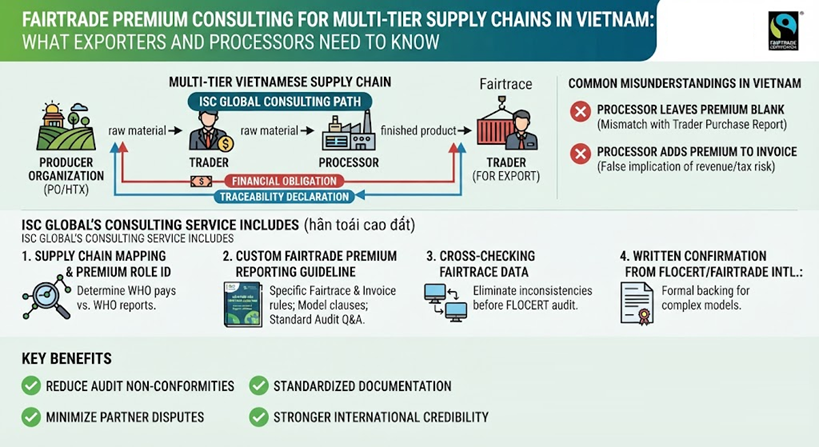
For exporters, traders, and processing companies participating in Fairtrade-certified supply chains, the Fairtrade Premium is one of the most commonly misunderstood elements of compliance — not because the arithmetic is difficult, but because companies frequently confuse a financial obligation with a traceability declaration. This confusion becomes especially acute in multi-tier supply chains, where a trader purchases raw material from a Producer Organization, a separate processing company converts it into a finished product, and the trader then buys the finished product back for export. ISC Global’s Fairtrade Premium consulting service was built specifically to resolve this gap before it turns into an audit finding.
1. What Is the Fairtrade Premium, and Why Does It Cause Confusion?
The Fairtrade Premium is an additional sum paid on top of the purchase price, intended for the certified Producer Organization (PO) to invest in community, infrastructure, or livelihood projects, as defined under the Fairtrade Standards. Critically, the Premium:
- Is not revenue or profit for any intermediary in the chain.
- Must be recorded transparently through Fairtrace, Fairtrade International’s traceability platform.
- Creates confusion specifically when the supply chain includes more than two tiers — for example, Trader → Processor → Trader.
In this structure, the processing company is typically not the Premium Payer, yet Fairtrace’s Sales Report template may still require a “Total Fairtrade Premium” value to be entered for every Sales Transaction, regardless of whether the seller actually collects or manages that amount.
Without proper guidance, processing companies commonly make one of two mistakes:
- Leaving the Premium field blank, which creates a mismatch against the trader’s Purchase Report (where the Premium was correctly declared against the transaction with the PO) — a red flag for any cross-referencing auditor.
- Listing the Premium as a payable line item on the commercial invoice, which wrongly implies the processor is collecting Premium funds it never actually receives — creating both tax exposure and contractual ambiguity.
2. Why This Matters for International Buyers and Certification Bodies
Fairtrade Standards do not provide a single, one-size-fits-all clause covering every supply chain configuration. For multi-tier models — particularly those involving toll processing or contract manufacturing — companies need to:
- Correctly identify each party’s role: who is the Premium Payer, and who is only a traceability reporter.
- Separate the invoice from the Fairtrace Report. These are two entirely different instruments: the invoice is a financial document; the Fairtrace Report is a traceability tool used by Fairtrade International and FLOCERT to verify the transaction chain.
- Draft contract clauses that clearly allocate Premium responsibility, reducing the risk of disputes between trading partners and of tax authority scrutiny.
- Prepare bilingual audit-ready explanations so that when FLOCERT auditors ask about Premium figures during a certification audit, every party in the chain gives a consistent, defensible answer.
3. What ISC Global’s Fairtrade Premium Consulting Service Includes
3.1. Supply Chain Mapping and Premium Role Identification
We map the full transaction flow — from the Producer Organization to the end customer — to determine precisely who qualifies as the Premium Payer under the Fairtrade Trader Standard, and who is simply a traceability reporter with no financial obligation.
3.2. A Custom “Fairtrade Premium Reporting Guideline”
We produce a bilingual (Vietnamese–English) internal reference document specifying:
- Which party declares the Premium in Fairtrace, and at what value.
- Whether (and how) the Premium should appear on the commercial invoice.
- Model contract clauses assigning Premium responsibility.
- A standard set of audit questions and answers for use during FLOCERT assessments.
3.3. Cross-Checking Fairtrace Report Data
We review every relevant Fairtrace Purchase and Sales entry, cross-referencing figures against trading partners in the same chain to eliminate inconsistencies before they surface during an audit — one of the most common cross-verification points FLOCERT auditors use.
3.4. Support Obtaining Written Confirmation from FLOCERT or Fairtrade International
For supply chain models without a clearly defined precedent in the Fairtrade Standards, we help companies prepare a written submission — including a transaction diagram and a description of the Premium mechanism — to FLOCERT or Fairtrade International, requesting formal written confirmation. This gives the company a solid, documented basis to rely on in subsequent audit cycles, rather than an internally inferred interpretation.
4. Benefits for Traders, Processors, and Buyers
- Reduced risk of Non-conformities related to financial declarations during FLOCERT audits.
- Fewer disputes between supply chain partners over Premium responsibility.
- Standardized documentation, reusable across every subsequent Fairtrace reporting cycle.
- Stronger credibility with international brands and buyers requiring transparent Fairtrade supply chains.
5. Frequently Asked Questions (FAQ)
Is the Fairtrade Premium considered company profit? No. The Premium is intended for the certified Producer Organization and is never company revenue or profit for any intermediary.
Does a processing company have to declare the Premium in Fairtrace even if it never receives it? This depends on the specific Fairtrace Report template. In many cases, if the template requires it, the company should still declare the correct value but must support it with documentation clarifying that the figure is reported for traceability purposes only.
Should the Fairtrade Premium appear on the commercial invoice? Generally, no — unless the company is genuinely the party collecting or paying the Premium. A clarifying note at the end of the invoice explaining the Premium mechanism is the recommended approach instead.
How much does Fairtrade Premium consulting cost? Cost depends on the complexity of the supply chain — the number of tiers involved, the number of Producer Organizations, and the volume of documentation requiring standardization. Contact us directly for a tailored quote.
Does this service cover audit preparation as well as documentation? Yes. Beyond drafting the guideline documents, we also support mock-audit review, staff briefing before FLOCERT assessments, and on-site support during the audit itself where required.
Contact Us For Business Consulting
ISC Global Co., Ltd.
Hotline: +84 933 096 426 – +84 868 591 260
Email: info@iscglobal.asia | van.pham@iscglobal.asia
Website: iscglobal.asia | iscglobal.edu.vn
No responses yet