As global supply chains grow more demanding, ISO 9001:2015 certification has shifted from a competitive advantage to a baseline requirement for manufacturers seeking to work with international buyers. Having supported manufacturing plants across wood products, furniture, electronics, and mechanical components through real certification audits — from initial gap analysis through Stage 1 and Stage 2 — ISC Global has direct, practical insight into what a Quality Management System (QMS) needs to genuinely function, not just to pass on paper.
This guide walks through the full certification journey, the challenges manufacturers typically face, and how a well-structured consulting process makes the difference between a smooth certification and a stressful one.
1. What Is ISO 9001:2015 and Why Does It Matter for Manufacturers?
ISO 9001:2015 is the international standard for Quality Management Systems (QMS), published by the International Organization for Standardization. It specifies requirements for an organization to consistently provide products and services that meet customer and applicable statutory/regulatory requirements, while pursuing continual improvement.
For manufacturers — particularly export-oriented or foreign-invested factories operating— ISO 9001:2015 certification delivers concrete business value:
● A prerequisite for supplier qualification: Multinational buyers and retail brands increasingly require ISO 9001 certification as a baseline screening criterion before signing long-term supply agreements.
● Lower defect rates and cost of poor quality (COPQ): Standardized production control, in-process inspection, and nonconforming-product control directly reduce rework and returns.
● Buyer confidence in cross-border trade: ISO 9001:2015 is globally recognized, giving international customers a common reference point to trust a supplier’s quality capability.
● Stronger internal operations: Risk-based thinking and the process approach give management better visibility and control over the supply chain, workforce competence, and production-line performance.
2. The Certification Journey: Step by Step
1. Gap Analysis Against ISO 9001:2015
Our consultants conduct an on-site assessment, comparing actual operations against each clause of ISO 9001:2015 (Clause 4 – Context of the Organization through Clause 10 – Improvement), identifying precisely which gaps need to be closed before certification.
2. Building the QMS Documentation
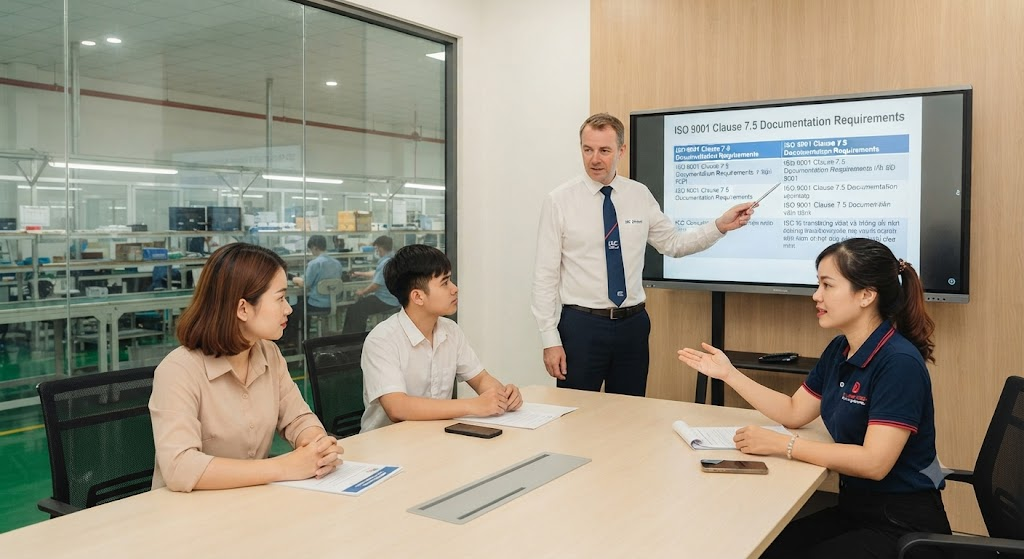
This includes the Quality Policy, measurable Quality Objectives with KPIs, a Risk & Opportunity register, Standard Operating Procedures (SOPs), work instructions for each production stage, and a document-control system aligned with Clause 7.5.3 — one of the areas auditors scrutinize most closely.
3. Awareness Training and Internal Auditor Training
Everyone from top management to shop-floor operators is trained to understand — and be able to explain to an auditor — the quality policy, quality objectives, and their own role in the QMS. A documented policy that shop-floor workers cannot describe during an interview is one of the most common findings we see.
4. Implementation, Internal Audit, and Management Review
We guide the organization through at least 2–3 months of live operation of the QMS before applying for certification, ensuring a full internal audit cycle and a Management Review Meeting that covers all the mandatory inputs of Clause 9.3.2, complete with signatures and corrective-action due dates.
5. Supporting Stage 1 and Stage 2 Certification Audits
ISC Global helps organizations select the right certification body, prepares the application, and provides ongoing consulting support throughout the two-stage certification audit process: Stage 1 (document review) and Stage 2 (on-site audit).
3. Common Challenges for Manufacturers
Based on direct experience supporting factories through real certification audits, most nonconformities (NCs) and Opportunities for Improvement (OFIs) do not stem from missing procedures — they come from the gap between documented procedures and what actually happens on the shop floor:
● Documents exist in multiple parallel versions without proper control under Clause 7.5.3, creating a risk that obsolete revisions remain in use at workstations.
● Internal audit records and management review minutes lack management sign-off or are missing mandatory inputs required by the standard.
● The quality policy and objectives exist only on paper and are not communicated or visually displayed on the production floor.
● Missing supplier evaluation records — a particularly common gap for FDI manufacturers whose substrate materials or components are supplied intra-company from a sister facility within the same group, which is sometimes mistakenly assumed not to require the same level of control as external suppliers.
● Measuring and monitoring equipment used for quality control lacking valid, up-to-date calibration records.
4. What Auditors Actually Check: Stage 1 vs. Stage 2
Stage 1 is typically conducted off-site (document review), confirming that the organization’s documented QMS is sufficiently developed and that internal audits and management review have been planned to a level that justifies proceeding to Stage 2. Stage 2 takes place on-site and evaluates the QMS’s actual implementation and effectiveness, using a combination of document inspection, interviews (not only with management, but with shop-floor personnel), direct observation of operations, and records review across all clauses from 4 through 10.
Findings are typically classified into four categories: 🔴 Major NC (a serious failure posing significant risk to QMS integrity or the ability to meet customer/statutory requirements), 🟡 Minor NC (an isolated failure that does not immediately threaten system effectiveness), 🔵 OFI (not yet a nonconformity, but a situation that could become one without improvement), and ✅ Conformity (objective evidence confirms the requirement is effectively met).
5. How ISC Global Supports International and FDI Manufacturers
ISC Global provides consulting support tailored to foreign-invested manufacturers operating. Our team brings direct, hands-on experience preparing organizations for real certification audits across ISO 9001, SMETA, ISO 37001, FSC-CoC, and other international standards, ensuring your documentation, records, and shop-floor practices are genuinely audit-ready — not just paper-ready.
Frequently Asked Questions
Q1: How long does ISO 9001:2015 certification take?
Typically 2 to 4 months from the start of consulting to completion of the Stage 2 audit and certificate issuance, depending on the organization’s current level of readiness. Organizations with a strong existing management foundation can complete the process in as little as 6–8 weeks.
Q2: What determines the cost of ISO 9001:2015 consulting?
Cost depends on headcount, the number of production processes, the number of sites in scope, and the current maturity of the management system. ISC Global always conducts an on-site assessment before quoting to ensure accuracy and transparency.
Q3: What is the difference between Stage 1 and Stage 2 audits?
Stage 1 is a document review (often conducted off-site) confirming the system is ready on paper. Stage 2 is an on-site audit where auditors interview staff, observe actual operations, and review implementation records before making a certification recommendation.
Q4: Do small and medium manufacturers need ISO 9001:2015?
Yes. The standard is scalable to any organization size. In practice, SMEs often use ISO 9001 implementation as an opportunity to standardize operations before scaling up or entering larger supply chains.
CONTACT US FOR A FREE CONSULTATION
ISC Global Co., Ltd.
Hotline: +84 933 096 426 – +84 868 591 260
Email: info@iscglobal.asia | van.pham@iscglobal.asia
Website: iscglobal.asia | iscglobal.edu.vn
No responses yet