Selling an electronic product in the United States may require more than a successful laboratory test. The manufacturer must first identify the correct FCC rule part and authorization route, configure a representative sample, complete the applicable testing, prepare compliant labeling and user information, and ensure that a legally valid responsible party is identified.
For manufacturers, the compliance challenge is often intensified by technical documentation, multiple model variants, overseas importers and late-stage requests from U.S. buyers. FCC compliance consulting coordinates these elements as one market-access project rather than treating the laboratory report as the final objective.
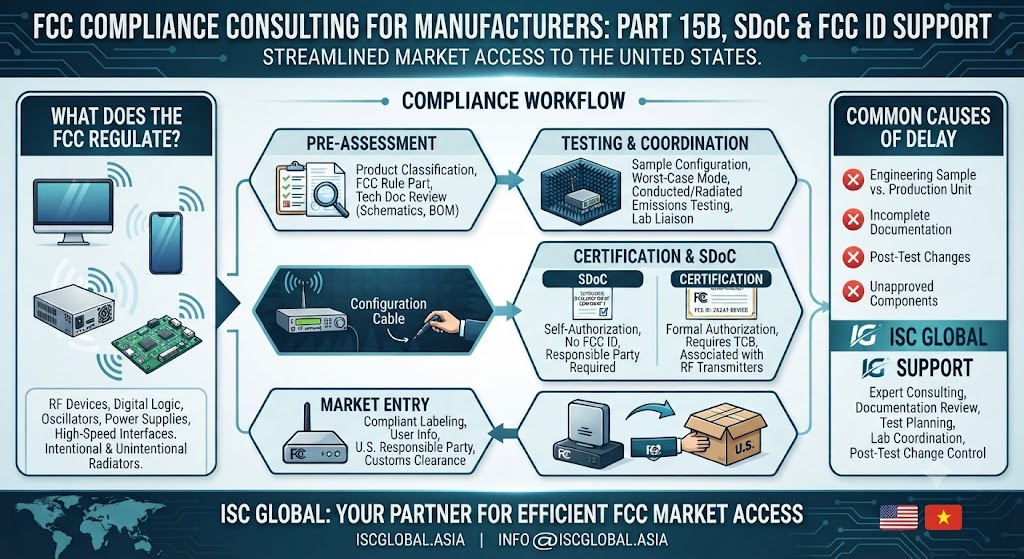
What does the FCC regulate?
The Federal Communications Commission regulates radio-frequency devices and the use of RF spectrum in the United States. A radio-frequency device is not limited to a wireless transmitter. Digital circuitry, oscillators, switching power supplies, processors and high-speed interfaces can generate RF energy even when wireless communication is not the product’s intended function.
Depending on its design, a product may be an intentional radiator, an unintentional radiator, an incidental radiator or a composite device. Classification affects the applicable technical limits, test methods, authorization route, labeling, filing requirements and post-authorization obligations.
SDoC versus Certification and FCC ID
Supplier’s Declaration of Conformity is a self-authorization procedure under which the responsible party ensures that the equipment complies with the applicable technical and administrative requirements. Representative data is generally not submitted to the FCC before marketing unless requested. A product authorized only through SDoC does not receive an FCC ID.
Certification is the more formal authorization procedure generally associated with intentional transmitters and specified higher-risk equipment. An approved product receives an FCC ID. Composite products may require both Certification for the transmitter and Part 15B compliance for the digital host.
When is FCC Part 15B relevant?
Part 15 Subpart B covers unintentional radiators. Typical examples include computers, peripherals, controllers, electronic power supplies, USB charging products, LED control equipment, household appliances with digital logic, measurement equipment and the host portion of products incorporating certified radio modules.
Under 47 CFR §15.101, Class B external switching power supplies and other Class B digital devices are among the categories authorized through SDoC or Certification. Product names alone are not sufficient for classification. Schematics, PCB design, clock frequencies, power architecture, interfaces, radio modules and operating modes should be reviewed.
Core FCC Part 15B testing considerations
The test programme commonly addresses conducted emissions on the AC mains and radiated emissions from the enclosure, PCB, cables and interfaces. The equipment under test must operate in a representative worst-case mode. The test configuration should reflect the product, accessories, loads, cables and software that will be marketed.
A test may be delayed or invalidated when the sample is incomplete, cannot operate continuously, uses temporary components, does not match the declared model, or lacks the required load and support equipment. Test readiness review is therefore a practical risk-control step.
The role of a U.S. Responsible Party
For equipment subject to SDoC, the responsible party must be located in the United States. For imported equipment, the U.S. importer may serve in this role. A retailer or original equipment manufacturer may also assume responsibility through an appropriate agreement.
The compliance information supplied with the product must identify the product, include the applicable compliance statement and provide the responsible party’s name, U.S. address and contact details. The role should not be treated as a mailbox service: it involves continued compliance and the ability to provide records or respond to FCC inquiries.
Our FCC compliance consulting workflow
review product functions, frequencies, radio modules, power design, intended users and target market.
review model list, block diagram, schematic, BOM, PCB layout, datasheets, photos, label and manual.
select representative samples, worst-case modes, loads, cables, accessories and applicable measurements.
manage sample questions, monitor configuration, review draft results and support technical communication.
assess failed results, structure the communication with design engineers and define the retest scope after correction.
prepare or review the SDoC, compliance information, labeling, user statements, model matrix and Responsible Party details.
help the manufacturer assess changes to critical components, PCB, power supply, enclosure, cables and firmware.
Information required for an accurate quotation
Manufacturers should provide the commercial name and exact model numbers; intended use; input/output ratings; ports and cable lengths; wireless functions; module details and FCC IDs where available; block diagram; schematic; BOM; PCB layout; critical-component datasheets; internal and external photos; label artwork; manual; accessories; firmware version; model differences and the U.S. buyer’s requirements.
A quotation based only on an external photo is necessarily provisional. Discovery of Bluetooth, Wi-Fi, NFC, wireless charging, proprietary transmitters or Part 18 functions can materially change the test programme, sample quantity, schedule and cost.
Common causes of delay and retesting
Frequent issues include testing an engineering sample that differs from production, changing the adapter or switching IC after the test, inconsistent model numbers, missing worst-case modes, unapproved cable substitutions, incomplete user information and assuming that a certified module automatically covers the entire host product.
Technical failures may arise from switching edges, grounding, PCB return paths, enclosure design, long cables or inadequate filtering. A consultant does not replace the product designer, but can translate test evidence into an organized corrective-action and retest process.
FCC support for manufacturers and exporters
ISC Global supports manufacturers, OEMs, ODMs and exporters with product classification, documentation review, test planning, laboratory coordination, SDoC/FCC ID documentation support, labeling, U.S. Responsible Party coordination and post-test change control.
The scope is tailored to the product rather than marketed as a generic “FCC certificate.” This approach is especially relevant to electronic manufacturers, furniture products with integrated power or USB charging, lighting, household appliances, industrial controllers, IT accessories, power supplies and IoT devices.
FCC market access is most efficient when compliance is considered during product development rather than immediately before shipment. Early classification and documentation review allow the manufacturer to budget accurately, lock critical components, select representative models and align responsibilities with the U.S. importer.
Companies may submit a product description, model list, electrical ratings, photos, schematics/BOM and the buyer’s compliance request for an initial FCC route assessment and a tailored service proposal.
Frequently Asked Questions (FAQ)
Does an SDoC product receive an FCC ID?
No. A product authorized only through SDoC does not receive an FCC ID. FCC IDs are associated with Certification.
Can a Vietnamese manufacturer be the SDoC Responsible Party?
The Responsible Party identified for SDoC must be located in the United States. The U.S. importer or another qualified U.S. entity may assume the role.
Does a certified Wi-Fi or Bluetooth module cover the host product?
Not automatically. Module integration conditions must be followed, and the digital host may still need Part 15B evaluation.
Can one test report cover several models?
Potentially, if technical similarity is documented and the representative worst-case model is properly selected.
What is the difference between consulting and laboratory testing?
The laboratory performs measurements. Consulting coordinates classification, documentation, test readiness, labeling, Responsible Party details and continued-compliance controls.
Contact Us
BUSINESS CONSULTATION
Hotline/Zalo: +84 933 096 426 – +84 868 591 260
Email: info@iscglobal.asia | van.pham@iscglobal.asia
Websites: https://iscglobal.asia/ | https://iscglobal.edu.vn/
Legal and Regulatory References
FCC – Equipment Authorization Procedures: https://www.fcc.gov/general/equipment-authorization-procedures
FCC – Equipment Authorization, RF Devices: https://www.fcc.gov/oet/ea/rfdevice
47 CFR §15.101 – Equipment authorization of unintentional radiators: https://www.ecfr.gov/current/title-47/section-15.101
47 CFR §2.906 – Supplier’s Declaration of Conformity: https://www.ecfr.gov/current/title-47/section-2.906
47 CFR §2.909 – Responsible party: https://www.ecfr.gov/current/title-47/section-2.909
47 CFR §2.1077 – Compliance information: https://www.ecfr.gov/current/title-47/section-2.1077
FCC KDB 896810 – SDoC Guidance: https://apps.fcc.gov/oetcf/kdb/forms/FTSSearchResultPage.cfm?id=203240&switch=P

No responses yet