
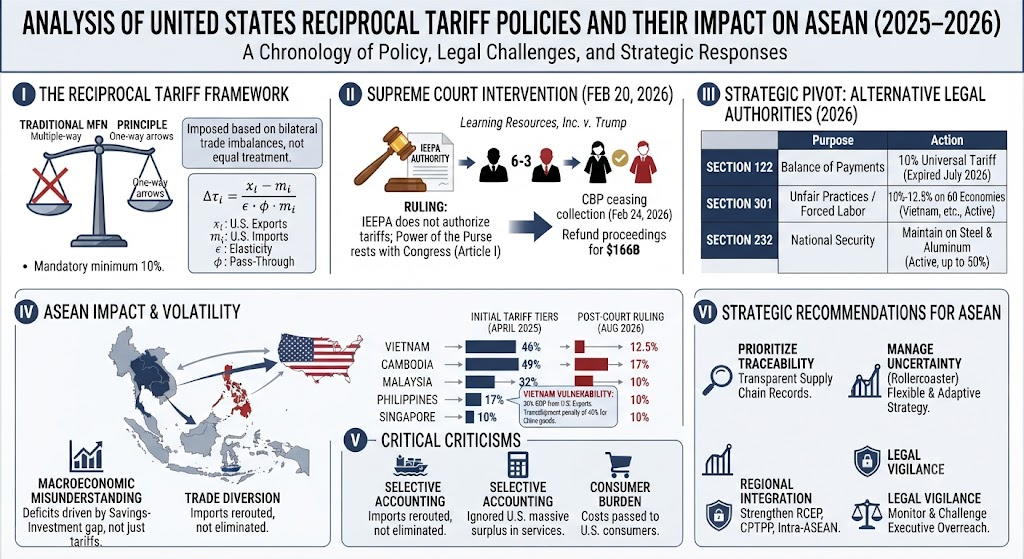
On April 2, 2025, designated as “Liberation Day” by the U.S. administration, the United States fundamentally altered its trade trajectory by announcing a “reciprocal tariff” system. This policy shifted the nation’s stance from multilateral trade liberalization toward aggressive protectionism. The primary objective was to eliminate bilateral trade deficits by imposing additional import duties on more than 180 trading partners.
The policy faced immediate legal challenges, culminating in a landmark U.S. Supreme Court decision on February 20, 2026 (Learning Resources, Inc. v. Trump). The Court ruled that the International Emergency Economic Powers Act (IEEPA) did not grant the President the authority to impose tariffs, effectively voiding the initial reciprocal tariff framework. Consequently, the administration pivoted to alternative legal authorities, including Section 122 and Section 301 of the Trade Act of 1974, to maintain its protectionist goals.
For the ASEAN region, the impact has been severe and volatile. Countries with significant trade surpluses with the U.S., such as Vietnam, Cambodia, and Laos, initially faced threatened tariffs as high as 46% to 49%. While legal rulings and subsequent negotiations have modified these rates, the period has been defined by extreme policy uncertainty, supply chain re-routing, and a concerted effort by ASEAN nations to diversify their trade partnerships.
I. The Reciprocal Tariff Framework: Policy and Rationale
Definition and Scope
The “Reciprocal Tariff” represents a departure from the Most Favored Nation (MFN) principle, which requires equal treatment of all trading partners. Instead, the U.S. sought to impose varying additional import duties based on the specific trade imbalances of each partner nation.
The Policy Formula
The Office of the U.S. Trade Representative (USTR) utilized a specific formula to determine these tariffs:
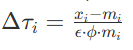
- x_i: U.S. exports to country i.
- m_i: U.S. imports from country i.
- \epsilon: Price elasticity of import demand.
- \phi: Import price pass-through.
In practical terms, the administration aimed for the tariff to be a function of the trade deficit divided by U.S. imports, with a mandatory minimum of 10 percent.
Stated Rationale
The administration argued that these measures were necessary for two primary reasons:
- Eliminating Deficits: Driving bilateral trade deficits to zero.
- Addressing “Unfair” Barriers: Counteracting foreign tariffs, non-tariff barriers (regulatory, environmental, and compliance hurdles), and currency manipulation/undervaluation.
II. Domestic Legal Challenges: The Supreme Court Intervention
The initial implementation of these tariffs relied on the International Emergency Economic Powers Act (IEEPA). This choice of legal basis led to a constitutional showdown in the case of Learning Resources, Inc. v. Trump (February 20, 2026).
The Ruling
By a 6–3 margin, the Supreme Court ruled that IEEPA does not authorize the President to impose tariffs. The Court held that the power to tax—which includes the imposition of tariffs—is a specific “branch of the taxing power” granted to Congress under Article I of the Constitution.
The “Major Questions Doctrine”
The Court applied the Major Questions Doctrine, asserting that when an executive agency (or the President) claims to exercise power of “vast economic and political significance,” the authority must be supported by “clear congressional authorization.” The Court concluded:
- IEEPA was intended for freezing assets and financial sanctions during foreign emergencies, not for broad-scale import taxation.
- The reciprocal tariffs, affecting trillions of dollars in trade across 180 partners, were a policy decision too significant to be inferred from an ambiguous statute.
Immediate Consequences
The ruling rendered the IEEPA-based tariffs void ab initio (invalid from the beginning). This led to:
- A cessation of IEEPA tariff collection by Customs and Border Protection (CBP) on February 24, 2026.
- Legal proceedings to refund approximately $166 billion in collected duties.
III. Strategic Pivot: Alternative Legal Authorities
Following the Supreme Court’s rejection of IEEPA, the administration utilized a layered system of domestic trade laws to maintain its tariff regime:
| Legal Authority | Purpose/Constraint | Application in 2026 |
| Section 122 (Trade Act of 1974) | Addresses “basic balance of payments” issues. | Imposed a 10% universal tariff for 150 days (expired July 24, 2026). |
| Section 301 (Trade Act of 1974) | Targets “unfair” trade practices or labor violations. | Applied a 10%–12.5% tariff to 60 economies (including Vietnam) following forced labor investigations (Active as of August 2026). |
| Section 232 (Trade Expansion Act of 1962) | National security protection for specific industries. | Maintained independent tariffs on steel, aluminum, and copper (up to 50%). |
IV. Impact on the ASEAN Region
ASEAN members faced varying levels of exposure based on their trade profiles. The initial “Reciprocal Tariff” list from April 2025 highlighted a structural paradox: small, developing nations dependent on U.S. exports faced the highest penalties.
Summary of Initial Reciprocal Tariff Tiers (April 2025)
- Singapore: 10% (U.S. Surplus of $2.8B).
- Philippines: 17% ($4.9B Deficit).
- Malaysia: 24% ($24.8B Deficit).
- Indonesia: 32% ($17.9B Deficit).
- Vietnam: 46% ($123.5B Deficit).
- Cambodia: 49% ($12.3B Deficit).
Case Study: Vietnam
Vietnam is highly vulnerable, as exports to the U.S. account for approximately 30% of its GDP.
- Tariff Volatility: Vietnam’s rates fluctuated wildly—from 46% (initial threat) to 10% (interim floor) to 20% (July 2025 framework) and finally to 12.5% under Section 301 as of August 2026.
- The Transshipment Penalty: A specific 40% penalty remains in effect for goods determined to be “transshipped” from third countries (primarily China) to evade tariffs. This creates significant risks for Vietnamese sectors (textiles, electronics) that rely on Chinese raw materials.
- Diplomatic Response: Vietnam has engaged in high-level dialogue to negotiate a “Reciprocal, Fair and Balanced Trade Agreement” to seek 0% tariffs on specific product categories.
Case Study: Singapore
Prime Minister Lawrence Wong characterized the tariffs as a threat to the global trading system, stating they are “not actions one does to a friend.”
- Response: Singapore established a national task force to provide financial aid and re-skilling programs for workers in affected sectors.
- Economic Strategy: A renewed emphasis on economic diversification and digital transformation to build long-term resilience.
Case Study: Indonesia
- Key Sectors: Textiles, footwear, and industrial machinery were most affected.
- Policy Shift: Indonesia signed a non-disclosure agreement on a reciprocal trade and investment security deal.
- Diversification: The country is actively pursuing market divergence toward BRICS nations, the Indonesia-EU CEPA, and accession to the CPTPP.
V. Critical Criticisms and Economic Counter-Arguments
The briefing context identifies several fundamental flaws in the reciprocal tariff logic:
- Misunderstanding Macroeconomics: Trade deficits are driven by national saving-investment gaps (low U.S. household savings and high federal deficits), not just foreign tariffs.
- Trade Diversion, Not Elimination: Tariffs often result in “trade diversion,” where imports are simply routed from a high-tariff country to a lower-tariff country, leaving the total U.S. global deficit unchanged.
- Selective Accounting: The reciprocal formula focuses exclusively on goods, ignoring the U.S. massive surplus in services and intellectual property. The U.S. is the world’s leading service exporter ($256B in 2024); excluding this data misleads the public regarding the “fairness” of the total trade balance.
- Consumer Burden: Empirical evidence from previous Section 301 tariffs suggests the economic incidence falls almost entirely on U.S. consumers and retailers through higher prices, rather than the foreign exporters.
VI. Strategic Recommendations for Stakeholders
- Prioritize Traceability: Businesses must maintain transparent supply chain records. With the 40% transshipment penalty in play, the ability to prove “substantial transformation” in the country of origin is essential.
- Manage for Uncertainty: The rapid shift between legal bases (IEEPA to Section 122 to Section 301) proves that policy uncertainty is a risk independent of the tariff rate itself. Strategy must be flexible enough to handle sudden rate changes.
- Regional Integration: ASEAN should continue its “hedging strategy”—refraining from direct retaliation while strengthening the RCEP, CPTPP, and intra-ASEAN markets to reduce over-reliance on the U.S. consumer market.
- Legal Vigilance: The U.S. judicial system remains a viable venue for challenging executive overreach. Stakeholders should monitor ongoing litigation regarding Section 122 and Section 301.
The Great Trade Reversal: 6 Surprising Realities of the New US Reciprocal Tariffs
On the morning of April 2, 2025—a date the administration triumphantly christened “Liberation Day”—the architecture of global commerce didn’t just shift; it shattered. For decades, the world operated under a consensus of liberalization that the United States itself had pioneered. In a single stroke, that era ended.
Consider the chaos for a business owner with a container ship halfway across the Pacific. On April 1, that cargo was a profitable venture; on April 2, it became a tax-heavy liability, as “Reciprocal Tariffs” of up to 49% were slapped on goods mid-transit. This sudden pivot toward aggressive protectionism has turned “rules-based trade” into a relic of the past, replaced by a volatile system where the rules of the game are rewritten via executive fiat.
As we analyze the fallout from late 2026, six surprising realities define this new, fragmented landscape.
1. “Liberation Day” Reached Far Beyond China
The primary shock of the April 2025 announcement was its sheer, systemic scale. This was not a surgical strike against a single geopolitical rival; it was a wholesale demolition of the multilateral trade system established in 1947. The administration moved against more than 180 trading partners simultaneously. By shifting from targeted enforcement to a broad-spectrum imposition of duties, the U.S. effectively signaled that the era of “Most Favored Nation” cooperation was dead, replaced by a regime of country-by-country confrontation.
2. The Math of Protectionism Punishes the Efficient
The logic of this new era is buried in a formula released by the Office of the U.S. Trade Representative (USTR). It is a “protectionist paradox” that turns the principle of comparative advantage on its head:
\Delta\tau_i = \frac{x_i – m_i}{\epsilon \cdot \phi \cdot m_i}
In this equation, x_i represents U.S. exports and m_i represents U.S. imports. Crucially, \epsilon (price elasticity) and \phi (tax pass-through rate) act as the government’s “levers.” By adjusting these variables, the USTR can manipulate final rates to hit specific policy targets, adding a layer of artificiality to the market. The result? The formula effectively punishes the efficient. Smaller, export-dependent nations in the ASEAN bloc—the very ones businesses turned to during the “China + 1” diversification trend—were hit with the highest penalties simply for being successful exporters.
Initial Reciprocal Tariff Rates (Announced April 2, 2025)
| Country | US Trade in Goods Surplus (Deficit)* | Reciprocal Tariff Rate |
| Singapore | $2.8B | 10% |
| Malaysia | ($24.8B) | 24% |
| Indonesia | ($17.9B) | 32% |
| Thailand | ($45.6B) | 36% |
| Vietnam | ($123.5B) | 46% |
| Cambodia | ($12.3B) | 49% |
*Based on 2024 USTR data (accessed April 2025). Values represent the U.S. perspective; parentheticals indicate a U.S. trade deficit.
3. The Erosion of the “Most Favored Nation” Principle
These tariffs represent a fundamental breach of the World Trade Organization (WTO) framework. The “Most Favored Nation” (MFN) principle—the bedrock of trade since 1947—requires countries to treat all trading partners equally.
“…each Member shall accord immediately and unconditionally to services and service suppliers of any other Member treatment no less favourable than that it accords to like services and service suppliers of any other country” (Article II:1 GATS / GATT 1994).
By imposing country-specific rates based on trade balances rather than uniform product categories, the U.S. has traded long-term predictability for short-term unilateral leverage.
4. The 2026 Plot Twist: The Court Defines a Constitutional Boundary
The most significant check on this policy didn’t come from the WTO, but from the U.S. Supreme Court. On February 20, 2026, in Learning Resources, Inc. v. Trump, the Court issued a stinging rebuke to executive overreach.
Applying the “Major Questions Doctrine,” the Court ruled that the power to tax—including the imposition of import duties—is a legislative prerogative under Article I of the Constitution. The President cannot use the International Emergency Economic Powers Act (IEEPA) to unilaterally tax global commerce without explicit, clear Congressional authorization. The initial reciprocal tariffs were declared void ab initio (invalid from the beginning), a rare instance of a domestic judiciary halting a global trade storm.
5. “Legal Laundering”: The Shell Game and Shadow Layers
The administration did not retreat after its Supreme Court defeat; it pivoted to what can only be described as a “legal shell game.” To maintain protectionist barriers, the government rapidly cycled through alternative legislative authorities to “launder” the tariffs into new forms:
- Section 122: Used for a 150-day window to address “balance of payments” emergencies.
- Section 301: The current resting place for the tariffs, justified via sprawling investigations into “forced labor.”
This maneuvering created a dizzying mutation of rates. For Vietnam, the duty plummeted from an initial 46% to a 10% floor during the Section 122 period, before creeping back up to 12.5% under Section 301 by August 2026.
Crucially, “shadow layers” remained untouched by the court ruling. A harsh 40% transshipment penalty persists for goods deemed to be bypassing China-specific duties via third countries. Furthermore, certain sectors remain under a separate 50% layer of Section 232 tariffs (steel and aluminum), independent of the broader reciprocal tariff fight.
6. The ASEAN Way: Hedging Over Retaliation
While many expected a global trade war, the ASEAN bloc chose a strategy of diplomatic hedging and non-retaliation. Recognizing that they lacked the leverage for a head-to-head fight, nations like Singapore and Vietnam focused on strengthening regional ties (RCEP/CPTPP) and diversifying away from U.S. dependency.
“The US may have decided to turn to protectionism, but the rest of the world does not have to follow the same path.” — Singapore PM Lawrence Wong
Rather than raising their own walls, these nations have turned to internal “deregulation” to lower business costs and engaged the U.S. in bilateral “Fair and Balanced” trade negotiations to seek specific carve-outs.
Conclusion: The Era of Discretionary Trade
We have moved from a rules-based system to one governed by the “Principle of Uncertainty.” In this fragmented future, the unpredictability of policy is as damaging as the tariffs themselves.
As the legal battles over Section 301 continue, global businesses are learning that no tariff rate is ever truly fixed. The Great Trade Reversal has proven that while the global system was built on transparency and rules, it currently runs on executive discretion and legal maneuvering. One must wonder: can we ever return to a predictable order, or was the era of “Most Favored Nations” merely a temporary ceasefire in a much longer history of protectionism?

No responses yet