
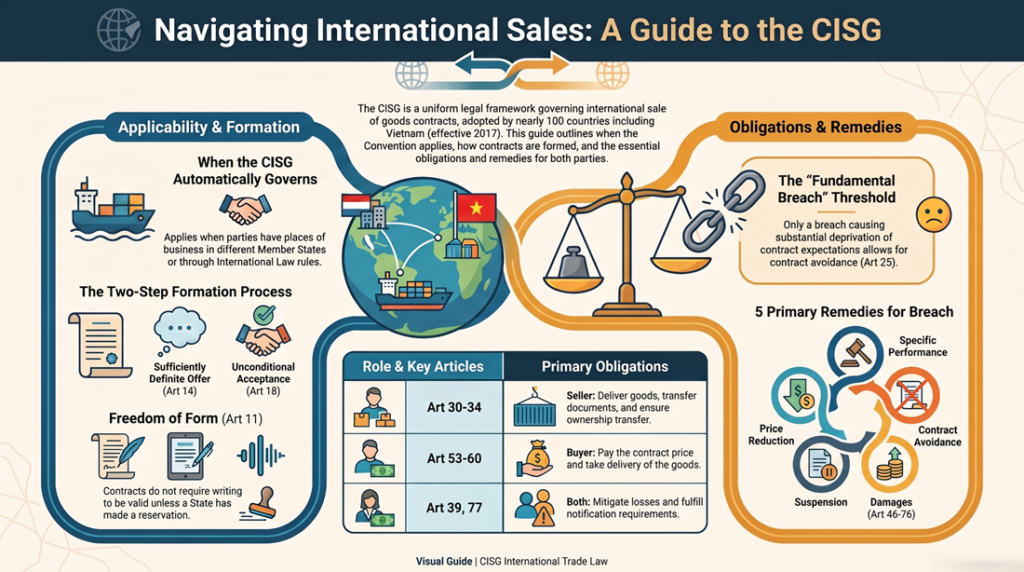
Since 1 January 2017, Vietnam has been a full member of the United Nations Convention on Contracts for the International Sale of Goods (CISG) — commonly known as the Vienna Convention 1980. As the 84th contracting state, Vietnam’s accession means that a large share of cross-border sale-of-goods contracts involving a Vietnamese buyer or seller are now automatically governed by CISG, whether or not the parties are aware of it. For foreign companies sourcing from Vietnam, selling into Vietnam, or negotiating framework agreements with Vietnamese manufacturers, understanding — and properly leveraging — CISG is no longer optional. It is a core part of contract risk management.
Why CISG Matters for Anyone Trading With Vietnam
Under Article 1 of the Convention, CISG applies to a contract for the sale of goods automatically when:
- The parties have their places of business in different CISG contracting states; or
- The rules of private international law lead to the application of the law of a contracting state; or
- The parties have expressly chosen CISG as the governing law.
Vietnam’s major trading partners — including the United States, China, Japan, South Korea, Germany, France, Australia, and most of the EU — are also CISG contracting states. This means that, in practice, the majority of international sale contracts touching Vietnam fall within CISG’s scope unless the parties have expressly opted out under Article 6.
Many standard-form contracts drafted by foreign counterparties already contain an express CISG exclusion clause — often in favour of a specific national law (English law, New York law, etc.) — bundled with an arbitration clause. Vietnamese exporters frequently sign these forms without recognising the implications, and end up litigating disputes under a legal framework they never actually considered.
Common Legal Pitfalls in Cross-Border Contracts With Vietnamese Parties
Through our contract review practice, ISC Global regularly identifies the following recurring issues:
- Unclear or conflicting governing-law clauses, especially where purchase orders and standard forms exchanged between the parties designate different national laws — a classic “battle of the forms” scenario that can leave the existence of a binding contract in doubt (as illustrated in the well-known U.S. case Hanwha Corp. v. Cedar Petrochemicals, Inc., 760 F. Supp. 2d 426 (S.D.N.Y. 2011), where a New York federal court applied CISG’s self-executing force after the parties failed to agree on a substitute governing law);
- Mismatched risk-transfer terms between the contract’s boilerplate language and the Incoterms rule actually referenced, creating ambiguity over who bears the loss if goods are damaged in transit;
- Missed notice deadlines for non-conforming goods — CISG requires notice within a “reasonable time” (Articles 38–39), a fact-specific and often shorter standard than parties expect, which can extinguish an otherwise valid claim;
- Premature contract avoidance — terminating a contract for a breach that does not meet CISG’s “fundamental breach” threshold (Article 25) can expose the terminating party to a counterclaim for damages;
- Overreaching damages claims that ignore the foreseeability limitation under Article 74, resulting in claims being partially or wholly disallowed by courts or arbitral tribunals.
Each of these risks is entirely preventable with proper contract drafting and pre-signature legal review.
Our CISG Legal Advisory Services
ISC Global’s advisory team combines formal legal training (LL.B.) with specialised coursework in international integration law — covering CISG, WTO dispute settlement, free trade agreements, and international investment law — together with hands-on experience reviewing hundreds of commercial contracts for manufacturers, exporters, and certification clients across Vietnam. Our CISG advisory services include:
- Applicability assessment — determining whether CISG governs a specific transaction or contract template;
- Contract review and drafting against a 10-point CISG compliance checklist covering delivery, conformity of goods, risk transfer, force majeure, damages, and dispute resolution;
- Comparative analysis between CISG, Vietnam’s Commercial Law 2005, and the Civil Code 2015 to identify the correct gap-filling law;
- Bilingual (English–Vietnamese) clause drafting for CISG election or exclusion, tailored to the client’s commercial strategy;
- Dispute advisory for claims involving non-conforming goods, late delivery, rejection of goods, contract avoidance, and damages calculation;
- In-house training for legal, procurement, and export-sales teams on practical CISG risk management.
Why Work With ISC Global
ISC Global operates combining international trade law advisory with deep, practical experience in international standards and certification consulting (ISO, FSC, CE Marking, GMP, EcoVadis, and more). For companies trading with Vietnam, this means a single point of contact for both contract legal risk and product/process compliance risk — two areas that, in practice, are rarely handled well by a single advisor.
Whether you are a foreign buyer negotiating your first supply agreement with a Vietnamese manufacturer, or a Vietnamese exporter reviewing a standard-form contract from an overseas client, our team can assess your exposure under CISG and recommend concrete contract language before you sign.
Contact Us for a Consultation
ISC Global Co., Ltd.
Hotline: +84 933 096 426 – +84 868 591 260
Email: info@iscglobal.asia | van.pham@iscglobal.asia
Website: iscglobal.asia | iscglobal.edu.vn
No responses yet