“The era of formalistic sustainability reports has closed. With the advent of the CSRD Directive and the ESRS Standards, the European Union is transforming ESG commitments from ‘voluntary’ to ‘statutory,’ reshaping the entire global supply chain.”
1. THE NATURE OF THE CHANGE: FROM THE CSRD DIRECTIVE TO THE ESRS STANDARDS
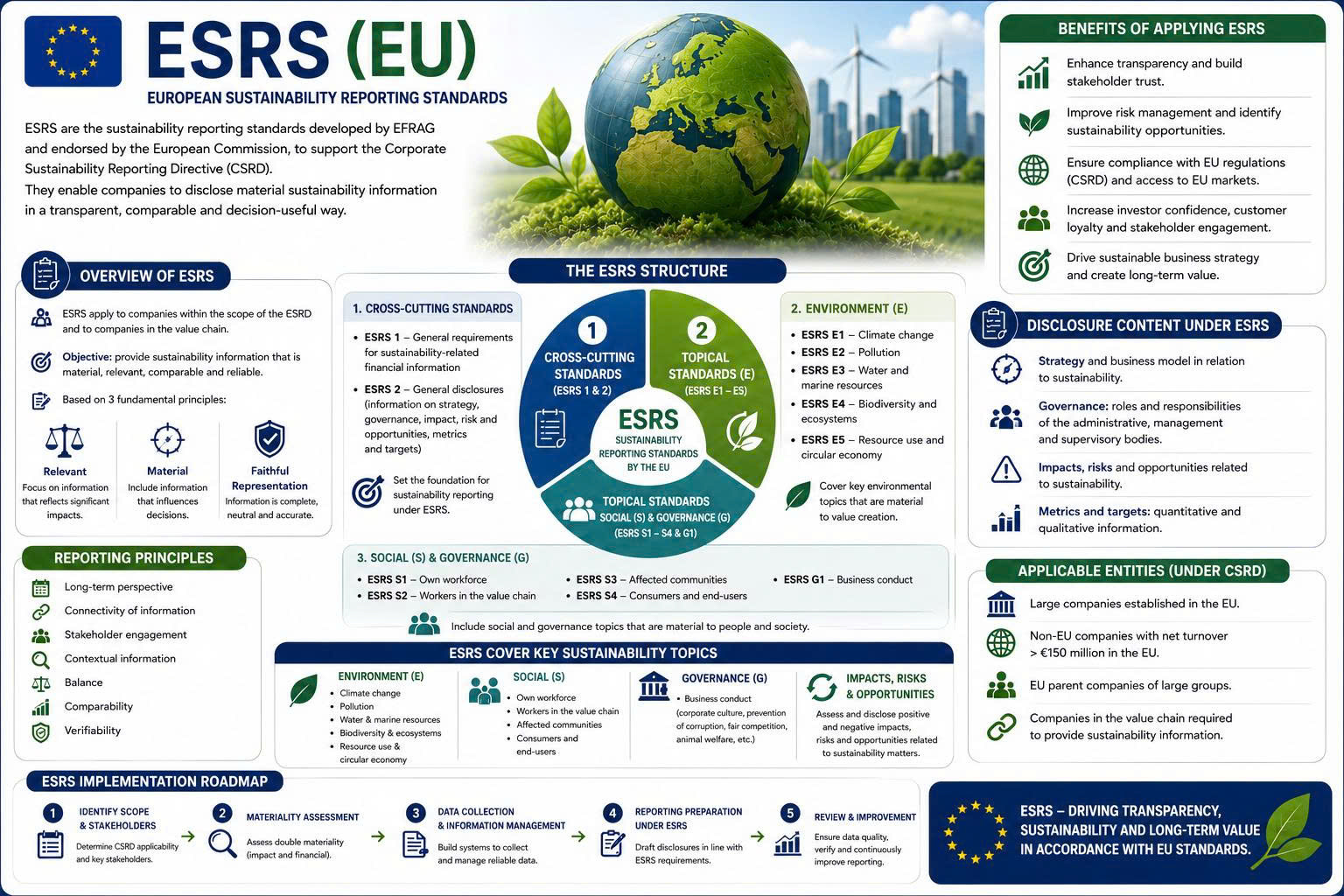
The European Union officially issued the Corporate Sustainability Reporting Directive (CSRD) to replace the former NFRD Directive. The CSRD requires sustainability data to be detailed, transparent, and equal in reliability to financial data.
To enforce the CSRD, the European Sustainability Reporting Standards (ESRS) were created. The core difference between ESRS and previous standards lies in Mandatory Assurance, meaning all disclosed metrics must be independently verified by a third party.
2. THE HEART OF ESRS: THE PRINCIPLE OF “DOUBLE MATERIALITY”
ESRS requires enterprises not to look from a single perspective but to evaluate risks and impacts through the lens of “Double Materiality.” This is the most complex challenge when implementing ESRS:
- Impact Materiality (Inside-Out): How does your enterprise positively or negatively impact the environment and people? (Example: How many tons of CO2 equivalent does production activities emit into the environment?)
- Financial Materiality (Outside-In): How do global ESG issues affect your cash flows, costs, and business risks? (Example: How will carbon taxes (CBAM) or climate change disrupting agricultural raw material sources increase production costs?)
3. THE 12-ESRS ECOSYSTEM: COVERING ALL ESG ASPECTS
ESRS does not allow the selection of “flattering” information for reporting. The standard set provides a comprehensive matrix of 12 standards:
Cross-cutting Standards Group (Mandatory):
- ESRS 1 & ESRS 2: General requirements on disclosure principles, ESG governance structure, risk management strategy, and target-setting methods.
Thematic Standards Group (Based on materiality assessment results):
- Environment (E1 – E5): Includes Climate Change (E1 – Mandatory Greenhouse Gas emissions inventory for Scopes 1, 2, and 3), Pollution (E2), Water & Marine Resources (E3), Biodiversity (E4), and Resource Use & Circular Economy (E5).
- Social (S1 – S4): Evaluates internal workforce (S1), value chain workers (S2 – Strict requirements for third-country suppliers), affected communities (S3), and consumers (S4).
- Governance (G1): Business ethics, anti-corruption, and corporate culture.
4. THE “TRICKLE-DOWN EFFECT”: DIRECT IMPACT ON VIETNAMESE ENTERPRISES
Do Vietnamese enterprises have to prepare ESRS reports?
Even if your enterprise has no branches in the EU, you are still heavily influenced by ESRS if you are part of a European partner’s supply chain.
To finalize their ESRS reports, EU corporations are required to collect data from upstream suppliers. This creates the “Trickle-Down Effect”:
- Scope 3 Data Pressure: EU customers will require you to provide accurate carbon emissions per unit of product.
- Risk Assessment Barriers (S2 & G1): You will have to pass rigorous audits on labor safety, human rights, and the environment (very similar to requirements from organizations like EcoVadis or SBTi).
- Risk of Losing Orders: If transparent data cannot be provided, brands will be forced to shift orders to other suppliers with better ESG capabilities to comply with EU law.
5. THE ESG TRANSFORMATION ROADMAP WITH ISC GLOBAL EXPERTS
Transforming data systems to meet ESRS is an interdisciplinary process requiring deep expertise in measurement techniques, regulations, and international management systems. ISC Global designs a 3-phase intervention roadmap to help enterprises master the new “rules of the game”:
Phase 1: Awareness & Internal Capacity Standardization (Training Solutions)
Deploying tailored training programs from management to technicians:
- Training on the methodology and practice of the “Double Materiality Assessment” tool.
- Technical training on Greenhouse Gas (GHG) Inventories according to IPCC methodology and ISO 14064 standards, directly meeting the ESRS E1 standard.
- Coaching on building flexible data compatibility frameworks between GRI, IFRS/ISSB, and ESRS.
Phase 2: Data Restructuring & Technical Consulting (Consulting Services)
ISC Global directly participates alongside the enterprise’s project management board to:
- Gap Analysis: Review current management systems (such as ISO 14001, ISO 45001, ISO 50001) to map directly to hundreds of ESRS datapoints, avoiding resource waste.
- Management Tool Setup: Build emission calculation tools (especially from wastewater treatment and energy consumption) and supplier risk assessment tools.
- Integrate ESRS reporting as leverage to improve EcoVadis scores and the factory’s SBTi target-setting roadmap.
Phase 3: Independent Assurance & Verification
Solving the mandatory requirements of the European market through reputable third-party evaluation services:
- Independent Assurance of Sustainability Report data, ensuring the integrity and transparency of emission data and labor metrics.
- Evaluation and certification of ISO management systems, creating a solid foundation to pass all screening rounds of global brands.
Today’s preparation determines your supplier eligibility for tomorrow. EU laws are narrowing the preparation time for businesses. Connect immediately with ISC Global’s team of experts to analyze the impact of ESRS on your supply chain and build a strategic action plan!
Contact us to download the bilingual English-Vietnamese PDF standard: from only $50
On the path toward integration and export, correctly understanding and applying international standards is essential. Yet language and technical terminology often pose real barriers. We are pleased to introduce our bilingual (English – Vietnamese) standards documentation service, translated by our own team of certification consultants.
What We Provide
• A clause-by-clause bilingual comparison, easy to consult and file.
• Professional Vietnamese translation in correct technical terminology, ready to use.
• Interpretation notes and application guidance from hands-on experts.
• Fast delivery in editable, easy-to-store PDF/Word format.
Standards Covered
ISO management systems (9001, 14001, 45001, 37001); sustainability certifications (ISCC, FSC, VFCS/PEFC); textiles and recycled materials (GRS, OCS, OEKO-TEX); social responsibility and ESG (SMETA, EcoVadis, Fairtrade), and many other industry standards upon request.
Why Choose Us
Our documents are translated by professionals who directly consult on and audit certifications, so the translation is accurate not only in language but also in real-world application — saving you time and reducing errors when preparing documentation.
Pricing
From only USD 50 per document, depending on length and complexity. Please send us the standard name to receive a free, accurate quotation.
How to Order
1. Contact us with the name of the standard you need.
2. Receive a quotation and delivery time.
3. Make payment and receive your document by email.
Payment
Bank transfer via QR code (provided with the quotation), or via PayPal: ducluongservices@gmail.com.
We look forward to accompanying you on your certification journey.
Best regards,
CONTACT INFORMATION
Hotline: +84 933096426 – +84 868 591 260
Email:
Website:
No responses yet