Vietnam remains one of Southeast Asia’s most attractive FDI destinations, driven by a strategic manufacturing base, an expanding consumer market, and an extensive network of free trade agreements. Yet since March 1, 2026, Law on Investment No. 143/2025/QH15 (“the 2025 Investment Law”) has officially replaced the 2020 Investment Law, introducing significant changes to licensing procedures, market access rules, and post-licensing supervision. For foreign investors, failing to align an investment plan with the new framework can mean delayed timelines, unnecessary costs, or outright rejection of an application.
Why Foreign Investors Need Specialized Legal Advisory
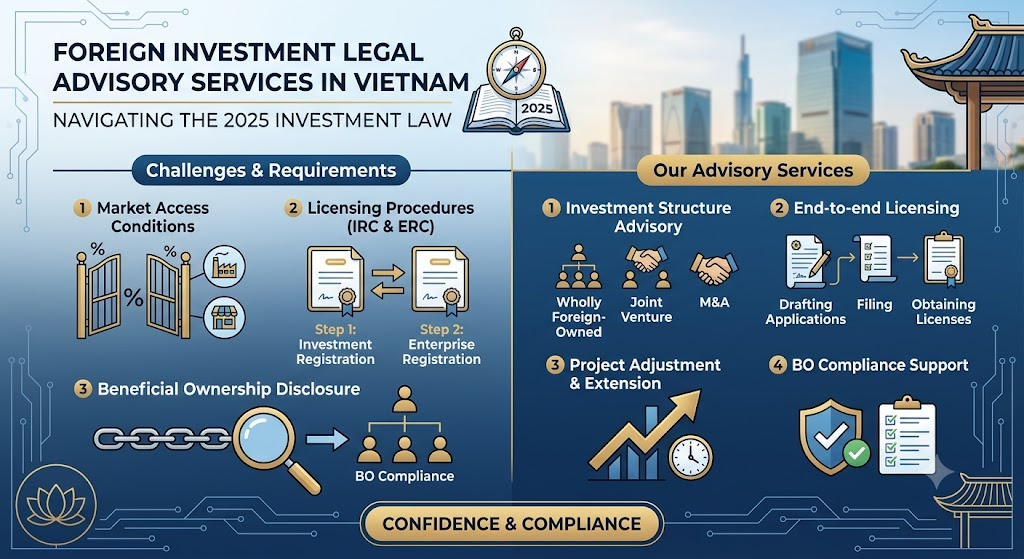
Unlike domestic investors, a foreign investor entering Vietnam must simultaneously navigate:
- Market access conditions specific to foreign investors under Article 8 of the 2025 Investment Law and Appendix I of Decree 96/2026/ND-CP, which impose additional requirements on ownership ratio, investment form, and scope of operation compared to domestic investors;
- A distinct licensing sequence: in-principle investment approval (where applicable), an Investment Registration Certificate (IRC), establishment of the economic organization, and an Enterprise Registration Certificate (ERC);
- Beneficial ownership (BO) disclosure obligations under Decree 168/2025/ND-CP, aimed at anti-money laundering compliance;
- Sector-specific rules on land, environment, labor, and food safety that often apply additional conditions to foreign-invested enterprises.
A single misclassification of the target sector, or an overlooked registration requirement once foreign ownership crosses the 50% threshold, can stall an entire transaction or force a costly restart of the licensing process.
Our Foreign Investment Legal Advisory Services
Backed by a dual background in investment law and international standards consulting (ISO, ESG), our team provides end-to-end legal advisory for foreign investors in Vietnam, covering:
1. Investment structure advisory
We assess and recommend the optimal investment vehicle for each client’s commercial objectives: a wholly foreign-owned enterprise, capital contribution or share/equity acquisition in an existing Vietnamese company, a Business Cooperation Contract (BCC), or project-based investment (including PPP structures).
2. Market access screening
We determine precisely whether the target sector falls under the list of prohibited sectors, conditional business sectors, or sectors subject to conditional market access for foreign investors under Appendix I of Decree 96/2026/ND-CP — reducing the risk of application rejection due to unrecognized market access restrictions.
3. End-to-end investment licensing
- Drafting and filing applications for in-principle investment approval where required;
- Obtaining or amending the Investment Registration Certificate (IRC);
- Establishing the economic organization and obtaining the Enterprise Registration Certificate (ERC), including advice on the new mechanism under Article 19 of the 2025 Investment Law that allows an economic organization to be established in parallel with, or ahead of, the IRC procedure for qualifying cases;
- Advisory on the special investment procedure available to projects located in industrial parks, export processing zones, hi-tech zones, and economic zones.
4. Project adjustment, extension, and termination
We assist investors with adjusting the in-principle approval or IRC when project scale, location, schedule, or technology changes, and advise on the conditions for extending a project’s operational term under Article 31 of the 2025 Investment Law and Article 28 of Decree 96/2026/ND-CP.
5. Beneficial ownership (BO) compliance
We review ownership structures to identify individuals qualifying as beneficial owners under both the ownership test and the control test set out in Decree 168/2025/ND-CP, and support timely, accurate disclosure filings.
Our Working Process
- Preliminary consultation (free of charge) — understanding investment objectives and an initial legal feasibility assessment;
- In-depth review — analysis of sector classification, investment form, and proposed ownership structure;
- Filing and execution — drafting, filing, and following up on applications with the competent authorities;
- Post-licensing support — handing over completed licenses and advising on ongoing reporting obligations.
Frequently Asked Questions
Must a foreign investor have an investment project before establishing a company in Vietnam? Under Article 19 of the 2025 Investment Law, a foreign investor may now establish an economic organization before completing the procedure to obtain or amend an Investment Registration Certificate, provided market access conditions are met at the time of establishment — a notable change from the 2020 Investment Law. The organization is still required to obtain an IRC as the legal basis for implementing its investment project.
How long does the investment licensing process typically take? Timelines vary depending on the sector, capital scale, and whether the project requires in-principle investment approval. We provide a project-specific estimate after reviewing the investor’s actual documentation.
Can a foreign-invested enterprise receive land use rights the same way a domestic enterprise can? Land use rights allocation to a foreign-invested economic organization is governed by separate rules under Vietnamese land law, depending on the form of land use and the project’s location. This is a critical item to review early in either a greenfield investment or an M&A transaction.
Contact Us for Business Advisory
ISC Global Co., Ltd. Hotline: +84 933 096 426 – +84 868 591 260 Email: info@iscglobal.asia | van.pham@iscglobal.asia Website: iscglobal.asia | iscglobal.edu.vn
Authorized Representative Partner in Vietnam – Duc Luong Services Hotline: +84 933 096 426 – +84 868 591 260 Email: ducluongservices@gmail.com Website: ducluongservices.com
STC VN Co., Ltd. (Staunchly Vietnam) Hotline: +84 933 096 426 – +84 868 591 260 Email: info@staunchlyservices.com.vn Website: staunchlyservices.com.vn
Beyond the 51% Rule: 5 Surprising Shifts in Vietnam’s New Foreign Investment Landscape
Vietnam remains a top-tier destination for foreign direct investment (FDI), yet the regulatory environment is undergoing its most profound transformation in a decade. The transition from the 2020 statutes to the Law on Investment 2025 (No. 143/2025/QH15) and the amended Law on Enterprises 2025 introduces significant “growing pains” that necessitate a complete rewrite of the foreign investor’s playbook. While the Law on Investment (LoI) 2025 officially takes effect on March 1, 2026, strategists must note that Appendix IV—the critical list of conditional business lines—is delayed until July 1, 2026. This four-month implementation gap, combined with a shift toward post-check compliance, means that by mid-2026, seasoned investors may find their established structures not only inefficient but legally vulnerable.
The 50% Threshold: Why One Percent Changes Everything
The most consequential shift is the refined “look-through” (soi chiếu) principle under Articles 20.1 and 20.2 of the LoI 2025. Historically, the 51% majority was the psychological and legal trigger for foreign restrictions. Under the new framework, the definitive ranh giới (boundary) has shifted to more than 50%.
If a foreign investor holds 50% or less of a company’s charter capital, the entity is treated as a “domestic” investor regarding market access and subsequent investment procedures. However, exceeding 50% by even a fraction triggers the full classification of a “Foreign-Invested Economic Organization” (FIEO). This constitutes a material threat to valuation if not managed correctly, as the entity suddenly inherits the same restrictive regulatory burden as a direct foreign entrant.
To navigate this, we now recommend a “Two-Stage Completion” mechanism for M&A. In Stage 1, investors should cap ownership at 49%. This provides a legal runway for pre-operational mobilization and fast-tracked domestic procedures. Stage 2—purchasing the remaining interest to hit 51%—should only be triggered as an “option” after critical Conditions Precedent (CPs), such as land use certificates and environmental licenses, are fully secured.
Principle of Look-Through: “A foreign-invested economic organization that has a foreign investor holding more than 50% of its charter capital… must satisfy the conditions and perform investment procedures as prescribed for foreign investors when (i) contributing capital or purchasing shares of another economic organization, or (ii) implementing other investment projects.” (Law on Investment 2025, Article 20.1)
The Great Sequence Reversal: Company First, License Later
Article 19.2 of the LoI 2025 and Decree 96/2026/NĐ-CP have upended the traditional “IRC-first” bottleneck. Foreign investors are now permitted to establish a legal entity—obtaining an Enterprise Registration Certificate (ERC)—before securing an Investment Registration Certificate (IRC).
- Strategic Advantage: This allows for immediate local presence, enabling the hiring of staff, leasing of office space, and opening of bank accounts without the 4–6 month wait for project approval.
- The Implementation Gap: Investors must be cautioned that while the law provides this right, as of mid-2026, local administrative desks are still finalizing the necessary forms and guidance. There is a tangible risk that the “local desk” may not yet be in sync with the national law.
- Repatriation Risk: This sequence reversal is a double-edged sword. If the IRC is subsequently denied, the investor is left with a functional legal entity but no legal basis for its underlying project, creating significant hurdles for capital repatriation.
Important New Point: “Clause 2, Article 19 of the Law on Investment 2025 allows foreign investors to establish an economic organization (apply for an ERC) before performing procedures for the issuance or adjustment of an IRC.”
The Transparency Trap: The Rise of the “Beneficial Owner” (BO)
In a bid to meet international FATF standards, Decree 168/2025/NĐ-CP now mandates the disclosure of “Beneficial Owners” (BO) for nearly all corporate forms, excluding state-owned or listed companies.
The criteria for disclosure are twofold:
- Ownership: Any individual holding 25% or more of charter capital or voting shares, whether directly or through intermediary holding structures.
- Control: Any individual with the power to appoint or dismiss key management, amend the charter, or dictate reorganization.
For privacy-conscious investors or those utilizing complex multi-layered holding structures, this transparency trap requires immediate attention during the due diligence phase. Failure to disclose or maintain accurate BO records can now derail a closing as effectively as a financial deficit.
Definition of BO: “Beneficial Owner is an individual who actually owns or controls a business… based on two criteria: ownership (holding 25% or more) and control (power to dominate key decisions).” (Decree 168/2025/NĐ-CP)
The “Fast-Track” Reality: Special Procedures & Post-Check Culture
Decree 96/2026 (Articles 46–50) introduces “Special Investment Procedures” designed to radically accelerate projects in specific zones. Eligible locations now include:
- Industrial Parks and Export Processing Zones.
- High-tech Zones and High-tech Digital Zones (khu công nghệ số tập trung).
- Free Trade Zones (khu thương mại tự do) and specific functional zones within Economic Zones.
Under this fast-track, traditional construction permits and Environmental Impact Assessment (EIA) reports are waived in favor of written commitments by the investor. However, this represents a fundamental shift from “Pre-check” (tiền kiểm) to “Post-check” (hậu kiểm). By signing a commitment, the liability moves entirely to the investor’s internal compliance team. Any failure to meet standards discovered during a post-check audit can trigger immediate work stoppages and heavy administrative penalties.
M&A Landmines: The Land and Environment Bottleneck
The 2026 framework reveals several “landmines” that can derail M&A deals, often due to seemingly minor business activities or historic oversights.
- The Rice/Sugar Trap: A target company may engage in the distribution of rice or sugar. While these may be insignificant revenue streams, they are restricted commodities for foreign entities. If an M&A deal takes a target company above the 50% threshold, it suddenly requires a specific “Retail Distribution License.” Without this difficult-to-obtain license, the entire deal can be blocked or the activity must be forcefully divested before closing.
- Land Use Reset: If a target company becomes an FIEO (51%+) while a Land Use Rights Certificate (LURC) application is pending, the process may be reset. The application will then be subjected to rigorous national security reviews, particularly if the land is in a sensitive area.
- Environmental Violations: Under the Law on Environmental Protection 2020, factories operating since 2020 without a valid Environmental License are in prolonged and serious violation. This is not merely a paperwork issue; it is a trigger for the mandatory suspension of operations. Investors must treat the absence of this license as a catastrophic risk to facility operation and valuation.
Warning on Legal Status: “The fact that the target company becomes a foreign-invested enterprise may affect the procedures for requesting a Certificate of Land Use Rights for the land plot… risking re-evaluation or suspension of the current application.”
Conclusion: The Agile Investor’s Path Forward
The 2025/2026 legal reforms in Vietnam offer a clear trade-off: unprecedented speed for heightened responsibility. While the framework removes administrative bottlenecks like the “IRC-first” requirement and pre-construction permits, it leaves no room for error in due diligence. Agile investors must pivot toward a compliance-first strategy, ensuring that land use rights, environmental permits, and “rice-trap” business lines are resolved before the ownership threshold is crossed.
In a system shifting from “permission” to “commitment,” is your internal compliance team ready to be the final arbiter of your legal safety?
No responses yet