

When a counterparty under-delivers, pays late, or ships defective goods, the instinct of many exporters and importers is to cancel the contract immediately. Under the CISG (Vienna Convention 1980), that instinct can backfire. The Convention only allows contract avoidance for a “fundamental breach” — a specific, fact-sensitive legal threshold — and getting this wrong can turn the party seeking to cancel into the party in breach. ISC Global’s advisory practice regularly walks exporters and importers through this exact analysis before a cancellation notice goes out.
The Legal Threshold: Article 25 CISG
Article 25 defines a fundamental breach as one that results in such detriment to the other party as substantially to deprive it of what it was entitled to expect under the contract — unless the breaching party did not foresee, and a reasonable person in the same circumstances would not have foreseen, that result. In practice, this means three things must be shown together:
- There must be an actual breach of a contractual obligation;
- That breach must substantially deprive the other party of what it reasonably expected from the contract;
- The breaching party must have foreseen, or a reasonable person in the same position would have foreseen, that consequence.
This is a materially higher bar than simply “the other side didn’t do what they promised.” Two real cases decided under CISG illustrate exactly how this plays out in opposite directions.
Case One: When Non-Payment Clearly Crosses the Line
In Doolim Corp. v. R Doll, LLC (U.S. District Court, Southern District of New York, 29 May 2009), a Korean garment manufacturer supplied goods to a U.S. buyer across multiple shipments. The buyer paid only USD 200,000 against an outstanding balance of over USD 1,040,000 — less than 20% of what was owed — and repeatedly fell behind on payment deadlines for prior shipments.
The court found this a clear fundamental breach under Article 25: paying less than a fifth of the contract price substantially deprived the seller of what it was entitled to expect — full payment within 15 days of delivery. The court also confirmed the seller’s right to invoke Article 72 (anticipatory avoidance): because the buyer’s pattern of non-payment made it clear that future obligations would not be met either, the seller was entitled to cancel the remaining, not-yet-due shipments without waiting for those breaches to actually occur.
Case Two: When a Few Days’ Delay Does Not
In Ego Fruits v. La Verja Begastri (Court of Appeal, Grenoble, France, 4 February 1999), a French buyer had agreed to receive a shipment of orange juice a few weeks earlier than originally scheduled, in exchange for a price discount. When the earlier delivery date arrived, the buyer refused to take delivery and asked for the goods on the original schedule instead.
The seller treated this as a fundamental breach and sought to avoid the contract. The French court disagreed: because the accelerated delivery was merely a reciprocal concession tied to a financial benefit, the buyer could reasonably regard a short delay in taking delivery as something the parties had not contemplated as triggering avoidance. The court held that the seller should instead have granted the buyer a reasonable additional period to take delivery — not moved straight to cancellation.
The Practical Takeaway
Read together, these two cases show that CISG tribunals look closely at degree and context, not just the fact of a breach:
- A payment shortfall below 20% of the contract price, combined with a documented pattern of prior delinquency, was enough to justify cancellation in Doolim.
- A delivery delay of a few days, arising directly from a mutually agreed schedule change, was not enough in Ego Fruits — the court expected the seller to grant additional time first.
Before declaring a contract avoided, a party should be able to show, with documentation, that the breach genuinely stripped it of the core benefit it bargained for — not merely that the counterparty missed a deadline or fell short on a technicality. Where the breach is arguably borderline, granting a reasonable additional period for performance (the approach implicit in CISG Articles 47 and 63) is generally the safer legal path than immediate cancellation.
Why This Matters for Contract Drafting, Not Just Disputes
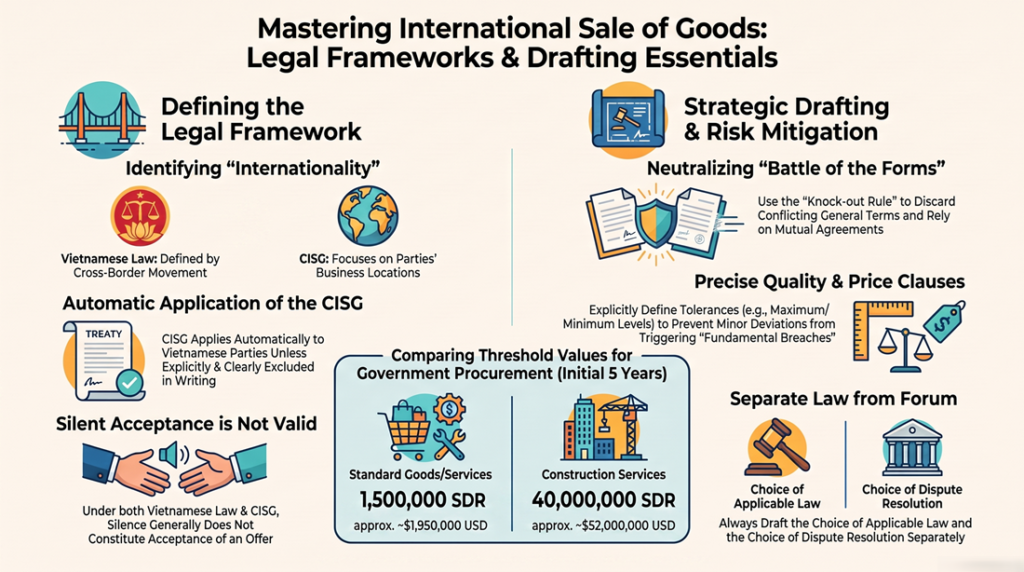
The lesson from these cases should also shape how sale contracts are drafted in the first place. Contracts that clearly define delivery windows, payment milestones, and quality tolerances — and that specify what level of shortfall constitutes a material breach — give both parties, and any eventual tribunal, an objective reference point instead of relying entirely on the general Article 25 standard after the fact.
How ISC Global Can Help
ISC Global advises exporters and importers on assessing whether a counterparty’s conduct meets the fundamental breach threshold before issuing a cancellation notice, on drafting contract clauses that reduce ambiguity around breach and remedies, and on structuring payment and delivery terms to minimize dispute risk from the outset.
Contact Us for a Consultation
ISC Global Co., Ltd.
Hotline: +84 933 096 426 – +84 868 591 260
Email: info@iscglobal.asia | van.pham@iscglobal.asia
Website: iscglobal.asia | iscglobal.edu.vn



No responses yet