In an era of tightening Extended Producer Responsibility (EPR) laws and Carbon Border Adjustment Mechanisms (CBAM), a loose marketing claim of “using recycled plastic” or “eco-friendly fibers” is no longer a safe promotional campaign; it is a legal and financial liability. If executive leadership still views the Global Recycled Standard (GRS) as a mere paper-collecting exercise to slap a green logo on packaging, your enterprise is exposing itself to severe trade fraud enforcement, greenwashing penalties (Greenwashing Penalties), and immediate expulsion from global retail supply chains. The GRS framework was not designed for casual recycling claims; it is a Recycled Material & Chemical Forensic System, dissecting the entire value chain—from scrap collection points and mechanical/chemical recycling processes to Manufacturing Restricted Substances Lists (MRSL) and labor conditions—into transparent, rigorously audited variables.
A forged or broken Transaction Certificate (Transaction Certificate−TC), an undetected trace of banned chemicals (APEOs,Phthalates) during dyeing or reprocessing, or an undeclared blend of virgin material (Virgin Material) will instantly trigger a system-wide certification revocation, invalidating export shipments and freezing corporate cash flow. Conversely, executing the GRS protocol with cold, uncompromising precision serves as an unassailable defensive shield—allowing manufacturers to master the circular materials game, neutralize audit liabilities, and safeguard net profit margins against international post-audit scrutiny.
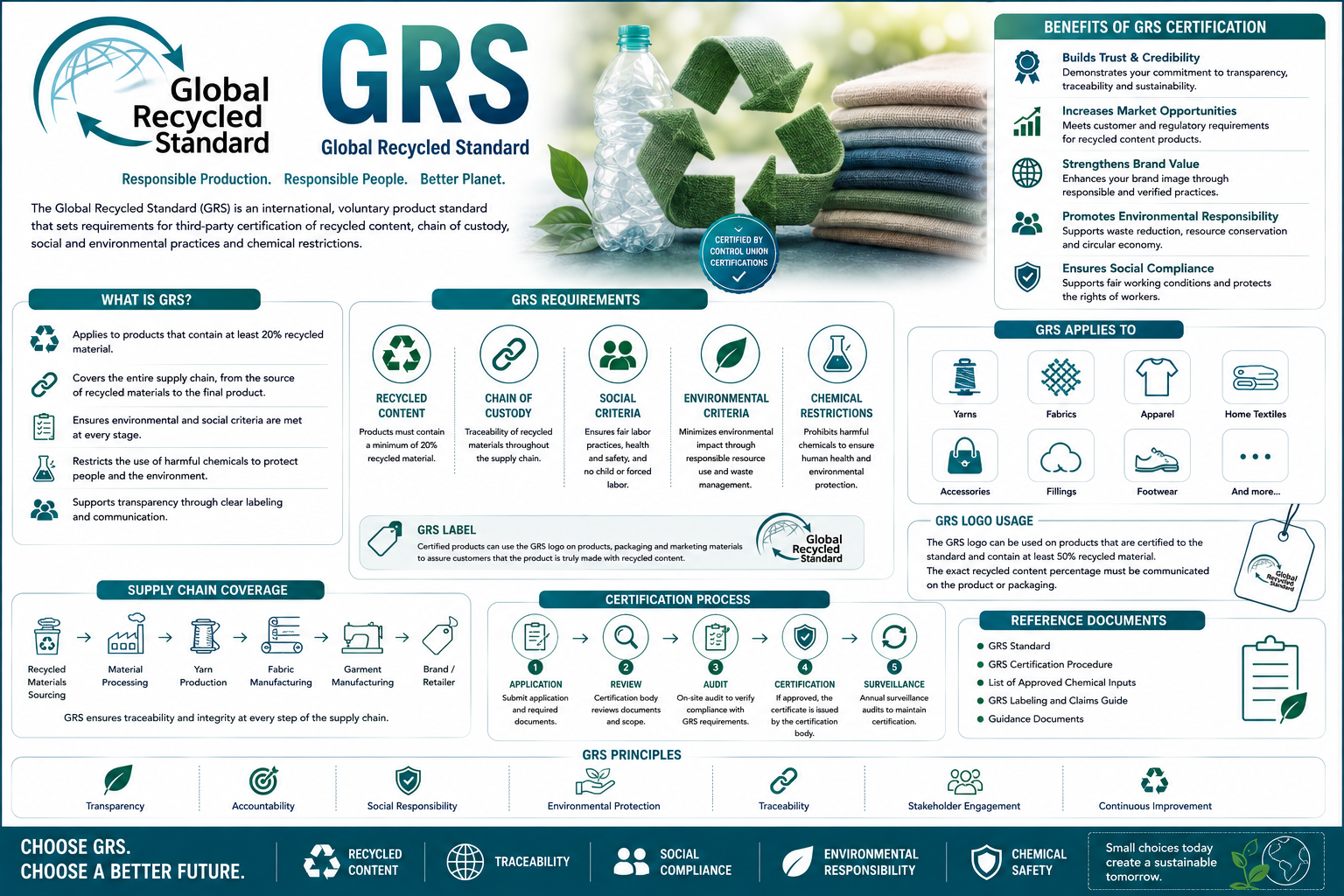
Circular Friction Reference Frame: The GRS framework does not accept unverified recycling statements; it measures compliance through chain of custody integrity (Chain of Custody), verified recycled content ratios (Recycled Content ≥20%), and the 100% continuity of the Transaction Certificate chain (TC Chain). We structure the GRS framework around hard quantitative variables: Pre-consumer vs. Post-consumer scrap segregation ratios, Manufacturing Restricted Substances List compliance (MRSL Compliance), and material loss tolerance bounds (Material Loss Tolerance ≤2%). A supply chain that fails to govern these metrics effectively surrenders its market share to international competitors.
For Chief Operating Officers (COOs), Chief Procurement Officers (CPOs), and Supply Chain Risk Auditors, mastering the GRS architecture is an absolute strategic imperative to lock down legal liabilities, neutralize greenwashing penalties, and secure a dominant position in global value chains.
1. System Anatomy: Three Structural Control Pillars Shaping the Circular Defense Capability of GRS
The core architecture of the GRS audit framework is dissected into three uncompromising control pillars that directly determine the legal validity and commercial survivability of products in international markets:
Pillar 1: Input Scrap Forensics & Chain of Custody Lock
- Pre-Consumer vs. Post-Consumer Input Verification: Enforcing strict segregation at the source. Pre-consumer (industrial waste diverted from the waste stream) and Post-consumer (waste generated by end-users) must be completely segregated from the collection stage. Products must contain a minimum of 20% recycled content to qualify for GRS certification, and a minimum of 50% to carry the consumer-facing GRS logo.
- Material Stream Lock via TC System: Every batch of material moving through processing stages (collection, shredding, spinning, weaving, finishing) must be accompanied by an official Transaction Certificate (TC) issued by an accredited certification body. Missing a single TC at any link immediately breaks the chain, stripping the final product of its GRS status.
Pillar 2: Rigorous Chemical Audit & Environmental Control
- Eradication of Banned Chemicals (Strict MRSL Compliance): GRS enforces a strict Manufacturing Restricted Substances List (MRSL). It completely bans substances causing mutagenic, reproductive, or bioaccumulative hazards (such as Phthalates, Heavy Metals, Alkylphenol Ethoxylates – APEOs, and PFAS). All chemicals used in processing facilities must carry verified Safety Data Sheets (SDS) and pass intake screening.
- Wastewater & EMS Environmental Audit: Manufacturing facilities must maintain a certified Environmental Management System (EMS). Wastewater from processing and dyeing operations must undergo strict audits for COD,BOD, pH levels, and heavy metal limits prior to discharge, ensuring zero secondary environmental contamination.
Pillar 3: Social Accountability & Labor Standards Forensic Audit
- International Labor Organization (ILO) Compliance: GRS goes beyond material tracking by directly auditing factory social conditions. Child labor and forced labor are strictly prohibited; workplaces must guarantee occupational safety, maximum working hours, living wages, and freedom of collective bargaining.
- Occupational Health & Safety (OHS): Auditing fire safety infrastructure, Personal Protective Equipment (PPE) for workers handling recycled chemical treatments, and mandatory safety training logs.
2. Operational Mechanics: The Risk Scanning and Valuation Algorithm of GRS
To ensure GRS does not degenerate into a performative paperwork routine, independent certification bodies apply strict material balance verification filters:
- Mass Balance Verification Filter: The audit system cross-examines incoming scrap volume against outgoing finished product weight. If a facility purchases 10 tons of PET scrap but issues 15 tons of GRS-certified yarn/pellets without proof of origin, the system instantly flags a virgin material contamination alert (Virgin Material Contamination) and freezes the facility’s certificate.
- Recycled Transformation Efficiency Formula:GRS Material Integrity Ratio=Total Input Scrap Volume (kg)−Process Waste (kg)TC-Certified Output Volume (kg)×(1−100MRSL Chemical Variance)This engine helps enterprises determine exact operational yield: maximizing the transformation of scrap into certified GRS products while holding chemical non-compliance variance at absolute zero.
- Unannounced Audit Matrix: Certification bodies retain the right to conduct unannounced, on-site inspections. Detecting unapproved chemicals or unverified material blending leads to immediate certificate suspension across the global Textile Exchange database.
3. Strategic Balance Sheet: Corporate Valuation Through the GRS Control Metric
Rigorous execution of the GRS framework establishes a stark divide between manufacturers with transparent circular supply chains and reactive, high-risk contract processors:
| Strategic Financial Indicators | Manufacturers Mastering GRS Architecture | Passive & Non-Certified Processors |
|---|---|---|
| Contract Cancellation & Greenwashing Risk | Near 0%. All products are backed by unbroken TC chains and transparent MRSL chemical testing logs. | Severe financial exposure. High risk of canceled purchase orders, heavy fines, and import rejections under EU/US anti-greenwashing laws. |
| Pricing Power & Net Margins | Command Premium Pricing. Generates higher margins by supplying verified sustainable materials to global brand owners (Nike, Adidas, H&M, IKEA). | Low & Squeezed Margins. Trapped in low-tier commodity contract manufacturing; facing relentless price competition and paper-thin margins. |
| Global Client Retention Rate | Reaches 95-98%. Becomes an irreplaceable strategic partner within the sustainable supply chain networks of multinational brand owners. | Easily substituted by competitors whenever buyers demand valid TC files or environmental compliance records. |
4. The 4-Step Attack Roadmap: Eliminating Fraud Risks, Locking In GRS Standards
To ensure 100% of recycled products achieve absolute material integrity and hold valid GRS transaction certificates, enterprises must execute a four-phase operational rollout:
- Step 1 – Material Stream Audit & Source Segregation: Review all upstream suppliers. Strictly segregate Pre-consumer and Post-consumer scrap streams. Establish physical warehouse barriers separating recycled materials from virgin stock.
- Step 2 – MRSL Chemical Lockdown & EMS Upgrades: Replace all non-compliant chemicals, dyes, and auxiliaries with MRSL-approved alternatives. Upgrade wastewater management infrastructure and maintain complete occupational safety documentation.
- Step 3 – TC Management Protocol Execution: Train logistics and import/export teams on issuing and claiming Transaction Certificates (TC) for every incoming

Contact us to download the bilingual English-Vietnamese PDF standard: from only $50
On the path toward integration and export, correctly understanding and applying international standards is essential. Yet language and technical terminology often pose real barriers. We are pleased to introduce our bilingual (English – Vietnamese) standards documentation service, translated by our own team of certification consultants.
What We Provide
• A clause-by-clause bilingual comparison, easy to consult and file.
• Professional Vietnamese translation in correct technical terminology, ready to use.
• Interpretation notes and application guidance from hands-on experts.
• Fast delivery in editable, easy-to-store PDF/Word format.
Standards Covered
ISO management systems (9001, 14001, 45001, 37001); sustainability certifications (ISCC, FSC, VFCS/PEFC); textiles and recycled materials (GRS, OCS, OEKO-TEX); social responsibility and ESG (SMETA, EcoVadis, Fairtrade), and many other industry standards upon request.
Why Choose Us
Our documents are translated by professionals who directly consult on and audit certifications, so the translation is accurate not only in language but also in real-world application — saving you time and reducing errors when preparing documentation.
Pricing
From only USD 50 per document, depending on length and complexity. Please send us the standard name to receive a free, accurate quotation.
How to Order
1. Contact us with the name of the standard you need.
2. Receive a quotation and delivery time.
3. Make payment and receive your document by email.
Payment
Bank transfer via QR code (provided with the quotation), or via PayPal: ducluongservices@gmail.com.
We look forward to accompanying you on your certification journey.
Best regards,
CONTACT INFORMATION
Hotline: +84 933096426 – +84 868 591 260
Email:
Website:
No responses yet