For more than three decades, ISO 9001 has been the world’s most widely adopted international standard for quality management systems (QMS), with well over a million certificates issued across virtually every industry and country. It is far more than a certificate on the wall — it is a management framework that helps organizations standardize processes, improve product and service quality, and strengthen competitiveness in both domestic and international markets. 2026 marks a particularly important milestone, as the revised ISO 9001:2026 standard is expected to be published later this year, succeeding the current ISO 9001:2015 edition after more than a decade in force. This guide explains what ISO 9001 is, its core structure and principles, the business case for certification, and what’s changing with the upcoming revision.
1. What Is ISO 9001?
ISO 9001 is an international standard published by the International Organization for Standardization (ISO) that specifies requirements for a quality management system. It is applicable to organizations of any size or sector — from manufacturing plants and service companies to construction firms and public administration bodies.
The current edition in force, ISO 9001:2015, is built on the High Level Structure (Annex SL) shared with other management system standards such as ISO 14001 (environment) and ISO 45001 (occupational health and safety), making it straightforward for organizations to integrate multiple management systems under a single governance framework.
2. The Seven Quality Management Principles Behind ISO 9001
All requirements in ISO 9001 are built on seven core quality management principles:
- Customer focus: Every activity of the organization should be aimed at meeting and exceeding customer expectations.
- Leadership: Top management must establish a unified vision and direction, and create conditions for people to engage with quality objectives.
- Engagement of people: Competent, empowered and engaged people at all levels are essential to enhancing the organization’s capability to create value.
- Process approach: Consistent and predictable results are achieved more effectively when activities are managed as interrelated processes.
- Improvement: Successful organizations maintain an ongoing focus on continual improvement to respond to changes in internal and external conditions.
- Evidence-based decision making: Decisions based on the analysis of data and information are more likely to produce the desired results.
- Relationship management: Organizations manage relationships with interested parties, such as suppliers, to optimize their impact on performance.
These principles serve as the compass guiding organizations toward genuinely effective quality management — not merely toward passing a certification audit.
3. Structure of ISO 9001:2015
ISO 9001:2015 is organized into 10 clauses, with clauses 4 through 10 containing the mandatory requirements organizations must meet:
- Clause 4 – Context of the organization: Identifying internal and external issues and the needs of interested parties.
- Clause 5 – Leadership: Top management’s role and commitment to the quality management system.
- Clause 6 – Planning: Addressing risks, opportunities, and quality objectives.
- Clause 7 – Support: Resources, competence, awareness, communication, and documented information.
- Clause 8 – Operation: Planning and controlling operational processes, from design through delivery.
- Clause 9 – Performance evaluation: Monitoring, measurement, analysis, internal audit, and management review.
- Clause 10 – Improvement: Handling nonconformities, corrective actions, and continual improvement.
A defining feature of ISO 9001:2015 compared with earlier editions is the adoption of risk-based thinking throughout the entire system, replacing the narrower preventive-action approach of previous versions.
4. Benefits of Implementing and Certifying to ISO 9001
Standardized processes, fewer defects. When operations are documented and tightly controlled through standardized procedures, organizations significantly reduce errors, defective products, and returns — translating directly into cost savings and improved margins.
Market access and competitiveness. Many large customers, multinational corporations, and government agencies require ISO 9001 certification as a mandatory condition in supplier qualification and tender processes. Holding this certification opens the door to larger markets, projects, and supply chains.
Stronger governance. Leadership gains a scientific, transparent management tool built on measurable indicators and periodic review processes, enabling faster and more accurate decision-making.
Improved customer satisfaction. With end-to-end quality control from inbound materials to final delivery, organizations are better positioned to meet rising customer expectations for consistent quality.
Global brand credibility. ISO 9001 is recognized and applied in nearly every country, functioning as a common language that helps organizations demonstrate quality management competence to international partners and buyers.
5. Important Update: The ISO 9001:2026 Revision
This is critical information for any organization currently certified to, or planning to implement, ISO 9001 in 2026. After more than a decade of ISO 9001:2015 being in force, ISO Technical Committee TC 176/SC 2 has completed the Final Draft International Standard (FDIS), with ISO 9001:2026 expected to be formally published around September 2026.
According to major certification bodies including SGS, DNV, BSI and Intertek, this revision is confirmed to be an evolutionary update rather than a full overhaul — the core framework, process approach, and fundamental requirements of the 2015 edition remain intact. Notable additions include:
- Greater emphasis on quality culture and ethical behaviour within organizations.
- Clarified and strengthened requirements around risk management.
- Explicit incorporation of climate change and sustainability considerations into the organizational context (Clause 4).
Organizations already certified to ISO 9001:2015 will have a standard three-year transition period, with existing certificates remaining fully valid until approximately September 2029. There is no need to rush, but organizations should begin planning their transition early to avoid a last-minute scramble as the deadline approaches.
6. Who Should Implement ISO 9001?
ISO 9001 is applicable to virtually any type of organization, but delivers particularly strong value for:
- Manufacturers seeking to standardize processes and reduce defect rates
- Exporters needing to meet international customer and buyer requirements
- Contractors and construction firms bidding on large-scale or government-funded projects
- Service providers (logistics, consulting, education, healthcare) looking to improve operational consistency
- Organizations already implementing other management systems (ISO 14001, ISO 45001) that want an integrated governance framework
7. Why Work With Our Training, Consulting and Certification Services
Building and maintaining an ISO 9001-compliant quality management system requires in-depth knowledge of the standard, hands-on implementation experience across diverse industries, and the ability to stay current with evolving requirements — especially during the upcoming transition to ISO 9001:2026.
ISC Global, Duc Luong Services, and STC VN Co., Ltd. (Staunchly Vietnam) provide an end-to-end solution to help organizations:
- Awareness training on ISO 9001 requirements and quality management thinking for all staff levels, from senior leadership to frontline employees.
- Documentation and process consulting, building procedures, forms and records tailored to each organization’s actual operations rather than generic templates.
- Internal auditor training, equipping teams to independently maintain the system after certification.
- Certification body coordination, connecting organizations with internationally recognized certification bodies for a smooth, well-managed audit process.
- Transition planning support for the upcoming move to ISO 9001:2026 once the revised standard is formally published.
Our consultants bring hands-on experience implementing ISO 9001 across hundreds of organizations in Vietnam spanning manufacturing, construction, food, logistics and services — allowing us to design practical, industry-specific pathways to certification and long-term quality management maturity.
Contact Us for Business Consultation
ISC Global
Hotline: +84 933 096 426 – +84 868 591 260
Email: info@iscglobal.asia | van.pham@iscglobal.asia
Website: iscglobal.asia | iscglobal.edu.vn
ISO 9001:2026 and the New “Harmonised” Era: 5 Takeaways Every Leader Needs to Know
1. Introduction: The Hidden Operating System of Modern Business
Think about the last time you used a coffee machine that didn’t leak, boarded a flight that landed five minutes early, or used a cloud app that didn’t crash right when you hit the save button. We often take these smooth experiences for granted, but they are never accidental. They exist because of a hidden backbone: a documented, obsessive, and continuously improving quality management system (QMS).
As a lead auditor, I have seen too many executives treat ISO 9001 as a “clipboard exercise”—a tedious hurdle to clear for a certificate. In reality, quality is the operating system or source code of the entire enterprise. ISO 9001 serves as this source code, guiding over a million organizations globally. We are now entering an evolutionary era with the transition from the 2015 version to the upcoming ISO 9001:2026 revision. Think of this as a “Version 2.0” upgrade; it is not a radical overhaul of the rules, but a structural and cultural refinement designed to make your business faster, more integrated, and far more resilient.
2. From HLS to “HS”: The Structural Upgrade You Didn’t Know You Needed
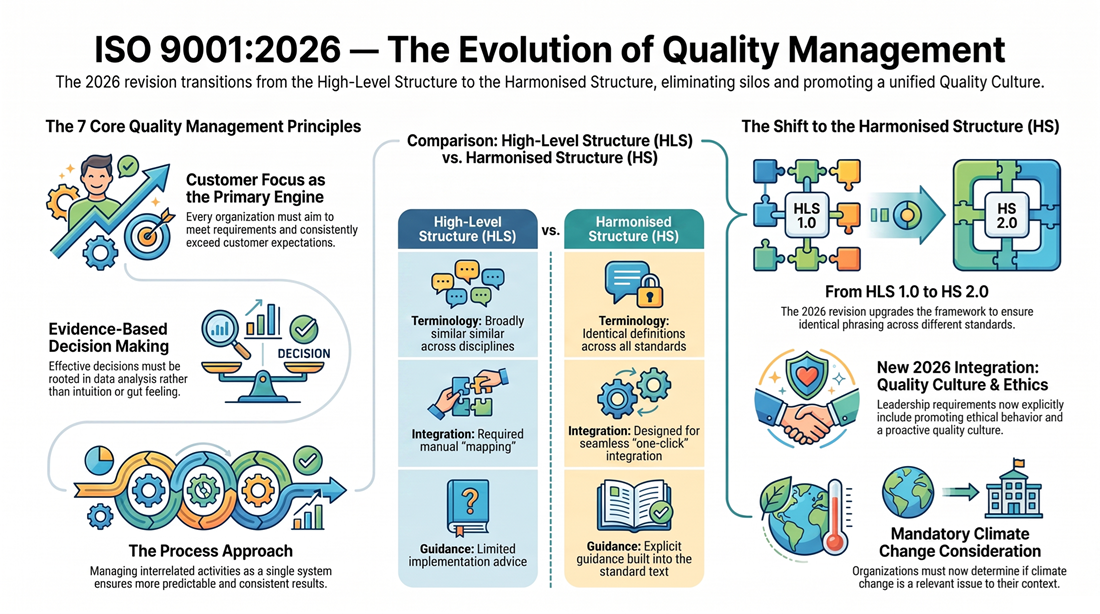
The most significant architectural shift in the 2026 revision is the transition from the High-Level Structure (HLS) to the new Harmonised Structure (HS). While the HLS, published in 2012, gave us a common language, the HS is the “plug-and-play” architecture the modern CEO needs. It allows leadership to view Risk, Environment, and Quality through a single pane of glass, rather than through competing silos.
The HS streamlines terminology and requirements to allow for “one-click” integration between different disciplines. If you are looking at a requirement in Quality (ISO 9001), it will now use identical phrasing in Environmental (ISO 14001) or Safety (ISO 45001) standards wherever possible.
| High-Level Structure (HLS) Base | Harmonised Structure (HS) Upgrade |
| Clause 1 (Scope): Focused on general descriptions. | Now explicitly includes the intended results of the management system. |
| Clause 3 (Terms): Definitions often referenced in separate documents. | Definitions must now be included within each standard for immediate clarity. |
| Clause 6.3 (Change): Planning of change was not a universal requirement. | Now a mandatory, universal requirement for all ISO management systems. |
| Clause 8 (Operations): Used the restrictive term “outsourced” processes. | Updated to “externally provided” to cover a broader range of modern supply chain realities. |
“The transition from the High-Level Structure (HLS) to the Harmonised Structure (HS) is essentially an ‘upgrade’ to the universal blueprint used for ISO standards… Think of it as moving from Version 1.0 to Version 2.0 of a master template.”
3. Quality Culture and Ethics: Moving Beyond the Policy Statement
We are finally seeing the standard catch up to organizational reality. A major entry in the 2026 draft is found in Clause 5.1 (Leadership and commitment), which now explicitly requires “Promoting quality culture and ethical behaviour.” This is not a suggestion; it is an auditable requirement.
As auditors, we are moving past “check-signing” leadership. We will no longer just look for a signed policy in the lobby; we will look for behavioral evidence that quality and ethics permeate the organization. Significantly, this theme is not isolated to leadership; it is also referenced in two other clauses in the new draft, signaling that culture is the responsibility of the entire collective. In future audits, expect us to be “on the floor” (the Gemba) interviewing staff to see if the culture exists in practice, rather than just in a manual on a shelf.
4. The Climate Change Clause: A New Mandatory Consideration
The 2026 revision fully integrates the Climate Action Amendments catalyzed by the 2021 London Declaration. These amendments are now permanent fixtures in the core requirements of the standard, specifically within Clause 4.1 and Clause 4.2.
- Clause 4.1 (Context): The organization shall determine whether climate change is a relevant issue.
- Clause 4.2 (Interested Parties): Leaders must note that relevant interested parties may have requirements related to climate change.
It is critical to understand the distinction here: the standard does not mandate that a quality-focused machine shop must “fix” the climate. However, it forces you to evaluate the impact of climate change on your ability to achieve quality results. If rising temperatures or severe storms could disrupt your supply chain or affect material consistency, you must account for that risk.
5. The “90% Rule”: Unmasking the Hidden Costs of Quality
The financial implications of a weak QMS are staggering. The 2025 ASQE Insights on Excellence report reveals that up to 90% of quality-related costs—engineering time, shipping delays, and lost orders—are often hidden from view. Perhaps most dangerously, only 31% of organizations actually understand their quality costs, meaning the remaining 69% are bleeding capital through an invisible “iceberg” of waste.
To capture these costs, leaders must avoid these common, resource-draining mistakes:
- Weak internal audits: Skipping audits or treating them as a formality allows recurring issues to stay hidden until they reach the customer.
- Lack of top management commitment: When objectives aren’t backed by assigned ownership and funding, the system stagnates.
- Inadequate supplier management: Failing to monitor external providers leads to supply chain interruptions that derail production.
“Toyota employees filed ≈ 810,000 ideas in 2023—about 14 per person—thanks to its 70-year-old Suggestion System.”
6. Streamlined Improvement: The Consolidation of Clause 10
The 2026 revision simplifies the path to excellence by merging Clause 10.1 and Clause 10.3 into a single, consolidated requirement for “Continual Improvement.” This isn’t just a wording change; it reflects a shift toward a more agile, data-driven approach.
The new “connected guidance” explicitly identifies emerging technologies, digitalization, and reliable data as the essential tools for modern improvement. This move validates the use of real-time monitoring and advanced analytics to fuel the Plan-Do-Check-Act (PDCA) cycle. In this era, if it isn’t measured with reliable data, it isn’t being improved.
“Quality Management Principles are the philosophical backbone of the system. The ‘why’ behind the ‘what.’… mastering ISO 9001 is less about simply collecting certificates and more about turning seven timeless principles into daily muscle memory.”
7. The Three-Year Countdown
The countdown has officially begun. The final release of ISO 9001:2026 is expected in the Fall of 2026 (likely October or November). However, the work for the ISO committees starts much sooner; the disposition of comments received on the current draft is scheduled for the first months of 2026.
Once published, you will have a three-year transition period (until late 2029) to migrate your certification. But do not wait until the final hour. The transition to the 2026 version is your opportunity to move beyond basic compliance. Ask yourself: “Is my Quality Management System a static manual, or is it a living part of my culture?” When quality culture drives every decision, your QMS stops being a burden of paperwork and becomes genuine competitive armor.
Contact us to download the bilingual English-Vietnamese PDF standard: from only $50
On the path toward integration and export, correctly understanding and applying international standards is essential. Yet language and technical terminology often pose real barriers. We are pleased to introduce our bilingual (English – Vietnamese) standards documentation service, translated by our own team of certification consultants.
What We Provide
• A clause-by-clause bilingual comparison, easy to consult and file.
• Professional Vietnamese translation in correct technical terminology, ready to use.
• Interpretation notes and application guidance from hands-on experts.
• Fast delivery in editable, easy-to-store PDF/Word format.
Standards Covered
ISO management systems (9001, 14001, 45001, 37001); sustainability certifications (ISCC, FSC, VFCS/PEFC); textiles and recycled materials (GRS, OCS, OEKO-TEX); social responsibility and ESG (SMETA, EcoVadis, Fairtrade), and many other industry standards upon request.
Why Choose Us
Our documents are translated by professionals who directly consult on and audit certifications, so the translation is accurate not only in language but also in real-world application — saving you time and reducing errors when preparing documentation.
Pricing
From only USD 50 per document, depending on length and complexity. Please send us the standard name to receive a free, accurate quotation.
How to Order
1. Contact us with the name of the standard you need.
2. Receive a quotation and delivery time.
3. Make payment and receive your document by email.
Payment
Bank transfer via QR code (provided with the quotation), or via PayPal: ducluongservices@gmail.com.
We look forward to accompanying you on your certification journey.
Best regards,
CONTACT INFORMATION
Hotline: +84 933096426 – +84 868 591 260
Email:
Website:
No responses yet