Less than a year remains before the EU’s Packaging and Packaging Waste Regulation (PPWR) enters general application. For Vietnamese businesses already exporting — or planning to export — to the EU market, this is no longer an optional “green trend” but a mandatory technical barrier that could determine whether your shipment clears customs at all.
1. WHAT IS THE PPWR, AND WHY DOES IT MATTER MORE THAN YOU THINK?
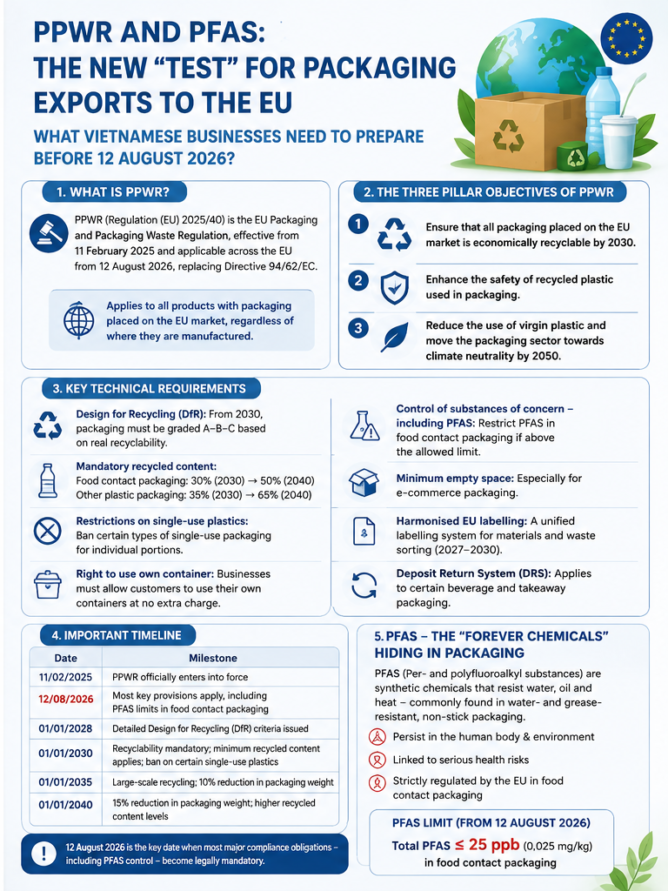
The PPWR — the Packaging and Packaging Waste Regulation, officially Regulation (EU) 2025/40 — is the EU’s new legal framework governing the entire lifecycle of packaging, from design and manufacturing through to collection and recycling. It entered into force on 11 February 2025 and will generally apply across the bloc from 12 August 2026, fully replacing Directive 94/62/EC, which had been in place for over three decades.
The key distinction lies in its legal nature: the PPWR is a Regulation, not a Directive. This means it applies directly and uniformly across all 27 EU member states, without the separate national transposition process required in the past — no more slightly different packaging rules from one EU market to another. For exporters, this cuts both ways: it’s good news (one single standard for the entire bloc) but also raises the stakes (no country-specific loopholes or exceptions).
Most importantly: the PPWR applies to any product with packaging placed on the EU market, regardless of where that product was manufactured. A PP woven-bag factory in Nghe An, a pipe manufacturer in Ho Chi Minh City, or an agricultural export processor in the Mekong Delta — all fall within scope if their goods’ packaging circulates in the EU.
2. THE THREE PILLARS OF THE PPWR
The PPWR is built around three overarching objectives:
- Making all packaging on the EU market economically recyclable by 2030 — meaning packaging must not only be “technically recyclable” but recyclable at a reasonable cost under the real-world conditions of existing collection and sorting infrastructure.
- Increasing the safety of recycled plastics used in packaging — ensuring recycled material is free of contaminants and harmful chemical residues.
- Reducing the use of virgin plastic, steering the packaging industry toward climate neutrality by 2050.
Alongside these, the Regulation sets targets to cut per-capita packaging waste: 5% by 2030, 10% by 2035, and 15% by 2040, benchmarked against 2018 — forcing businesses to rethink packaging design toward minimalism.
3. SPECIFIC TECHNICAL REQUIREMENTS BUSINESSES NEED TO KNOW
- Design for Recycling (DfR): From 2030, packaging must be rated on an A–B–C scale based on actual recyclability. Packaging rated poorly or failing minimum criteria will be removed from the EU market.
- Mandatory recycled content: Food-contact plastic packaging must contain at least 30% recycled plastic by 2030, rising to 50% by 2040; other plastic packaging must reach 35% by 2030, rising to 65% by 2040.
- Single-use plastic restrictions: bans on certain single-use packaging formats for individual portions (e.g. single-serve condiment/sauce sachets).
- Right to bring your own container: takeaway food and beverage businesses must allow customers to use their own reusable containers without an extra charge.
- Control of substances of concern — including PFAS: restricts PFAS in food-contact packaging above the regulatory threshold (detailed below).
- Empty-space limits: applying particularly to e-commerce packaging, to reduce wasted packaging material and unnecessary shipping costs.
- EU-wide harmonised labelling: a unified labelling system for materials and waste-sorting instructions, rolling out between 2027 and 2030.
- Deposit Return System (DRS): applicable to certain beverage and takeaway packaging sectors, requiring specific reuse rates to be achieved.
4. KEY TIMELINE FOR BUSINESSES TO REMEMBER
| Date | Milestone |
| 11 Feb 2025 | PPWR enters into force |
| 12 Aug 2026 | General application of most core provisions, including the PFAS limit for food-contact packaging |
| 1 Jan 2028 | Detailed Design for Recycling (DfR) criteria published |
| 1 Jan 2030 | Mandatory recyclability; minimum recycled-content requirements apply; certain single-use plastics banned |
| 1 Jan 2035 | Large-scale recycling requirements; 10% packaging-volume reduction |
| 1 Jan 2040 | 15% packaging-volume reduction; higher recycled-content thresholds |
The 12 August 2026 deadline deserves particular attention, as this is when the majority of core compliance obligations — including PFAS control — become legally binding.
5. PFAS — THE “FOREVER CHEMICALS” HIDING IN PACKAGING
What is PFAS, and why is it a concern?
PFAS (Per- and polyfluoroalkyl substances) are a class of synthetic chemicals containing carbon–fluorine bonds — among the strongest chemical bonds in organic chemistry. Because of this stability, PFAS barely break down in the natural environment, persisting for generations even after emissions have completely stopped — which is why they’re known as “forever chemicals.”
PFAS are widely used for their oil-repellent, water-repellent, and heat-resistant properties — especially common in paper, box, and food-bag packaging that requires grease resistance (such as fast-food containers or paper bags for oily food).
Health and environmental risks
Scientific studies have linked PFAS exposure to a range of serious health concerns: thyroid disease, several types of cancer (breast, liver, kidney, testicular), inflammatory bowel disease, and effects on unborn children such as delayed development, lower birth weight, and increased miscarriage risk. Environmentally, PFAS persist and accumulate in soil, water, air, and the food chain, causing widespread ecosystem disruption.
The European Commission estimates that if current PFAS pollution levels continue through 2050, the cost to society will reach €440 billion — while early action to reduce releases at source could save up to €110 billion. This is why the EU is tightening PFAS control on multiple fronts: drinking water, soil, industrial emissions, and now food-contact packaging through the PPWR.
How must businesses prove compliance?
This is a point businesses frequently overlook: the PPWR does not accept self-declaration. To demonstrate that packaging meets the permitted PFAS threshold, businesses must obtain test results from an accredited, independent laboratory.
The recommended testing pathway typically involves two steps:
- Total Fluorine (TF) screening — a general-purpose, lower-cost test that provides a quick assessment of overall risk.
- Targeted PFAS compound analysis — only required if the TF screening result exceeds the alert threshold, in order to precisely identify the specific compound and its concentration. This step is significantly more expensive than the initial screening.
Because of this two-step mechanism, total testing cost cannot be fixed in advance of the screening result — something businesses should account for when budgeting for compliance.
6. WHY VIETNAMESE EU EXPORTERS CANNOT AFFORD TO SIT THIS OUT
Many Vietnamese packaging, consumer goods, agricultural, and processed-food manufacturers still assume EU regulations “only apply to European companies.” This is a costly misconception. As noted above, the PPWR applies to any product with packaging placed on the EU market, regardless of manufacturing origin. This means:
- A shipment of woven PP packaging exported to Germany, the Netherlands, or France must fully comply with PPWR requirements exactly as if it were manufactured within the EU itself.
- If packaging fails to meet the PFAS threshold or design/recyclability requirements, goods can be refused entry right at the port of import, resulting in serious losses in time, storage costs, and reputation with trading partners.
- The PPWR also ties into the Extended Producer Responsibility (EPR) mechanism under an “ecomodulation” approach — more sustainable packaging incurs lower EPR fees, while less sustainable packaging faces higher fees. This is both a mandatory cost and a competitive lever for businesses that adapt early.
In short, the PPWR is both a compliance risk requiring careful management and a differentiation opportunity for businesses that prepare thoroughly ahead of their competitors.
7. CONSEQUENCES OF BEING UNPREPARED
- ❌ Goods refused import or held at port for additional inspection, incurring storage and demurrage costs.
- ❌ Administrative fines or forced recall of products already on the market.
- ❌ Lost business opportunities with importers, retail chains, and multinational corporations — buyers who have already tightened ESG criteria across their supply chains and increasingly treat PPWR compliance as a prerequisite for supplier selection.
- ❌ Reactive remediation costs spiralling if problems are only discovered after goods have already been rejected, rather than through proactive early review and adjustment.
8. ISC GLOBAL – STC VN: YOUR PARTNER FROM TRAINING TO COMPLIANCE IMPLEMENTATION
Drawing on extensive experience advising international ESG, environmental, and management-system standards for manufacturing and exporting businesses across Vietnam, ISC Global — in partnership with STC VN (Staunchly Vietnam) — offers a full-service solution to help businesses proactively achieve PPWR compliance and PFAS control ahead of the 12 August 2026 deadline, built around three pillars:
✅ In-house training
We deliver training sessions for technical, QA/QC, purchasing, and export teams — helping each department fully understand PPWR requirements and PFAS control rules, learn how to read and interpret test results, and clearly understand their own role in maintaining long-term compliance — not just a one-time fix, but building sustainable internal capability.
✅ Packaging and material review consulting
We inventory all packaging lines exported to the EU, identify materials, structure (single-layer/multi-layer), and ancillary suppliers (inks, coatings) that could affect compliance. From there, we benchmark current designs against the PPWR’s specific requirements on recyclability, recycled content, and PFAS thresholds.
✅ Independent testing coordination
We help determine the exact test parameters required and connect businesses with internationally accredited laboratories such as Eurofins, SGS, Bureau Veritas, Intertek, and TÜV SÜD/TÜV Rheinland — following the correct pathway of Total Fluorine screening first, then targeted testing only if needed, helping businesses optimise testing costs rather than testing broadly and expensively.
✅ Remediation and EPR registration guidance
Based on test results and the review, we build a concrete remediation plan (material, design, or supplier adjustments as needed), while also guiding the process of registering with the Extended Producer Responsibility (EPR) platform in the EU member state(s) relevant to the business’s export markets.
Cost transparency is a principle we place above all else: consulting/training fees are quoted clearly upfront, while third-party costs (laboratory testing, EPR registration) are always noted separately and paid directly by the client to the relevant service provider — no hidden fees, no charges beyond the agreed scope.
Contact ISC Global – STC VN today for a free initial consultation and a preliminary assessment of your business’s readiness for PPWR/PFAS compliance.
Contact us to download the bilingual English-Vietnamese PDF standard: from only $50
On the path toward integration and export, correctly understanding and applying international standards is essential. Yet language and technical terminology often pose real barriers. We are pleased to introduce our bilingual (English – Vietnamese) standards documentation service, translated by our own team of certification consultants.
What We Provide
• A clause-by-clause bilingual comparison, easy to consult and file.
• Professional Vietnamese translation in correct technical terminology, ready to use.
• Interpretation notes and application guidance from hands-on experts.
• Fast delivery in editable, easy-to-store PDF/Word format.
Standards Covered
ISO management systems (9001, 14001, 45001, 37001); sustainability certifications (ISCC, FSC, VFCS/PEFC); textiles and recycled materials (GRS, OCS, OEKO-TEX); social responsibility and ESG (SMETA, EcoVadis, Fairtrade), and many other industry standards upon request.
Why Choose Us
Our documents are translated by professionals who directly consult on and audit certifications, so the translation is accurate not only in language but also in real-world application — saving you time and reducing errors when preparing documentation.
Pricing
From only USD 50 per document, depending on length and complexity. Please send us the standard name to receive a free, accurate quotation.
How to Order
1. Contact us with the name of the standard you need.
2. Receive a quotation and delivery time.
3. Make payment and receive your document by email.
Payment
Bank transfer via QR code (provided with the quotation), or via PayPal: ducluongservices@gmail.com.
We look forward to accompanying you on your certification journey.
Best regards,
CONTACT INFORMATION
Hotline: +84 933096426 – +84 868 591 260
Email:
Website:
No responses yet