
If your products contain plastics, polyurethane, foams, textiles, rubber, adhesives, paints, electronics, or any chemical-intensive component, two regulations stand between your factory and your overseas customers: the European Union’s REACH Regulation (EC) No 1907/2006 and the State of California’s Safe Drinking Water and Toxic Enforcement Act of 1986, commonly known as California Proposition 65.
Both regulations share a single underlying message: if your product contains restricted chemicals above declared thresholds, you cannot legally place it on the market — or, in the case of Prop 65, you must carry a clear warning label that most major retailers (Amazon, Walmart, Target, Costco) will reject outright.
For Vietnamese exporters, this is not a theoretical risk. Customs authorities at Hamburg, Rotterdam, and Long Beach routinely sample shipments. Brand-name buyers (IKEA, Decathlon, Walmart, Carrefour, Target) embed REACH and Prop 65 clauses in their purchase orders, with chargebacks ranging from USD 5,000 per non-conforming SKU to full container rejection.
The right move is to verify compliance before shipment — not after a recall notice arrives.
What REACH actually requires (in plain terms)
REACH is built around three control mechanisms that matter for finished-article exporters:
1. Annex XVII — Restrictions on hazardous substances. This is the regulation’s “do not exceed” list. As of 2026, Annex XVII contains over 70 entries restricting substances such as cadmium (Entry 23), Dimethyl Fumarate (Entry 61), Phthalates in plasticised materials (Entry 72, covering DIHP, DMEP, DiPP, DPP, DnHP), 8 Polycyclic Aromatic Hydrocarbons in skin-contact articles (also Entry 72), and Formaldehyde in articles (Entry 77).
2. SVHC — Substances of Very High Concern (Article 33). The European Chemicals Agency (ECHA) maintains the Candidate List of SVHCs, currently containing 253 substances + 2 newly added entries (latest update: January 2026). Article 33 requires suppliers of articles to communicate the presence of any SVHC at concentrations above 0.1% by weight, both to downstream business customers (within 45 days of request) and, on request, to consumers.
3. PFAS and POP overlap. The EU’s Persistent Organic Pollutants Regulation (POP) and the recent PFAS restriction proposal under REACH are increasingly relevant for waterproof, oil-resistant, and high-performance materials. PFOA, PFOS, and PFHxS are already banned; the broader PFAS restriction is expected to expand in 2026–2027.
Non-compliance is enforced by national authorities (BAuA in Germany, ANSES in France, HSE in the UK), with fines reaching EUR 100,000 per violation in most Member States and potential criminal liability for repeat offenders.
What California Proposition 65 actually requires
Proposition 65 is fundamentally a disclosure regulation, not a ban. California maintains a list of approximately 900 chemicals “known to cause cancer or reproductive harm,” and any product sold into California that exposes consumers to listed chemicals above the No Significant Risk Level (NSRL) or Maximum Allowable Dose Level (MADL) must carry a specific warning.
The chemicals most commonly triggering Prop 65 violations for manufacturers like yours include Lead (NSRL: 0.5 µg/day for cancer; 0.5 µg/day for reproductive toxicity), Phthalates — particularly DEHP, DBP, BBP, DINP, and DnHP, Cadmium (NSRL: 0.05 µg/day inhalation), BPA, Acrylamide, and Formaldehyde.
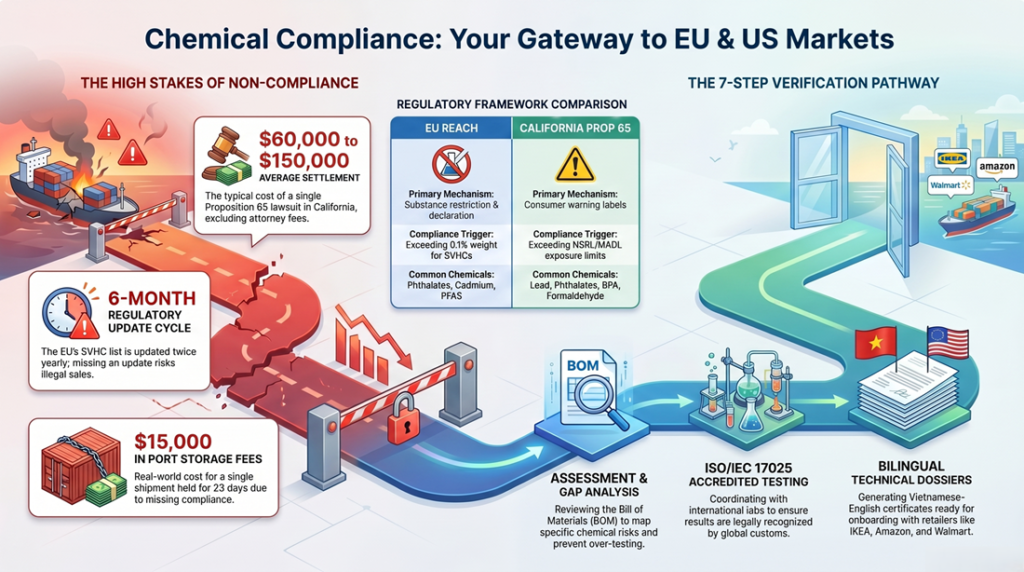
The enforcement model is uniquely aggressive: Prop 65 grants a private right of action to citizen plaintiffs, who can sue any non-compliant manufacturer, importer, or retailer. Settlement amounts in 2024–2025 averaged USD 60,000–150,000 per case, with plaintiff attorneys’ fees often exceeding the actual penalty.
For Vietnamese exporters selling to Amazon US, Walmart.com, or any retailer with California distribution, Prop 65 testing is no longer optional — it is part of vendor onboarding.
The ISC Global verification pathway
ISC Global has developed a structured, repeatable consulting pathway for REACH and California Proposition 65 verification, specifically tuned to the manufacturing realities of Vietnamese factories. Our role is to sit between you and the accredited laboratory — translating regulatory language into actionable steps, ensuring your samples and dossiers are accepted on the first submission, and reducing the total compliance timeline from months to weeks.
Step 1 — Initial assessment and gap analysis. We review your product, Bill of Materials (BOM), supplier declarations, and existing test reports. We map each material against the relevant Annex XVII restrictions, the current SVHC Candidate List, and the Prop 65 chemical list. Output: a written technical scope identifying exactly which parameters need testing, which can be skipped based on existing evidence, and where supplier declarations are required.
Step 2 — Sample preparation guidance. Laboratories reject roughly 30% of incoming samples in Vietnam due to incorrect sample size, mixed materials, missing representative homogeneity, or contaminated packaging. We provide you with documented sample preparation protocols specific to your product type (homogenous polymer, multi-layer composite, coated article, etc.) and validate the prepared samples before shipment to the lab.
Step 3 — Test Request Form preparation. A poorly completed Test Request Form (TRF) is the single most common cause of delayed test results. We complete the TRF with you, declaring the full material composition, the regulatory framework, the test methods, and the reporting format required.
Step 4 — Laboratory coordination with our accredited partner. Samples are tested by our accredited laboratory partner — an internationally recognised testing organisation operating under ISO/IEC 17025 scope with a global accreditation network. Test methods follow internationally recognised standards: EN 16711-2:2015 (heavy metals), ISO 14389:2014 (phthalates), AfPS GS 2019:01 PAK (8 PAHs), CPSC methods (Prop 65), and validated in-house methods for SVHC screening and PFAS.
Step 5 — Test report review and interpretation. We translate raw analytical results into a compliance verdict, benchmarked against the regulatory limits. Where a parameter exceeds the limit, we provide a corrective action pathway: substitute material identification, supplier change recommendations, or reformulation guidance.
Step 6 — Compliance dossier and Certificate of Verification. ISC Global issues a bilingual (Vietnamese / English) Certificate of Verification, supported by the underlying laboratory test report and a technical compliance dossier. This dossier is structured to satisfy buyer onboarding requirements at IKEA, Decathlon, Target, Walmart, and Amazon Vendor Central.
Step 7 — Post-certification advisory. The SVHC list is updated by ECHA every six months (typically in January and July). Annex XVII restrictions are amended several times per year. We monitor these changes against your product portfolio and notify you of any new obligations within 14 days of publication in the EU Official Journal.
Two service tiers tailored to your market entry strategy
We offer two service options because the right scope of testing depends on your market and your buyer:
Option 1 — Full REACH + California Proposition 65 verification. This option covers Extractable Heavy Metals, Phthalates (Annex XVII Entry 72), 8 PAHs, the full 253+2 SVHC list, Cadmium content (Entry 23), Dimethyl Fumarate (Entry 61), Formaldehyde (Entry 77), PFAS screening (REACH and POP Regulation), plus Lead and Phthalates under California Prop 65. This is the recommended scope for first-time exporters to the EU and U.S., and for any manufacturer onboarding with major retailers.
Option 2 — Targeted Phthalates verification. This narrower scope covers REACH Annex XVII Entry 72 Phthalates, SVHC 253+2 substances, and Prop 65 Phthalates content. It is appropriate when your buyer specifically requires only Phthalates evidence, or when your product is already covered by separate heavy metal and PAH test reports.
Total project timeline is typically 4–6 weeks from contract signing to Certificate of Verification, including 2–3 weeks of laboratory turnaround.
Why work with ISC Global
ISC Global is a Vietnam-based international standards training and certification partner with a portfolio spanning ISO 14001, ISO 9001, ISO 45001, ISO 37001, ISO 14064, EcoVadis, ISCC EU, SEDEX SMETA, FM Approvals, Fairtrade, REACH, RoHS, and California Proposition 65…
What sets us apart for chemical compliance work is the combination of three capabilities under one roof: ESG and chemical compliance consulting, direct laboratory partnership with an ISO/IEC 17025 accredited testing organisation, and legal-grade documentation prepared by consultants who include lawyer-in-training expertise. Our deliverables are designed to withstand both regulatory inspection and buyer audit.
We have supported manufacturers in polyurethane, food contact materials, textiles, footwear, furniture, electronics, packaging, and chemical trading — and our bilingual deliverables are built from day one for use with international customers.
Get started
If you are preparing for a first export shipment, responding to a buyer audit, or facing a Prop 65 demand letter, we can begin with a no-obligation product assessment.
📧 Email: info.vietnam@iscglobal.asia | van.pham@iscglobal.asia
📞 Hotline: +84 933 096 426 | +84 868 591 260
🌐 Website: www.iscglobal.asia | iscglobal.edu.vn
ISC Global — Your trusted partner for international standards certification and chemical compliance verification in Vietnam.
Contact us today to receive dedicated advice and the most suitable solution for your business!
Hotline: +84 933096426 – +84 868 591 260
Email:
Website:
Partners in Vietnam:
Contact Vietnam representative: Duc Luong Services
Hotline: +84 933096426 – +84 868 591 260
Email: ducluongservices@gmail.com
No responses yet