For apparel, footwear and sewn-product manufacturers, WRAP certification has become a decisive credential for winning and retaining orders from global brands and retailers. This guide explains what WRAP is, the 12 Principles behind it, the audit process, certification levels and fees — and how expert consulting and training can help your factory pass with confidence.
What is WRAP?
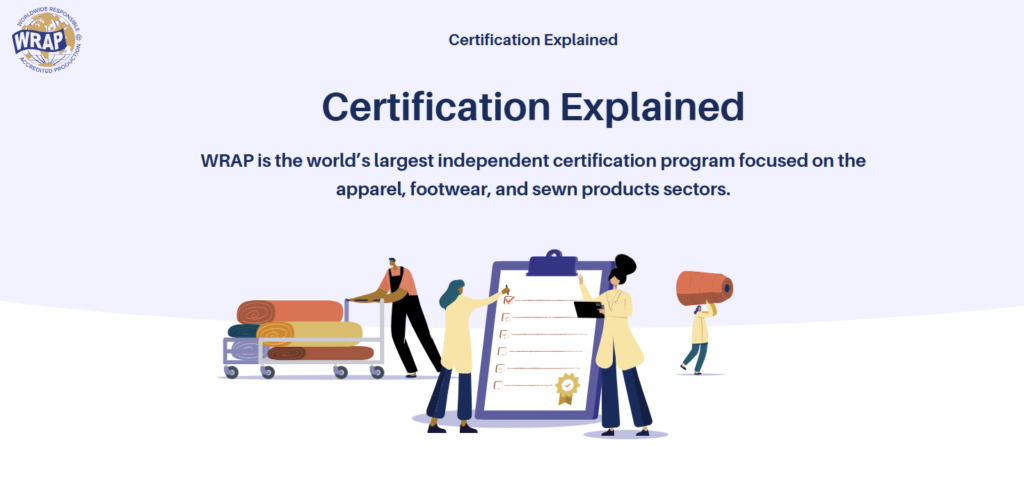
WRAP stands for Worldwide Responsible Accredited Production (formerly Worldwide Responsible Apparel Production). It is an independent, non-profit organization dedicated to promoting safe, lawful, humane and ethical manufacturing worldwide through certification and education. Headquartered in Arlington, Virginia (USA), WRAP operates the world’s largest factory-based certification program for the apparel, footwear and sewn-products sectors, and maintains representation across Asia — including Vietnam.
WRAP certification is accepted by hundreds of leading brands and retailers. For many buyers, holding a valid WRAP certificate is a prerequisite for being listed as an approved supplier — making it especially relevant for Vietnam’s export-driven garment and footwear industry.
The 12 WRAP Principles
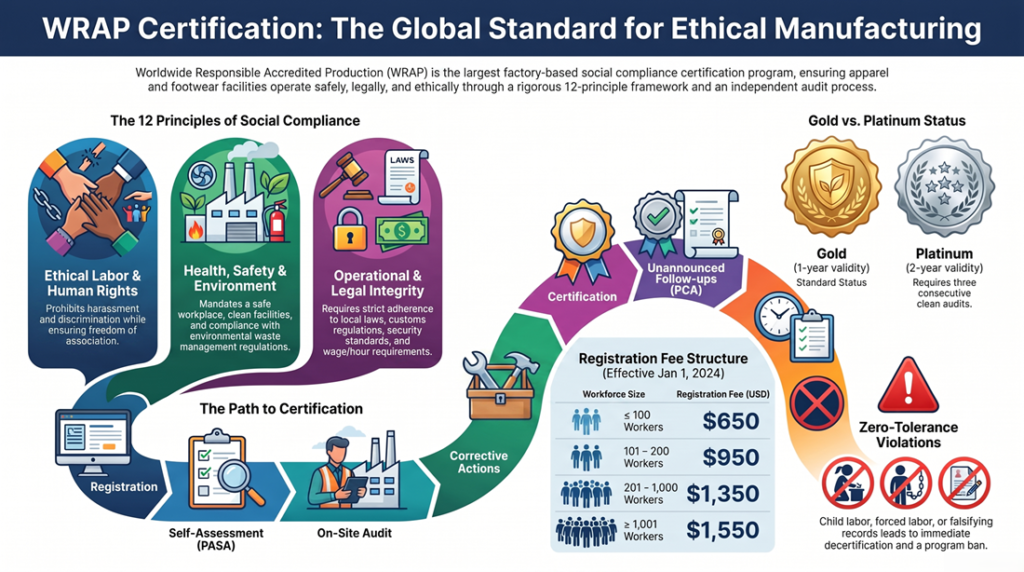
At the heart of the program are the 12 Principles, grounded in internationally recognized workplace standards, local laws and respected frameworks such as the spirit of the International Labour Organization (ILO) conventions, the UN Declaration of Human Rights, the UN Guiding Principles on Business and Human Rights, and the OECD Guidelines for Multinational Enterprises.
- Compliance with Laws and Workplace Regulations — adhere to all applicable local, national and international laws, including ethics, anti-corruption and environmental rules.
- Prohibition of Forced Labor — no involuntary, bonded, indentured, prison or trafficked labor; employment must be strictly voluntary.
- Prohibition of Child Labor — no workers below age 15 (14 in less-developed countries) or the legal minimum age, referencing ILO Convention 138.
- Prohibition of Harassment and Abuse — a workplace free from corporal punishment, harassment, intimidation and bullying.
- Compensation and Benefits — pay at least the legally mandated minimum wage, overtime, allowances and social insurance.
- Hours of Work — respect legal limits on working hours and provide at least one day off per seven-day period.
- Prohibition of Discrimination — base employment decisions on ability, not personal characteristics or beliefs.
- Health and Safety — provide a safe, clean and healthy workplace (and housing, where provided).
- Freedom of Association and Collective Bargaining — respect workers’ lawful rights and maintain an effective grievance mechanism.
- Environment — comply with environmental regulations, manage waste responsibly and apply reduce-reuse-recycle practices.
- Customs Compliance — accurate labeling, complete records and prevention of illegal transshipment.
- Security — maintain corporate, transportation and physical security, benchmarked against the U.S. CBP’s CTPAT program.
Together, these principles advance responsible business conduct, strengthen human-rights due diligence and support the UN Sustainable Development Goals — particularly SDG 8 (Decent Work and Economic Growth) and SDG 12 (Responsible Consumption and Production).
WRAP Certification Levels
WRAP awards two official certification levels, determined by WRAP based on the breadth and stability of a facility’s social-compliance program:
- Gold — awarded to facilities demonstrating full compliance with the 12 Principles. Valid for one year. More than 90% of certified facilities hold this level.
- Platinum — awarded to facilities that demonstrate full compliance across three consecutive audits with no corrective actions and uninterrupted certification. Valid for two years.
The WRAP Audit Process
- Application & monitor selection — the facility applies, selects a WRAP-accredited monitoring firm and pays the registration fee.
- Pre-Audit Self-Assessment (PASA) — optional but recommended; it previews sample questions and helps organize documentation.
- On-site audit — the monitoring firm conducts a full social-compliance audit across all shifts and submits its report to WRAP within 10 days.
- Review & corrective actions — WRAP reviews the findings; any noncompliances must be corrected and independently verified.
- Certification decision — issued only after all corrective actions are implemented and verified, with oversight from WRAP’s independent review board.
- Post-Certification Assessments (PCAs) — random, unannounced checks during the certification period to ensure ongoing compliance.
Registration Fees (Reference)
Effective January 1, 2024, WRAP’s registration fee is scaled by workforce size:
US$650 for facilities with 100 or fewer workers;
US$950 for 101–200;
US$1,350 for 201–1,000; and
US$1,550 for 1,001 or more.
These are WRAP’s registration fees only and exclude the monitoring firm’s audit fee and internal preparation costs.
Zero-Tolerance Issues
Certain violations lead to automatic decertification and a ban from the program — including child labor, forced labor, inhumane treatment, compromising an auditor’s integrity, and falsifying documents or hiding production. A genuine compliance culture and robust internal systems are therefore essential, not optional.
How ISC Global Supports Your WRAP Journey
To be clear: the WRAP certificate is issued by WRAP through an accredited monitoring firm. Our role is to train, advise and prepare your factory to pass the audit on solid footing. Our services include:
- Awareness training on the 12 WRAP Principles for management, supervisors and workers.
- Gap assessment against WRAP requirements and a prioritized remediation plan.
- Documentation systems covering HR, health & safety, environment, security and Vietnamese labor-law compliance.
- Mock audits and PASA preparation to maximize first-time pass rates.
- Corrective-action support and ongoing maintenance toward the Platinum level.
With multi-standard expertise (ISO 14001/45001/9001, SMETA/SEDEX, GRS/OCS, EcoVadis and more) and combined ESG and legal capability, we help factories integrate WRAP into a single, efficient management system — ideal for FDI manufacturers operating in Vietnam.
Frequently Asked Questions
Who needs WRAP certification? Apparel, footwear and sewn-product factories — and related supply-chain operations — especially those exporting to major international buyers.
How long is a WRAP certificate valid? Gold is valid for one year; Platinum for two years. Each renewal requires a new audit.
Can a factory apply on its own? Yes, but structured preparation with an experienced consultant shortens timelines and reduces the risk of costly re-audits.
📞 Contact Us for WRAP Consulting & Training
ISC Global Co., Ltd.
Hotline: +84 933 096 426 – +84 868 591 260
Email: info@iscglobal.asia | van.pham@iscglobal.asia
Website: iscglobal.asia | iscglobal.edu.vn
More Than a Label: 5 Surprising Realities of Global Ethical Manufacturing
Behind the seams of the global apparel industry lies a complex network of supply chains that often operate far from the public eye. The human cost of these operations remains staggering. As of 2021, an estimated 50 million people worldwide are ensnared in modern-day slavery; by 2024, approximately 138 million children remain trapped in forced labor. These figures represent more than just data; they are a harrowing indictment of systemic failure.
While these numbers suggest a crisis of accountability, a quiet infrastructure of standards has been scaling in the background for 25 years. It is called WRAP (Worldwide Responsible Accredited Production). In an industry plagued by “audit fatigue” and “greenwashing,” WRAP has spent a quarter-century acting as the floor—not the ceiling—of global compliance. To understand what it actually takes to be “ethically certified,” we have to look past the hangtag and into the machinery of the factory floor.
1. The World’s Largest “Passport” (That You’ve Likely Never Heard of)
While consumers recognize fair-trade logos on specialty coffee, WRAP is the heavyweight champion of the factory floor. It is the largest factory-based certification program in the world for the apparel, footwear, and sewn-products sectors. For manufacturers in export-heavy hubs like Vietnam, a WRAP certificate is quite literally a “passport.” It is the primary prerequisite for being listed as an approved supplier for hundreds of global brands.
This scale matters because it provides a “universal language” for social compliance. Instead of a factory undergoing twenty different audits for twenty different brands—a process that leads to “audit fatigue” and superficial fixes—WRAP establishes a single, rigorous standard.
“WRAP is an independent, non-profit organization dedicated to promoting safe, lawful, humane, and ethical manufacturing worldwide through certification and education.”
2. The “Death Penalty” for Dishonesty
Most certification programs are built on the philosophy of “continuous improvement,” allowing factories to remediate minor issues over time. However, WRAP enforces a strict “Zero-Tolerance” policy for violations that compromise human dignity or the “Spirit of ILO (International Labour Organization) conventions.”
If a factory is caught in the following, they face an immediate ban and permanent decertification:
- Child labor or Forced labor: No margin for error.
- Inhumane treatment: This includes corporal punishment, harassment, or bullying.
- Audit Fraud: This is where the “Journalist” lens reveals the gritty reality. Dishonesty often takes the form of “shadow factories” (off-the-books production sites) or the falsification of records to hide production volumes and working hours.
While “Gold” status indicates full compliance, these specific violations carry a “death penalty.” There is no remediation period for a shadow factory; there is only exclusion from the global market.
3. Why Your T-Shirt Needs Anti-Terrorism Security
A counter-intuitive pillar of WRAP’s social compliance framework is “Principle 12: Security.” To the uninitiated, it seems odd to include locks and container seals in an ethical audit. However, WRAP benchmarks these requirements against the U.S. Customs and Border Protection (CBP) CTPAT program (Customs-Trade Partnership Against Terrorism).
As a consultant, I tell my clients that an unsecure supply chain is a playground for human trafficking and smuggling. Physical and transportation security are fundamental to “humane” manufacturing. If a facility cannot control who enters its gates or what is loaded into its containers, it cannot guarantee the safety of its workers or the integrity of its products. By integrating anti-terrorism standards, WRAP ensures that “humane” manufacturing includes a workspace protected from the illicit trades that fuel global instability.
4. The Elite 10%: The High Stakes of the “Platinum Flex”
WRAP operates a two-tier system that separates the compliant from the masters of the craft.
- Gold Status: The standard-bearer. Held by 90% of certified factories, it confirms full compliance with the 12 Principles and is valid for one year.
- Platinum Status: The ultimate “flex.” This is awarded only to facilities that demonstrate full compliance across three consecutive audits with zero corrective actions. Platinum certificates are valid for two years.
Here is the surprising reality: one mistake resets the clock. If a factory earns Gold for two years but receives a single minor corrective action in their third year, the three-year “Platinum timer” resets to zero. Achieving Platinum status signals to global buyers that a manufacturer hasn’t just passed a test; they have maintained a flawless culture of ethics for nearly half a decade without interruption.
5. The “Tuesday Afternoon” Test
The true test of a factory’s ethics is not how it performs on a scheduled audit day with a polished floor and prepared files. It is how it operates on a random Tuesday afternoon three months later. This is the role of the Post-Certification Assessment (PCA).
PCAs are random, unannounced audits conducted during the certification period. This “snapshot” approach is a tool for long-term sustainability. It ensures that the ethical system “lives” every day, preventing factories from “window dressing” for a scheduled inspector. If a factory is truly ethical, an unannounced visit should reveal the same standards as the day the certificate was hung on the wall.
The New Math of Compliance (2024 Fee Update)
To ensure that the “ethical choice” is accessible even for smaller facilities, WRAP updated its tiered registration fees effective January 1, 2024. This ensures that a 50-person boutique factory isn’t priced out of the market compared to a 5,000-person conglomerate.
| Workforce Size | Registration Fee (USD) |
| ≤ 100 Workers | $650 |
| 101 – 200 Workers | $950 |
| 201 – 1,000 Workers | $1,350 |
| 1,001+ Workers | $1,550 |
Conclusion: The Future of the “Made In” Narrative
WRAP is more than a checklist; it is a bệ phóng (launchpad) for a manufacturer’s ESG (Environmental, Social, and Governance) goals. By adhering to these 12 Principles, factories contribute directly to the UN Sustainable Development Goals—specifically SDG 8 (Decent Work) and SDG 12 (Responsible Production).
The next time you check a garment’s tag, will you look for the country of origin, or the ethical standards of the roof it was built under?
Contact us to download the bilingual English-Vietnamese PDF standard: from only $50
On the path toward integration and export, correctly understanding and applying international standards is essential. Yet language and technical terminology often pose real barriers. We are pleased to introduce our bilingual (English – Vietnamese) standards documentation service, translated by our own team of certification consultants.
What We Provide
• A clause-by-clause bilingual comparison, easy to consult and file.
• Professional Vietnamese translation in correct technical terminology, ready to use.
• Interpretation notes and application guidance from hands-on experts.
• Fast delivery in editable, easy-to-store PDF/Word format.
Standards Covered
ISO management systems (9001, 14001, 45001, 37001); sustainability certifications (ISCC, FSC, VFCS/PEFC); textiles and recycled materials (GRS, OCS, OEKO-TEX); social responsibility and ESG (SMETA, EcoVadis, Fairtrade), and many other industry standards upon request.
Why Choose Us
Our documents are translated by professionals who directly consult on and audit certifications, so the translation is accurate not only in language but also in real-world application — saving you time and reducing errors when preparing documentation.
Pricing
From only USD 50 per document, depending on length and complexity. Please send us the standard name to receive a free, accurate quotation.
How to Order
1. Contact us with the name of the standard you need.
2. Receive a quotation and delivery time.
3. Make payment and receive your document by email.
Payment
Bank transfer via QR code (provided with the quotation), or via PayPal: ducluongservices@gmail.com.
We look forward to accompanying you on your certification journey.
Best regards,
CONTACT INFORMATION
Hotline: +84 933096426 – +84 868 591 260
Email:
Website:
No responses yet