WHAT IS ECO LABEL CERTIFICATION?
As environmental concerns, climate change, and resource depletion continue to gain global attention, consumers, businesses, and governments are increasingly prioritizing products and services that demonstrate environmental responsibility. In response to this growing demand, eco-labeling programs have become an important tool for identifying and promoting environmentally preferable products and services.
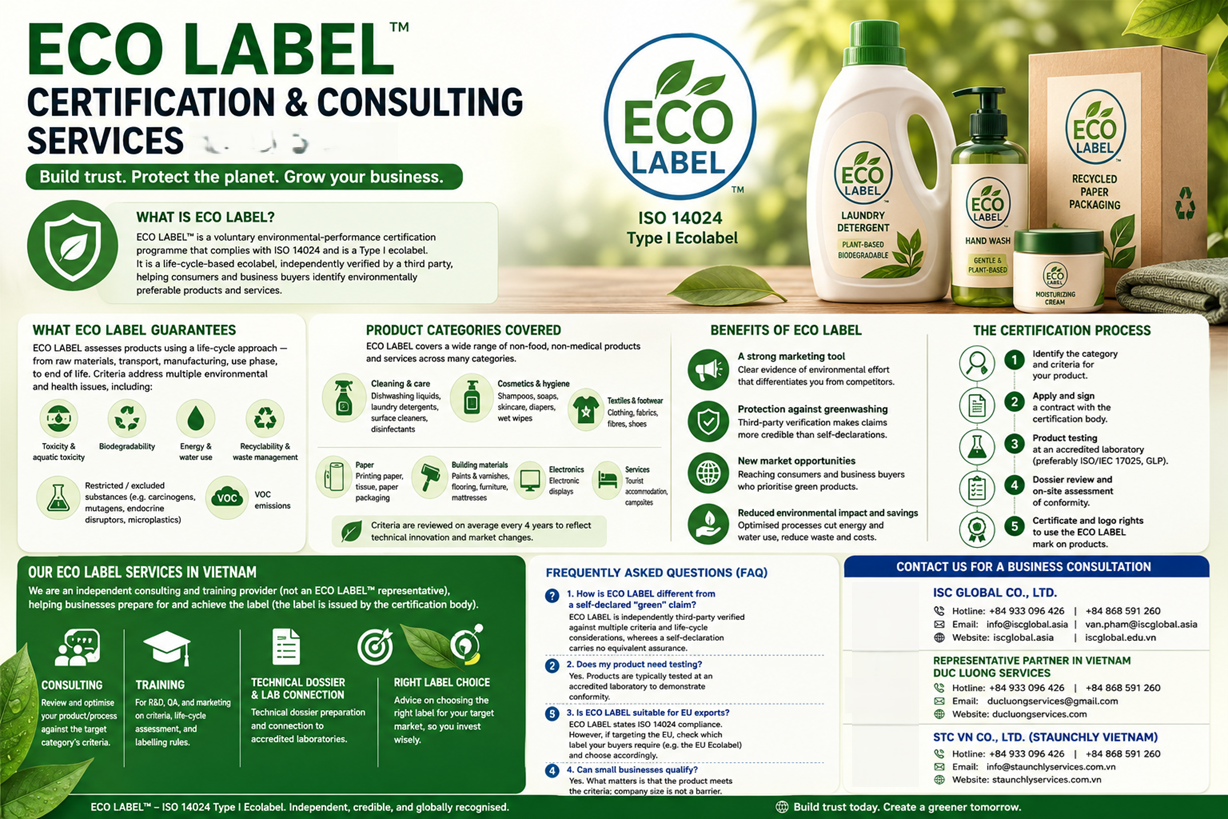
ECO LABEL Certification is an internationally recognized environmental labeling program designed to evaluate and certify products and services that meet established environmental performance criteria. The certification is awarded through an independent third-party assessment process, providing objective verification that certified products have reduced environmental impacts throughout their life cycle.
By obtaining ECO LABEL Certification, organizations can demonstrate their commitment to sustainable production, responsible resource management, environmental protection, and continuous improvement of environmental performance.
WHY IS ECO LABEL CERTIFICATION IMPORTANT?
Today’s consumers are more informed than ever and increasingly seek products that are safe, sustainable, and environmentally responsible. Governments, retailers, and business partners are also implementing stricter environmental requirements throughout their supply chains.
ECO LABEL Certification provides organizations with a credible way to demonstrate their environmental commitment and differentiate themselves in a competitive marketplace.
Key benefits include:
- Demonstrating commitment to environmental protection and sustainability.
- Enhancing brand reputation and corporate image.
- Building trust among customers, business partners, and stakeholders.
- Strengthening market competitiveness in both domestic and international markets.
- Supporting participation in green procurement and sustainable purchasing programs.
- Meeting growing customer expectations regarding environmental responsibility.
- Creating additional value and market opportunities for environmentally friendly products and services.
Furthermore, ECO LABEL Certification reflects an organization’s dedication to reducing environmental impacts and contributing to global sustainable development goals.
LIFE CYCLE APPROACH TO ENVIRONMENTAL PERFORMANCE
One of the fundamental principles of ECO LABEL Certification is the life cycle approach.
Rather than focusing solely on the manufacturing stage, the certification considers the environmental impact of a product or service throughout its entire life cycle, including:
- Raw material extraction and sourcing.
- Product design and manufacturing processes.
- Energy and resource consumption.
- Packaging and transportation.
- Product use and maintenance.
- Waste generation and emissions.
- Recycling, reuse, and end-of-life disposal.
This comprehensive assessment helps ensure that certified products provide genuine environmental benefits and support sustainable consumption patterns.
ECO LABEL CERTIFICATION CRITERIA
Specific requirements vary depending on the product category or service sector. However, ECO LABEL assessments generally focus on the following key areas:
Environmentally Responsible Materials
- Reduction or elimination of hazardous substances.
- Preference for sustainable, renewable, or recycled materials.
- Responsible sourcing practices.
- Compliance with applicable environmental regulations.
Efficient Use of Resources
- Energy efficiency during production and use.
- Water conservation measures.
- Optimization of raw material consumption.
- Reduction of unnecessary resource use.
Pollution Prevention and Environmental Protection
- Minimization of waste generation.
- Reduction of greenhouse gas emissions.
- Proper management of wastewater and pollutants.
- Adoption of environmentally sound production practices.
Product Quality and Performance
- Verification that environmental improvements do not compromise product quality.
- Promotion of durability, reliability, and longer product life cycles.
- Encouragement of sustainable product design.
Sustainable Packaging
- Reduction of excessive packaging materials.
- Use of recyclable, reusable, or environmentally preferable packaging.
- Improvement of packaging efficiency throughout the supply chain.
PRODUCTS AND SERVICES ELIGIBLE FOR ECO LABEL CERTIFICATION
ECO LABEL Certification can be applied across a wide range of industries and sectors, including:
- Paper and paper-based products.
- Office supplies and stationery.
- Electrical and electronic equipment.
- Cleaning and household products.
- Personal care products.
- Children’s products.
- Textiles and apparel.
- Furniture and household goods.
- Paints and surface coatings.
- Building and construction materials.
- Automotive-related products.
- Hospitality and accommodation services.
- Cleaning and facility management services.
- Various consumer products and environmental services.
The certification criteria are tailored to the specific environmental impacts associated with each product category or service sector.
ECO LABEL CERTIFICATION PROCESS
The certification process generally consists of the following steps:
Step 1: Application Submission
The organization submits information regarding the product or service seeking certification.
Step 2: Documentation Review
Technical documentation, product specifications, material information, and environmental data are reviewed by qualified assessors.
Step 3: Testing and Verification
Where required, products may undergo laboratory testing or independent verification to confirm compliance with applicable environmental criteria.
Step 4: Conformity Assessment
Assessment results are evaluated against the relevant ECO LABEL requirements.
Step 5: Certification Approval
Upon successful completion of the evaluation process, the organization is granted certification and authorization to use the ECO LABEL mark in accordance with program requirements.
Step 6: Ongoing Surveillance and Maintenance
Certified organizations are required to maintain compliance throughout the certification period and may be subject to periodic surveillance activities.
ECO LABEL CERTIFICATION AS A STRATEGIC BUSINESS ADVANTAGE
Sustainability has become a critical component of modern business strategy. Organizations that proactively address environmental challenges are increasingly recognized and rewarded by customers, investors, and regulators.
ECO LABEL Certification serves as a powerful tool for demonstrating environmental leadership and corporate responsibility. It helps organizations communicate their sustainability achievements, improve stakeholder confidence, and strengthen their position in environmentally conscious markets.
By achieving ECO LABEL Certification, organizations not only contribute to environmental protection but also create long-term value through improved brand recognition, enhanced customer trust, and increased access to sustainable business opportunities.ECO LABEL Certification represents a commitment to responsible production, sustainable consumption, and a greener future for generations to come.
Contact us today to receive dedicated advice and the most suitable solution for your business!
Hotline: +84 933096426 – +84 868 591 260
Email:
Website:
Partners in Vietnam:
Contact Vietnam representative: Duc Luong Services
Hotline: +84 933096426 – +84 868 591 260
Email: ducluongservices@gmail.com
Website:
STC VN Co., Ltd.
Hotline: +84 933096426 – +84 868 591 260
Email: info@staunchlyservices.com.vn
Website: https://stauchlyservices.com.vn

No responses yet