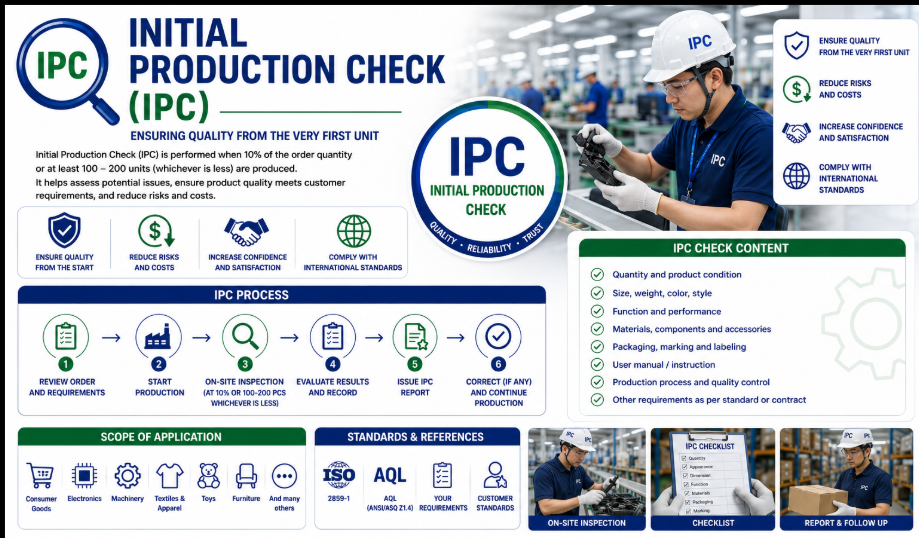
If your executive team, supply chain management heads, and quality control (QA/QC) engineers still treat the Initial Production Check (IPC) as a superficial factory visit or a passive checklist routine to send photo updates to buyers, your enterprise is dumping millions of dollars of operating capital (OPEX) into an extreme-risk failure pit. In the era of technocratic manufacturing and compressed commercialization cycles, multinational conglomerates and Tier-1 retail networks do not accept a “wait until production finishes to inspect” mindset (PSI); they deploy the IPC pre-production matrix to expose every technical bottleneck, raw material parameter drift, and machinery configuration risk the moment a line reaches just of its production run.
The legitimacy of initiating a mass production line tolerates zero behavioral margins. A single trace variance in raw material blending ratios, a microscopic die alignment error caused by crude tooling calibration, or a minor operator deviation from Standard Operating Procedures (SOPs) across the first 50 units will instantly propagate a systematic error (
) across the hundreds of thousands of units that follow. The cascading impact triggers catastrophic mass scrap generation, ruptures delivery timelines (Gantt chart milestones), exposes the business to severe contractual breach penalties, and permanently revokes your access to elite global supply chains.
The Clinical Pre-Production Evaluation Reference Frame (IPC Reference Frame): We do not perform IPC audits through subjective visual inspections. The core of a technocratic IPC audit rests on the operational capability to isolate quality risk variables at the exact moment raw materials transition into finished goods. This framework mandates locking down 3 technical pillars: Validating raw material authenticity against the approved Golden Sample (), verifying the mechanical precision of machinery, jigs, and fixtures (
), and measuring process capability metrics (
) through First Article Inspection (
). A minor uncorrected drift in plastic extrusion temperatures or pneumatic torque settings during the IPC phase is enough to completely neutralize downstream quality controls.
For Supply Chain Directors, Plant Managers, and Global QA/QC Heads, commanding this IPC audit blueprint serves as the ultimate technocratic weapon to crush defects in their infancy, defend net profit margins, and lock down technical compliance across manufacturing operations.
1. Systemic Bottlenecks: Raw Material Degradation and Tooling Displacement Silently Destroying Production Lines
Through manufacturing line forensic audits (Production Line Forensic Audit) and mass scrap crisis interventions across manufacturing plants, we have isolated 3 core blind spots that routinely degrade early-stage production efficiency:
- Raw Material Matrix Discrepancies and Component Parameter Drift: Occurs when factories unilaterally swap sub-tier material suppliers, introduce non-conforming grades, or allow moisture and contaminant degradation in resin/phoi stock prior to hopper loading. This creates silent structural defects within initial product runs that—if not dissected immediately during IPC—will result in total batch scrap at final packing.
- Equipment Configuration Drift and Tooling Instability (
): Failures triggered when technicians adjust machine parameters (temperatures, pressure profiles, cutting speeds, clamp forces) based on personal experience rather than standardized CMM engineering parameter sheets. Combined with micro-vibrations and displacement in unlocked jigs (
), the output immediately exceeds geometric dimensioning and tolerancing caps (
).
- Operator Egress and Workmanship Blind Spots: Assembly operators ignoring Standard Operating Procedures (SOPs), skipping critical safety steps, or misapplying technical steps due to insufficient pre-production training. This behavioral drift turns individual assembly stations into bottleneck points that feed systemic errors down the line.
The consequence of loose IPC governance is severe financial damage caused by mass scrap and rework, delayed shipment schedules forcing air freight surcharges (), and the total destruction of supplier credibility in the eyes of international procurement syndicates.
2. Solution Matrix: Locking Manufacturing Tolerances via 4-Tier Technocratic Pre-Checks
To eliminate line risk variables and ensure 100% of units coming off the first tranches meet specification boundaries, our IPC framework deploys 4 closed-loop technical gates:
- Golden Sample Reconciliation and Upstream Material Audits: Executing a 1:1 audit between actual shop-floor raw materials/components against the signed Golden Sample (
) and Bill of Materials (BOM). Deploying rapid diagnostic tools (XRF spectrometers, moisture analyzers) to verify material grade authenticity before feeding stock into production lines.
- First Article Inspection and Process Capability Evaluation (
): Sampling First Off Samples (
) randomly as line output hits the
mark. Performing full dimensional, electro-mechanical, and capability analysis (
) to verify the line is running within stable statistical control.
- Machine Parameter Standardization and Mechanical Jig Locking: Auditing machine control panels (injection pressures, temperature zones, hold times, RPM settings) against master engineering specifications. Conducting mechanical backlash checks and calibrating all production jigs (
) directly on the line.
- SOP Operator Audits and Boundary Defect Mapping: Conducting physical station audits to verify operator compliance against SOP instruction cards. Establishing visual limit samples (
) directly at workbenches to give operators and line QC staff an immediate visual benchmark for defect isolation.
3. Performance Metrics: Converting Early Line Compliance into Operating Capital Surplus (OPEX Optimization)
Establishing an empirical, data-backed IPC system is a high-yield strategy to eliminate material waste and optimize manufacturing operating expenses:
| Risk Parameter Indicators | Technocratic IPC Line Governance | Passive Operations Reliant on Post-Production Inspection (PSI) |
| Scrap and Rework Rates ( | Eradicates systemic errors within the first | Systemic errors run unmonitored throughout the run, driving scrap rates up to |
| On-Time Delivery Velocity (OTD) | Detects and resolves tooling and setup anomalies within the first 2 hours, securing a | Defects are discovered only after full batch completion, forcing line stoppages, mass reworks, and delivery delays spanning weeks or months. |
| Final Inspection Approval Pass Rate (PSI Pass Rate) | Achieves a | Final inspections repeatedly fail, incurring third-party re-inspection fees ( |
4. Technical Action Roadmap: Phasing IPC Controls from Raw Material Storage to Packing Stations
Our IPC deployment strategy follows a strict sequential audit protocol executed on the factory floor:
- Step 1 – Pre-Run Material and Pre-Operation Audit: Auditing raw material storage conditions, resin drying times, mold cleanliness, and pneumatic line purity prior to pressing the main power switch.
- Step 2 – Trial Run Supervision and FAI Sampling: Running the line at rated operational speeds, sampling First Article Inspection (
) units across stations, and routing them to internal testing labs for dimensional, mechanical, and functional verification.
- Step 3 – Station Audits and Real-Time Adjustments: Monitoring operator proficiency; if parameter or procedural deviations occur, an immediate Emergency Line Stop (
) is triggered for recalibration.
- Step 4 – IPC Sign-off and Mass Production Release: Generating a comprehensive IPC audit report backed by empirical measurements. Mass production acceleration is authorized only when the Lead IPC Auditor and Plant Manager co-sign the clearance certificate.
5. Driving Verifiable ESG Milestones via Pre-Production Quality Governance
Enforcing rigorous IPC protocols provides concrete proof of an enterprise’s execution of its ESG (Environmental, Social, Governance) mandates through operational excellence:
- The Environmental Pillar (Environment): Eliminating early-line scrap minimizes industrial solid waste, reduces energy/compressed air consumption spent on defective units, and optimizes natural resource utilization.
- The Social Pillar (Social): Secures workplace safety by validating machine safety interlocks, jig stability, and station ergonomics during trial runs before full-scale manufacturing speeds are engaged.
- The Governance Pillar (Governance): Establishes an unalterable production data pipeline, removing shop-floor defect concealment and building long-term trust with international investors and procurement partners.
Conclusion
Initial Production Check (IPC) is no longer a passive administrative checklist or a routine factory stopover. It is the core technocratic competency that dictates product quality sovereignty, financial risk boundaries, and engineering reputation within the global manufacturing ecosystem.
Commanding a rigid IPC audit framework backed by empirical measurement data provides your business with an ironclad defense against mass scrap risks. It optimizes operating costs and consolidates your status as an elite Tier-1 supplier on the international industrial map.
Contact us to download the bilingual English-Vietnamese PDF standard: from only $50
On the path toward integration and export, correctly understanding and applying international standards is essential. Yet language and technical terminology often pose real barriers. We are pleased to introduce our bilingual (English – Vietnamese) standards documentation service, translated by our own team of certification consultants.
What We Provide
• A clause-by-clause bilingual comparison, easy to consult and file.
• Professional Vietnamese translation in correct technical terminology, ready to use.
• Interpretation notes and application guidance from hands-on experts.
• Fast delivery in editable, easy-to-store PDF/Word format.
Standards Covered
ISO management systems (9001, 14001, 45001, 37001); sustainability certifications (ISCC, FSC, VFCS/PEFC); textiles and recycled materials (GRS, OCS, OEKO-TEX); social responsibility and ESG (SMETA, EcoVadis, Fairtrade), and many other industry standards upon request.
Why Choose Us
Our documents are translated by professionals who directly consult on and audit certifications, so the translation is accurate not only in language but also in real-world application — saving you time and reducing errors when preparing documentation.
Pricing
From only USD 50 per document, depending on length and complexity. Please send us the standard name to receive a free, accurate quotation.
How to Order
1. Contact us with the name of the standard you need.
2. Receive a quotation and delivery time.
3. Make payment and receive your document by email.
Payment
Bank transfer via QR code (provided with the quotation), or via PayPal: ducluongservices@gmail.com.
We look forward to accompanying you on your certification journey.
Best regards,
CONTACT INFORMATION
Hotline: +84 933096426 – +84 868 591 260
Email:
Website:

No responses yet