As global brands tighten their plastic-neutrality commitments and Extended Producer Responsibility (EPR) obligations, Plastic Credits have emerged as a credible financing mechanism for waste collection and recycling operations. For manufacturers, recyclers, and pyrolysis plant operators in Vietnam, understanding how to qualify for certification under the Verra Plastic Waste Reduction Standard (PWRS) is now a strategic priority. This guide, prepared by the consulting team at ISC Global, walks through what Plastic Credits are, how the Verra program works, and how to approach certification without over-promising outcomes that lie outside a consultant’s control.
1. What Are Plastic Credits?
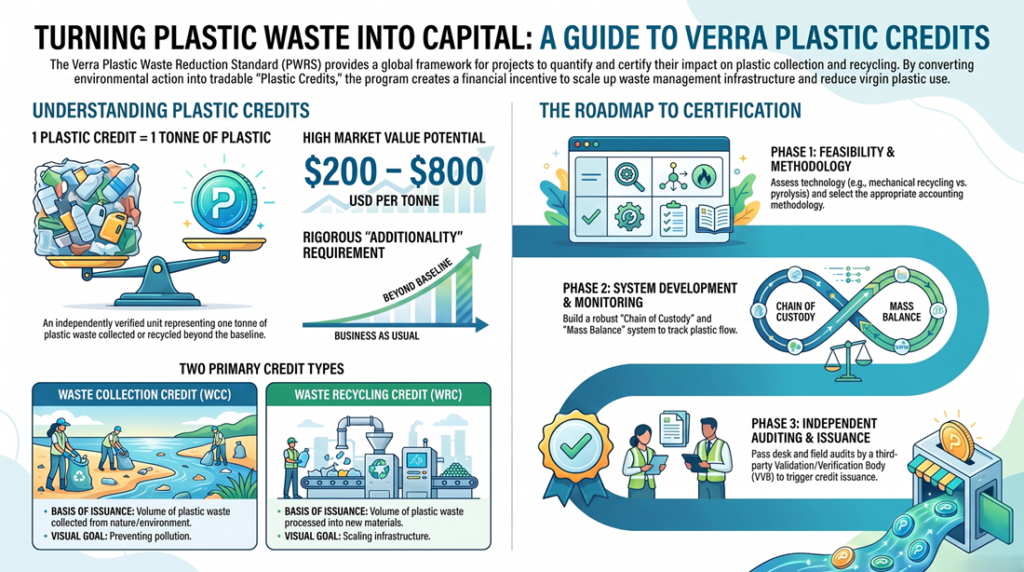
A Plastic Credit is an independently verified unit representing one tonne of plastic waste collected or recycled beyond what would have happened under business-as-usual conditions (the baseline). The mechanism mirrors carbon credits: verified environmental impact is converted into a tradable unit that companies can purchase to offset their plastic footprint or meet voluntary EPR commitments.
Based on early market estimates published by Verra, Plastic Credit prices have ranged broadly between US$200 and US$800 per tonne, depending on project type (collection vs. recycling), geography, material category, and associated social co-benefits. This price range is significantly above typical plastic waste processing costs, which is why recycling and collection operators across Southeast Asia are increasingly exploring certification.
2. Why Verra PWRS Is the Leading Program
Among the various plastic credit programs available globally — Verra, Plastic Credit Exchange (PCX), rePurpose Global, Plastic Bank, and TÜV SÜD-verified schemes — Verra’s Plastic Waste Reduction Standard (PWRS) stands out for several reasons:
- A transparent, independently operated Registry with serialized credit tracking;
- Two officially approved methodologies: PWRM0001 (Plastic Waste Collection Methodology) and PWRM0002 (Plastic Waste Recycling Methodology);
- Mandatory third-party Validation and Verification by an accredited Validation/Verification Body (VVB) before any credit is issued;
- Strong recognition among international corporate buyers, who typically ask about Verra certification first when sourcing plastic credits.
Each credit represents one tonne of plastic collected or recycled, and can carry additional labels for social and environmental co-benefits, which often increase market value.
3. Who Should Consider Verra PWRS Certification?
ISC Global recommends the following categories of businesses evaluate their eligibility:
- Plastic recycling facilities (mechanical or chemical) processing PET, HDPE, PP, or mixed materials;
- Waste collection and sorting operators working at industrial or community scale;
- Pyrolysis plants converting plastic waste and end-of-life tires into oil, recovered steel, and carbon black — this category requires particularly careful eligibility review;
- FDI manufacturers and packaging companies looking to invest in collection/recycling projects to support their parent company’s plastic-neutrality targets.
Not every waste-processing model automatically qualifies. This is precisely why a Feasibility Assessment should always precede full project development.
4. ISC Global’s 4-Phase Consulting Approach
Phase 1 – Feasibility Assessment: site visit, feedstock and technology review, additionality assessment, and determination of the applicable methodology (PWRM0001 or PWRM0002).
Phase 2 – Project Development: drafting the Project Description, Monitoring Plan, Mass Balance system, Chain of Custody procedures, and a full set of 30–40 management documents, together with staff training.
Phase 3 – Validation Support: supporting the client throughout the independent Validation process conducted by an accredited VVB, including evidence preparation and response to findings.
Phase 4 – Registration Support: finalizing and submitting documentation to the Verra Registry and following up on registration status.
Typical implementation timelines run 5 to 6.5 months, depending on project scale and the client’s data readiness.
5. A Special Note on Pyrolysis-Based Projects
Pyrolysis plants — converting plastic and tire waste into pyrolysis oil, recovered steel, and carbon products — represent a distinct category that requires closer technical scrutiny. Eligibility depends heavily on:
- Whether the pyrolysis output is classified as recycling, material recovery, or energy recovery under the applicable methodology;
- The composition of feedstock (packaging plastics vs. tires vs. industrial waste);
- Demonstrated additionality relative to existing regulation and common practice in the region.
Not all pyrolysis operations will qualify for Plastic Credits — a rigorous Feasibility Assessment is essential before committing to full project development.
6. Benefits of Verra Plastic Credit Certification
- New revenue stream from operations that already incur processing costs;
- Enhanced brand credibility with international buyers, export partners, and green financing institutions;
- Stronger data governance (traceability, mass balance) that improves operational efficiency independent of certification outcomes;
- Improved access to green investment and sustainability-linked financing.
7. Frequently Asked Questions
Are Plastic Credits the same as carbon credits? No. Plastic Credits measure tonnes of plastic collected or recycled, while carbon credits measure greenhouse gas emission reductions. A single facility may pursue both mechanisms in parallel if it meets the respective eligibility criteria.
Can a pyrolysis plant qualify for Plastic Credits? It depends. Eligibility hinges on how the pyrolysis output is classified under the applicable Verra methodology and whether the project can demonstrate additionality. This must be confirmed through a Feasibility Assessment before proceeding.
Who buys Plastic Credits? Primarily consumer goods, packaging, and retail companies with plastic-neutrality commitments or voluntary EPR obligations, sourcing credits through direct agreements, marketplaces, or brokers.
Does ISC Global handle credit sales or brokerage? ISC Global’s scope covers project development and registration support under Verra PWRS. Brokerage, marketplace listing, and credit trading fall outside this scope and are handled by the client or a dedicated credit broker.
8. Contact ISC Global for Business Consulting
Business Consulting Contact – ISC Global
Hotline: +84 933 096 426 – +84 868 591 260
Email: info@iscglobal.asia | van.pham@iscglobal.asia
Website: iscglobal.asia | iscglobal.edu.vn
The “New Gold” of Waste: 5 Surprising Realities of the Global Plastic Credit Market
Introduction: The 430-Million-Ton Problem
The world currently generates a staggering 430 million tons of plastic annually. Two-thirds of this material quickly becomes waste, fueling a crisis that disproportionately impacts high-leakage markets in Southeast Asia. For forward-thinking organizations, however, this environmental liability is being transformed into a sophisticated financial instrument: the Plastic Credit. By monetizing externalities, the global market is operationalizing circularity, creating a robust bridge between corporate stewardship and the urgent need to scale recycling infrastructure. This isn’t just a “green” initiative; it is a serialized environmental commodity market designed to reward verified ecological impact with financial liquidity.
1. A Ton of Waste is Worth More Than You Think
For industries that have long viewed waste as a sunk cost, the financial valuation of plastic credits is a revelation. By converting recovered waste into a verified asset, organizations are discovering a “new gold” that can fundamentally de-risk the transition to sustainable operations.
Market data indicates that the value of a plastic credit—representing one tonne of waste—generally ranges between US $200 and US $800. The specific price is influenced by the credit type: Waste Collection Credits (WCCs), which fund the removal of plastic from the environment, and Waste Recycling Credits (WRCs), which incentivize the processing of waste into new feedstock. For facilities in emerging hubs like Vietnam and Thailand, implementing the necessary systems to generate these credits typically requires a strategic implementation timeline of 5 to 6.5 months.
“A Plastic Credit represents one tonne of collected or recycled plastic waste, certified to the Plastic Standard.”
2. The “Additionality” Rule — You Can’t Get Paid for Business-as-Usual
A critical reality of this market is that environmental impact must be “additional.” Organizations cannot claim credits for activities already mandated by law or profitable on their own. This stringent requirement is the market’s primary defense against greenwashing, ensuring that every credit purchased represents a real, incremental reduction of plastic in the environment.
To maintain integrity, project “baselines” are not static; they are moving targets. Verra requires that baselines be adjusted every seven years to reflect the evolving regional landscape of waste management. To qualify, a project must prove it exceeds the following:
- Legal Requirements: Activities must go beyond what is already required by local or national regulations.
- Common Practice: The project must not simply replicate standard waste management activities prevalent in the region.
- Financial Viability: The activity must require the incentive of credit sales to become financially feasible.
3. Not All Waste Processing is Created Equal (The Pyrolysis Paradox)
While high-tech solutions like pyrolysis—the thermal decomposition of waste into oil, steel, and carbon—are gaining traction in markets like Vietnam for processing complex waste and end-of-life tires, technology alone does not guarantee credit issuance.
The eligibility of advanced thermal plants depends on the strict classification of the output. Under the Plastic Waste Reduction Standard (PWRS), credits are contingent on whether the process results in “recycling” or “material recovery” rather than “energy recovery” (incineration for fuel). Because of this technical nuance, a rigorous Feasibility Assessment is a mandatory prerequisite. For a strategic developer, this assessment is the only way to mitigate the financial risk of investing in infrastructure that may fail to qualify for WRCs due to its output profile.
4. Data is the Real Product, Not Just Plastic
While the physical removal of plastic is the visible goal, the actual commodity traded on the Verra Registry is data. The backbone of any certified project is not the machinery, but a sophisticated documentation ecosystem comprising 30 to 40 distinct management procedures.
In the eyes of international buyers, traceability is the most valuable asset a project developer owns. To satisfy rigorous independent audits, a project must maintain a comprehensive “Monitoring Plan” that establishes an immutable chain of custody. Key data requirements include:
- Mass Balance: A precise accounting system ensuring the volume of material entering the facility matches the output, preventing double-counting.
- Chain of Custody: Verified documentation of the plastic’s journey from the point of collection to final management.
- Calibration Records: Regular evidence that all weighing equipment meets international accuracy standards.
- Internal Audits: Systematic self-reviews to identify and rectify data discrepancies before third-party verification.
5. The “Stackable” Advantage — Integrating with ISO, SMETA, and Social Safeguards
For facilities already operating under international standards like ISO 9001 or ISO 14001, the PWRS offers a “stackable” administrative advantage. Rather than creating redundant silos, the standard integrates into existing Quality and Environmental Management Systems.
Critically, this integration extends beyond the “Environmental” pillar of ESG to include “Social Safeguards.” The Plastic Standard professionalizes the informal waste sector by requiring projects to improve the livelihoods and safety of waste pickers. This “Social” dimension is a significant value-driver; credits that demonstrate verified benefits—such as increased wages and safe working conditions—often command a premium in the international market.
“The Plastic Standard will help create a more circular economy involving companies, NGOs, governments, recycling companies, infrastructure investors, energy companies and waste pickers.”
Conclusion: Beyond the Credit
The global plastic credit market is rapidly maturing from a voluntary exercise into a rigorous financial landscape. As the “Global Plastic Treaty” takes shape, we are seeing a shift toward regulatory integration. In a model analogous to the carbon tax frameworks in Colombia and South Africa, emerging Extended Producer Responsibility (EPR) schemes may soon allow organizations to surrender Plastic Credits in lieu of paying EPR fees. The fundamental question for your organization is no longer how to manage waste as a cost, but whether you are ready to manage it as a verified, tradable asset. Is your waste ready for the registry?
Contact us to download the bilingual English-Vietnamese PDF standard: from only $50
On the path toward integration and export, correctly understanding and applying international standards is essential. Yet language and technical terminology often pose real barriers. We are pleased to introduce our bilingual (English – Vietnamese) standards documentation service, translated by our own team of certification consultants.
What We Provide
• A clause-by-clause bilingual comparison, easy to consult and file.
• Professional Vietnamese translation in correct technical terminology, ready to use.
• Interpretation notes and application guidance from hands-on experts.
• Fast delivery in editable, easy-to-store PDF/Word format.
Standards Covered
ISO management systems (9001, 14001, 45001, 37001); sustainability certifications (ISCC, FSC, VFCS/PEFC); textiles and recycled materials (GRS, OCS, OEKO-TEX); social responsibility and ESG (SMETA, EcoVadis, Fairtrade), and many other industry standards upon request.
Why Choose Us
Our documents are translated by professionals who directly consult on and audit certifications, so the translation is accurate not only in language but also in real-world application — saving you time and reducing errors when preparing documentation.
Pricing
From only USD 50 per document, depending on length and complexity. Please send us the standard name to receive a free, accurate quotation.
How to Order
1. Contact us with the name of the standard you need.
2. Receive a quotation and delivery time.
3. Make payment and receive your document by email.
Payment
Bank transfer via QR code (provided with the quotation), or via PayPal: ducluongservices@gmail.com.
We look forward to accompanying you on your certification journey.
Best regards,
CONTACT INFORMATION
Hotline: +84 933096426 – +84 868 591 260
Email:
Website:
No responses yet