One of the most consequential — and most frequently overlooked — clauses in any international sale contract with a Vietnamese counterparty is the governing law clause. Get it right, and both parties know exactly which rules apply if something goes wrong. Get it wrong, or leave it blank, and a dispute can turn into a costly secondary battle over which law even applies before either side gets to argue the merits. ISC Global’s advisory team regularly helps foreign companies and Vietnamese exporters navigate exactly this decision.
Two Legal Frameworks, One Contract
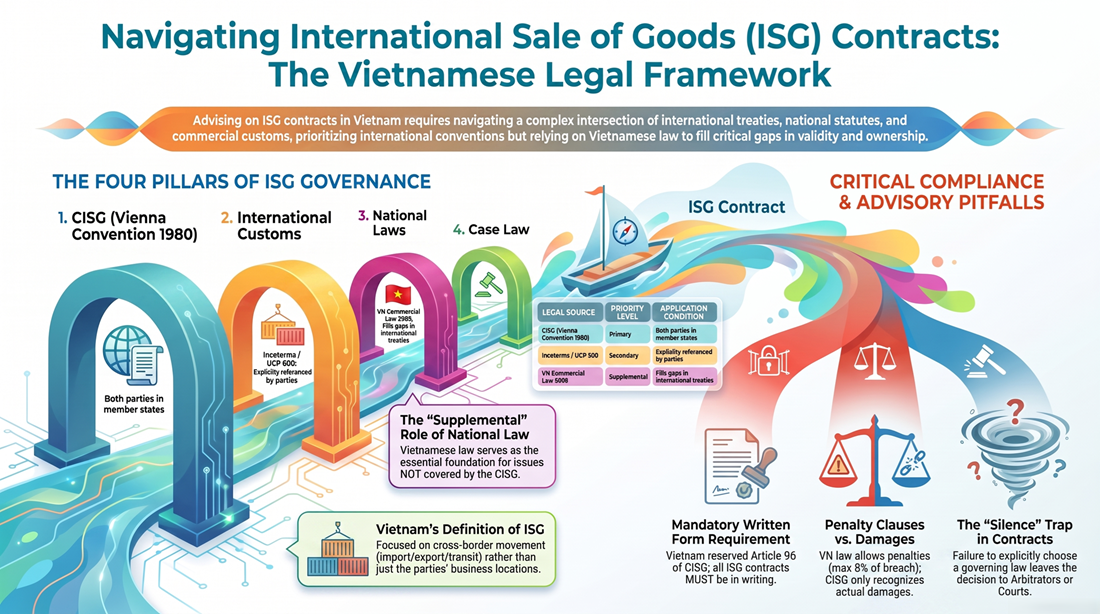
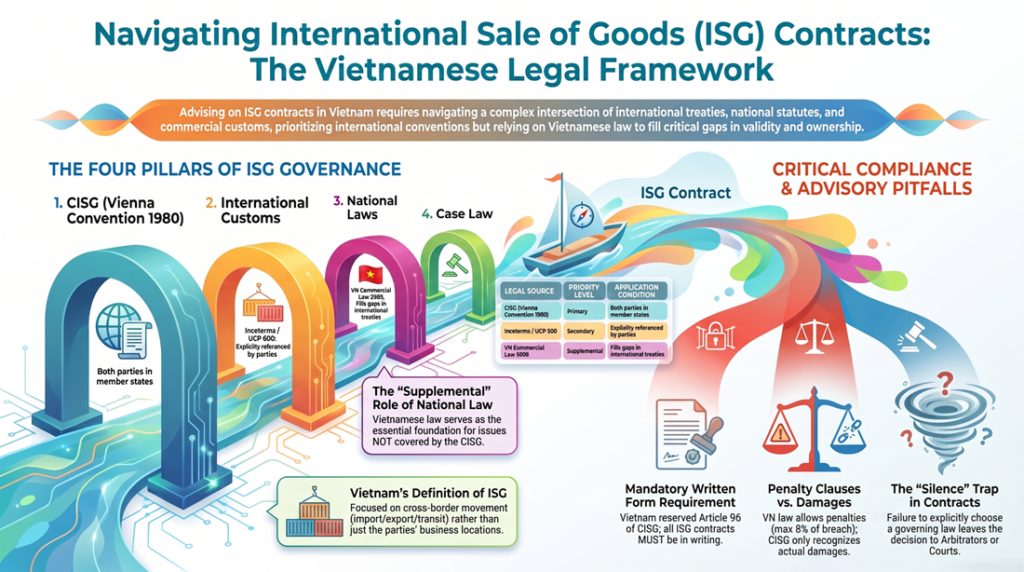
A contract for the international sale of goods involving a Vietnamese party can be governed by one of two frameworks, or a combination of both:
- CISG (the Vienna Convention 1980) — applies automatically when the Vietnamese party’s counterparty has its place of business in another CISG contracting state, and the parties have not expressly excluded the Convention (Article 6 CISG). Vietnam has been a full member since 1 January 2017.
- Vietnamese domestic law — primarily the Commercial Law 2005 and the Civil Code 2015 — applies when CISG does not apply, when the parties expressly choose it, or as a gap-filling law for matters CISG does not cover.
A critical point that surprises many foreign counsel: choosing an arbitration center or court in Vietnam is not the same as choosing Vietnamese law. These are two separate contractual decisions. A contract can designate arbitration in Ho Chi Minh City while still being governed, in whole or in part, by CISG, or even by the law of a third country. Contracts that address dispute resolution but stay silent on governing law leave this question to be resolved — often expensively — by the arbitral tribunal itself.
Key Differences Foreign Companies Should Understand
| Issue | CISG | Vietnamese Law (Commercial Law 2005 / Civil Code 2015) |
|---|---|---|
| Contract form | Freedom of form (Art. 11), unless a reserving state is involved | Written form is mandatory (Art. 27.2, Commercial Law 2005) |
| Liquidated damages / penalty clause | No equivalent regime | Permitted, capped at 8% of the value of the breached obligation |
| Damages | Limited by the foreseeability principle (Art. 74) | Compensation for actual, direct loss |
| Contract avoidance | Only for “fundamental breach” (Art. 25) | Based on agreed termination conditions or serious breach |
| IP warranty / product warranty | No express provision | Expressly regulated (Arts. 46, 49, Commercial Law 2005) |
Because Vietnam maintains a reservation under Article 96 of CISG, any contract involving a Vietnamese party must be in writing to be valid — this holds true even when CISG governs the substance of the contract. Foreign parties used to jurisdictions where oral or informal contracts are enforceable should take particular note of this requirement.
A Worked Example: Determining Governing Law When the Contract Is Silent
Consider a realistic scenario drawn from our advisory practice: a Chinese seller and a Vietnamese buyer sign a contract for industrial machinery, FOB a Chinese port under Incoterms 2020, payment partly by advance T/T and partly by an irrevocable sight L/C subject to UCP 600, with disputes referred to a Vietnam-based arbitration center. The contract says nothing about governing law — only about the arbitral forum.
When the seller fails to deliver and the buyer files a claim, the analysis unfolds as follows:
- Check for an express choice of law. None exists — only a dispute-resolution clause, which does not by itself select a governing law.
- Check CISG applicability. Both China and Vietnam are CISG contracting states, and there is no exclusion clause, so CISG governs matters within its scope (delivery obligations, breach, remedies, damages) under Article 1(1)(a).
- Identify gap-filling law. For matters CISG does not address — contract validity, capacity, transfer of ownership, the L/C mechanism itself (governed separately by UCP 600 as incorporated custom) — the arbitral tribunal must determine the applicable law under Article 14 of Vietnam’s Commercial Arbitration Law 2010 and the conflict-of-laws rules in Article 683 of the Civil Code 2015, which generally point to the law of the country most closely connected to the contract — typically the seller’s country, subject to rebuttal based on the specific facts.
The lesson: an unresolved governing-law question does not disappear — it simply gets decided later, by someone else, often after both parties have already spent significant legal fees arguing about it.
Recommendations Before You Sign
- Include an express governing law clause, separate from the dispute resolution clause, specifying both the primary applicable law (CISG or a named national law) and the gap-filling law for matters outside its scope;
- If Vietnamese law will apply in whole or in part, confirm the contract satisfies the mandatory written form requirement;
- If a liquidated damages / penalty mechanism is important to your risk strategy, consider whether CISG or Vietnamese law better supports it — CISG has no direct equivalent to Vietnam’s statutory penalty clause;
- Align the governing law clause with the chosen Incoterms rule and payment mechanism (L/C, UCP 600) to avoid internal contradictions within the contract.
How ISC Global Can Help
ISC Global advises both foreign companies contracting with Vietnamese suppliers or buyers, and Vietnamese exporters reviewing contracts drafted abroad. Our services include governing-law analysis, bilingual contract drafting, and dispute-risk assessment before signature — combined with our group’s practical experience across ISO, product, and trade-compliance consulting through ISC Global, Duc Luong Services, and Staunchly Vietnam.
Contact Us for a Consultation
ISC Global Co., Ltd.
Hotline: +84 933 096 426 – +84 868 591 260
Email: info@iscglobal.asia | van.pham@iscglobal.asia
Website: iscglobal.asia | iscglobal.edu.vn

No responses yet