GMP certification has become a non-negotiable requirement for many manufacturers — and a powerful differentiator for those targeting export markets. This complete guide explains what Good Manufacturing Practice (GMP) is, the main GMP standards, Vietnam’s regulatory framework, the 2023 EU GMP Annex 1 revision, and how our end-to-end consulting and training services help you get certified faster and stay compliant.
What Is GMP (Good Manufacturing Practice)?
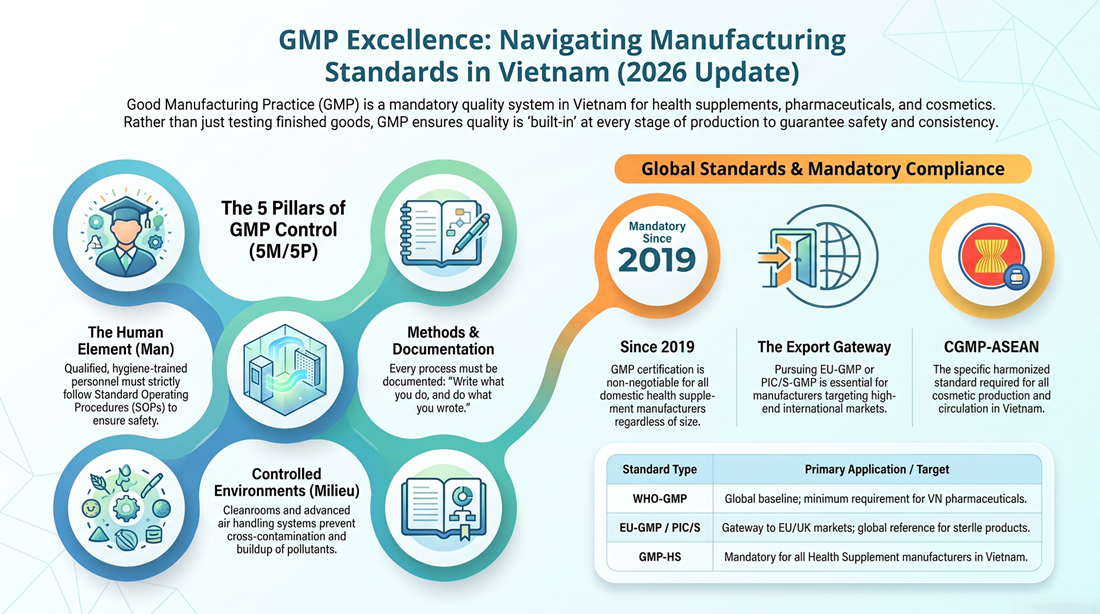
GMP stands for Good Manufacturing Practice — a system of principles and standards that control every factor affecting product quality throughout the manufacturing process, from incoming raw materials to finished goods.
The core philosophy is simple but powerful: quality must be built into the product at every stage, not merely tested at the end. GMP ensures products are safe, consistent, and fit for their intended use — especially critical for products that affect human health, such as pharmaceuticals, health supplements, cosmetics, and medical devices.
The Five Core Elements GMP Controls
A robust GMP system controls these elements together:
- People — trained, qualified personnel who follow hygiene rules and SOPs.
- Materials — strict control and traceability of incoming raw materials.
- Machines & facilities — well-designed, maintained, and calibrated equipment and premises that prevent cross-contamination.
- Methods — documented Standard Operating Procedures (SOPs), batch records, and in-process controls.
- Environment — clean rooms, air handling, sanitation, and contamination control.
The Main GMP Standards Explained
- WHO-GMP — the global baseline standard from the World Health Organization, widely adopted in Vietnam as the minimum for pharmaceutical manufacturing.
- EU-GMP — the rigorous European Union standard; the gateway to the EU pharmaceutical market.
- cGMP — the US FDA standard; “current” emphasizes the duty to keep technology and methods up to date for the US market.
- PIC/S-GMP — the Pharmaceutical Inspection Co-operation Scheme standard, essentially aligned with EU-GMP and recognized across dozens of member authorities.
- GMP-ASEAN — a WHO-based harmonized standard for the ASEAN region (with CGMP-ASEAN for cosmetics).
- GMP for Health Supplements (HS) — Vietnam’s GMP for dietary/health-supplement manufacturers.
Key Update: EU GMP Annex 1 (2023)
The EU’s Annex 1 on the manufacture of sterile medicinal products was comprehensively revised, published in August 2022 and effective from 25 August 2023 (with a specific lyophilizer requirement applying from 25 August 2024). The revision is a near-complete rewrite and a joint EU–PIC/S–WHO project, making it the global reference baseline for sterile manufacturing. Headline changes include:
- A mandatory, holistic Contamination Control Strategy (CCS).
- Quality Risk Management (QRM) as the foundation for decisions.
- Expanded guidance on barrier technologies (RABS, isolators), cleanroom design, and airflow.
- Stricter environmental monitoring (notably continuous Grade A monitoring), sterility testing, and media fills.
Because PIC/S incorporates the EU text, every PIC/S authority treats Annex 1 as its inspection baseline — relevant to any manufacturer exporting sterile products into the EU/UK.
GMP Regulations in Vietnam
Health Supplements
- Decree 15/2018/ND-CP makes GMP mandatory for domestic health-supplement manufacturers from 1 July 2019, regardless of company size.
- Circular 18/2019/TT-BYT provides detailed GMP principles for health-supplement production (amended by Circular 29/2020/TT-BYT).
- 2026 update: Vietnam’s Food Safety Authority issued a GMP assessment procedure with a checklist of 10 content groups and nearly 170 criteria, tightening market quality control.
Facilities already holding valid GMP, HACCP, ISO 22000, or FSSC 22000 certificates may be exempt from certain food-safety condition certificate procedures under Decree 15/2018.
Pharmaceuticals & Cosmetics
Pharmaceutical manufacturers must meet WHO-GMP as a minimum, with many pursuing EU-GMP/PIC/S-GMP for export. Cosmetics follow CGMP-ASEAN under the ASEAN Cosmetic Directive.
How GMP Relates to HACCP, ISO 22000 & FSSC 22000
GMP is typically a prerequisite program (PRP) — the foundation for higher systems. HACCP adds hazard analysis and critical control points; ISO 22000 / FSSC 22000 integrate GMP + HACCP + management systems into an internationally (GFSI) recognized framework. Building GMP well first lets you invest once and scale up without rework.
Benefits of GMP Certification
- Legal compliance — avoid suspension, product recalls, and penalties during inspections.
- Market access — a precondition for product registration and lawful distribution (especially health supplements).
- Higher quality, fewer defects and waste.
- Stronger brand trust with customers and partners.
- Export readiness to meet international buyers’ requirements.
Our End-to-End GMP Services
We support Vietnamese and FDI manufacturers from gap analysis to certification, working bilingually in English and Vietnamese.
- Gap analysis — assess your facility, processes, and documentation against GMP requirements.
- Facility design advisory — layout, flow, cleanrooms, and contamination control.
- Documentation — quality manual, SOPs, batch records, and QC procedures tailored to your applicable GMP.
- Training — awareness, role-specific, and internal auditor courses (including EU GMP Annex 1 and the 2026 HS criteria).
- Implementation & trial operation support.
- Internal audit & corrective actions (CAPA).
- Certification support — coordinate with certification/assessment bodies through to a successful outcome.
Frequently Asked Questions (FAQ)
1. Is GMP mandatory in Vietnam? Yes for health supplements (from 1 July 2019), pharmaceuticals, and cosmetics. For general food, manufacturers may choose GMP, HACCP, ISO 22000, or FSSC 22000.
2. How long does GMP certification take? Typically 6–18 months depending on your starting point. Professional consulting can shorten this significantly.
3. Are EU-GMP and PIC/S-GMP the same? Essentially yes — PIC/S adopts the EU-GMP text (including Annex 1 2023). They differ mainly in cross-country recognition.
4. Can SMEs achieve GMP? Absolutely. With a well-structured roadmap, small and medium manufacturers can meet GMP requirements cost-effectively.
Contact Us for a Business Consultation
Let us guide your GMP journey — accurate, efficient, and built to last.
📞 Hotline: +84 933 096 426 – +84 868 591 260
✉️ Email: info@iscglobal.asia | van.pham@iscglobal.asia
🌐 Website: iscglobal.asia | iscglobal.edu.vn
Beyond the Checklist: 5 Game-Changing Realities of GMP You Can’t Afford to Ignore in 2026
1. Introduction: The GMP Paradigm Shift
For decades, many manufacturers in Vietnam have viewed Good Manufacturing Practice (GMP) as a burdensome “compliance tax”—an expensive hurdle of paperwork and audits required merely to keep the doors open. As we head into 2026, this perspective is not just outdated; it is a liability.
The industrial landscape is undergoing a radical transformation. Regulatory bodies are no longer satisfied with basic hygiene; they are pivoting toward stricter international benchmarks like WHO-GMP, EU-GMP, and the high-stakes requirements of PIC/S-GMP. In this new era, GMP must be repositioned as a “quality built-in” business engine. For the C-suite, the objective is clear: compliance is the ultimate competitive advantage. Those who master the complexities of these evolving standards will capture the market share left behind by competitors who fail to adapt to the “market cleaning” effect of 2026.
2. Takeaway 1: Quality Isn’t Tested—It’s Manufactured
The traditional “test-at-the-end” mentality is the single greatest drain on manufacturing ROI. In that reactive model, quality is checked only when the product is finished. If a defect is found, the entire batch—and the capital invested in it—is liquidated.
GMP mandates a “Quality Built-In” philosophy. This requires controlling every variable, from the molecular integrity of raw materials to the humidity of the facility, to prevent errors before they materialize. This is anchored in the ten basic principles of GMP, most notably: “Write down what you do, do what you wrote, and record what you did.” By shifting from catching errors to preventing them, you reduce the cost of non-compliance, eliminate batch waste, and secure the consistency required for international tenders.
“Quality must be built into the product at every stage, not merely tested at the end.”
3. Takeaway 2: The Sterile Revolution—EU GMP Annex 1 is the New Global Baseline
The 2023 revision of EU GMP Annex 1 has fundamentally reset the global expectations for sterile manufacturing. While technically a European standard, it has become the de facto international baseline. This is especially critical as Vietnam is currently in the preparation phase to join PIC/S. Adopting these standards is no longer just for exporters; it is the roadmap for domestic survival in an internationally recognized industry.
The revision demands a shift toward barrier technologies—Restricted Access Barrier Systems (RABS) and Isolators—which are now expectations, not options. To demonstrate technical mastery, leadership must be aware of specific implementation timelines, such as the mandatory lyophilizer requirements effective since August 25, 2024.
The Pillars of the Annex 1 Revision:
- Contamination Control Strategy (CCS): A mandatory, holistic document that maps every potential contamination risk and dictates the technical and organizational controls to mitigate them.
- Quality Risk Management (QRM): The foundational framework used to justify every process and design decision with data-driven logic.
- Continuous Grade A Monitoring: Stricter, non-negotiable requirements for environmental monitoring during operations to ensure absolute sterility.
4. Takeaway 3: The “Brain” vs. The “Defense”—The Strategic QA/QC Dynamic
A world-class facility is built on the synergy between Quality Assurance (QA) and Quality Control (QC). In this dynamic, QA acts as the “Brain.” It is the strategic center that uses Quality Risk Management (QRM) as its engine to design systems and SOPs that replace expensive guesswork with data-driven certainty. QC is the “Last Line of Defense,” utilizing quantitative science to verify that the manufactured product meets the established standards.
However, equipment alone does not guarantee a lead in the industry. The most sophisticated automated lines are useless without a “culture of compliance.” This mindset must permeate every level, from the warehouse floor to the boardroom. It is the intangible asset that protects your brand from the catastrophic costs of a recall.
“This is the foundational factor for building a culture of compliance—something that cannot be bought with equipment or money.”
5. Takeaway 4: The 2026 Squeeze—A Market Purge of 170 Criteria
Since July 1, 2019, Decree 15/2018/ND-CP has made GMP mandatory for all health supplement (TPBVSK) manufacturers in Vietnam. However, the 2026 update from the Vietnam Food Safety Authority represents a significant escalation. The new assessment procedure features a rigorous checklist divided into 10 content groups and nearly 170 specific criteria.
This is not merely a checklist; it is a market purge. For Small and Medium Enterprises (SMEs), these criteria are non-negotiable survival requirements. As the government tightens its grip, facilities that fail to meet these 170 points will be excluded from the legal market. For the prepared, this “market cleaning” effect is a rare opportunity to capture the vacuum left by non-compliant competitors.
6. Takeaway 5: GMP is the “Prerequisite” Master Key for ISO and HACCP
Strategic leaders understand that quality standards are not siloed; they are a hierarchy. In the pharmaceutical and food sectors, GMP serves as the Prerequisite Program (PRP). It is the indispensable foundation upon which all other international certifications are built.
- GMP (PRP): Controls the environment, personnel, and basic processes.
- HACCP: Layered on top to manage hazard analysis and critical control points.
- ISO 22000 / FSSC 22000: Integrates the two into a globally recognized management framework.
The strategic insight here is to “invest once and scale up.” By building a robust, EU-aligned GMP system today, your facility is automatically prepared to scale to ISO or FSSC standards without rebuilding your factory flow or documentation from scratch. This efficiency secures international tenders and minimizes long-term CAPEX.
7. The Future-Proof Factory
The journey of GMP has evolved from a legal obligation into a sophisticated strategy for market dominance. As we move toward 2026, the divide between those who view GMP as a hurdle and those who view it as an engine will define the industry’s leaders. In an era where “good enough” is a death sentence for a brand, your facility must be designed for excellence, not just existence.
In a global market that no longer accepts “good enough,” is your facility built to pass an inspection, or is it built to lead an industry?
Contact us to download the bilingual English-Vietnamese PDF standard: from only $50
On the path toward integration and export, correctly understanding and applying international standards is essential. Yet language and technical terminology often pose real barriers. We are pleased to introduce our bilingual (English – Vietnamese) standards documentation service, translated by our own team of certification consultants.
What We Provide
• A clause-by-clause bilingual comparison, easy to consult and file.
• Professional Vietnamese translation in correct technical terminology, ready to use.
• Interpretation notes and application guidance from hands-on experts.
• Fast delivery in editable, easy-to-store PDF/Word format.
Standards Covered
ISO management systems (9001, 14001, 45001, 37001); sustainability certifications (ISCC, FSC, VFCS/PEFC); textiles and recycled materials (GRS, OCS, OEKO-TEX); social responsibility and ESG (SMETA, EcoVadis, Fairtrade), and many other industry standards upon request.
Why Choose Us
Our documents are translated by professionals who directly consult on and audit certifications, so the translation is accurate not only in language but also in real-world application — saving you time and reducing errors when preparing documentation.
Pricing
From only USD 50 per document, depending on length and complexity. Please send us the standard name to receive a free, accurate quotation.
How to Order
1. Contact us with the name of the standard you need.
2. Receive a quotation and delivery time.
3. Make payment and receive your document by email.
Payment
Bank transfer via QR code (provided with the quotation), or via PayPal: ducluongservices@gmail.com.
We look forward to accompanying you on your certification journey.
Best regards,
CONTACT INFORMATION
Hotline: +84 933096426 – +84 868 591 260
Email:
Website:
No responses yet