The Responsible Fishing Vessel Standard (RFVS) is the only vessel-level seafood certification programme available on a global scale. It certifies operational best practice and crew welfare on board fishing vessels, is owned and operated by the Global Seafood Alliance (GSA) under its Best Seafood Practices (BSP) programme, and was the first standard worldwide to achieve SSCI At-Sea Operations recognition.
As international buyers tighten their expectations around social responsibility at sea and forced-labour due diligence, Vietnamese seafood exporters need credible, independently verified proof of responsible practice — right where fish are caught. The Responsible Fishing Vessel Standard (RFVS) answers that need. This guide from ISC Global explains what RFVS is, its core principles, how it became a globally recognised benchmark, and how your business can prepare for certification.
1. What is the Responsible Fishing Vessel Standard (RFVS)?
The Responsible Fishing Vessel Standard (RFVS) is a voluntary, vessel-based certification programme that certifies high standards of operational practice relating to crew safety and welfare on board fishing vessels. It is an assurance tool that helps vessel owners and operators demonstrate industry-agreed best practice through independent, third-party auditing.
What makes RFVS unique is its scope: it is the only certification programme at the level of the individual vessel with global reach. While many seafood standards focus on processing plants or aquaculture sites, RFVS provides assurance of decent working conditions from the catch to the quay — closing a long-standing gap in seafood supply-chain assurance.
The standard applies to any commercially licensed fishing vessel or fleet, regardless of length or tonnage, including support/tender vessels, provided they meet the scope and eligibility criteria. The unit of certification includes the vessel, the skipper and the vessel owner(s).
2. From Seafish’s RFS to a global standard: a brief history
- January 2016: Seafish, the public body supporting the UK seafood industry, launched the Responsible Fishing Scheme (RFS) to meet market demand for independent due-diligence audits of fishing vessels.
- October 2017: The RFS certified its 100th vessel.
- April 2018: Seafish signed an MoU with the Global Aquaculture Alliance (GAA) to migrate the scheme into the newly established Global Seafood Assurances (GSA).
- 11 June 2020: The final RFVS was publicly released and ownership transferred from Seafish to GSA, after a two-year, open and collaborative development process.
- January 2021: The first vessel achieved RFVS certification.
- November 2022: RFVS (Issue 2.1) became the first standard globally to be recognised under the Consumer Goods Forum’s SSCI At-Sea Operations benchmark.
Today, RFVS is operated under the Best Seafood Practices (BSP) programme of the Global Seafood Alliance — the world’s only third-party certification programme capable of linking responsible wild fisheries to certified vessels and processing plants (alongside the Seafood Processing Standard, SPS).
3. The two core principles of RFVS
RFVS is built on two core principles:
Principle 1 — Vessel Management and Safety Systems
Vessel operations must be managed through a documented set of policies, processes and procedures covering the planning and execution of core business areas (catching and storage). The vessel must demonstrate a documented management system capable of meeting legal obligations and customer requirements, covering maritime safety, maintenance and risk management.
Principle 2 — Crew Rights, Safety and Wellbeing
This is the standard’s defining strength — a strong focus on human welfare on board, underpinned by international conventions including:
- The ILO Work in Fishing Convention (C188)
- The ILO Protection of Wages Convention, 1949 (No. 95)
- The Universal Declaration of Human Rights and other global instruments
It covers transparent employment contracts, timely payment of wages, working/rest hours, living conditions, medical care, worker voice and grievance mechanisms, and personal safety.
4. Key strengthening features (Issue 2.0 & 2.1)
- Zero Tolerance Policy (ZTP): addresses serious human-rights abuses and the use of illegal child labour.
- Crew remediation policy: triggered if the ZTP is breached.
- Support/tender vessels can be included, audited and certified as part of a group/fleet assessment.
- SSCI recognition: RFVS Issue 2.1 was the first standard to be benchmarked against SSCI’s At-Sea Operations requirements, signalling leadership in credible social and operational assurance at sea.
The RFVS certification process is based on ISO/IEC 17065 protocols and APSCA social-auditing requirements, ensuring consistency and credibility. Certification is typically valid for three years from the initial certification date, with periodic surveillance.
5. Why RFVS matters for Vietnamese seafood exporters
Vietnam is one of the world’s leading seafood exporters, yet faces growing scrutiny:
- EU IUU “yellow card”: pressure to demonstrate legal, reported and regulated fishing.
- Rising social-compliance expectations from EU, US, UK and Japanese buyers regarding labour conditions at sea and forced-labour prevention.
- Supply-chain due-diligence regulation in Europe that requires verifiable evidence.
By providing an independently verified social component, RFVS gives buyers confidence that the seafood they purchase has been checked against credible criteria — turning compliance into a competitive advantage rather than a cost.
6. The road to RFVS certification (overview)
- Eligibility check — confirm the vessel/fleet meets the criteria and is free of disqualifying conditions.
- Gap analysis — benchmark current practice against the two core principles.
- System and documentation build — management system, crew-welfare policies, contracts, safety procedures, remediation and grievance mechanisms.
- Awareness training — for management, skippers and crew.
- Internal audit and corrective action.
- Third-party certification audit — by an accredited certification body under ISO/IEC 17065 and APSCA.
- Certificate issuance and maintenance — valid ~3 years with surveillance.
7. Frequently asked questions (FAQ)
Who owns and operates RFVS today? The Global Seafood Alliance (GSA) owns and operates RFVS under its Best Seafood Practices (BSP) programme, following the 2020 handover from Seafish.
Is RFVS mandatory? No — it is voluntary. However, it is increasingly expected by international buyers as proof of responsible fishing.
How is RFVS different from MSC? MSC focuses on the environmental sustainability of the fishery, while RFVS focuses on vessel operations and crew rights and welfare (social). They are complementary.
Can a whole fleet be certified together? Yes. RFVS supports group/fleet certification, including support/tender vessels.
How long is an RFVS certificate valid? Typically three years from the initial certification date, subject to periodic surveillance.
8. Partner with ISC Global on your RFVS journey
As an ESG, ISO and sustainability consultancy, ISC Global — together with Duc Luong Services and STC VN (Staunchly Vietnam) — offers end-to-end support: gap analysis, bilingual system and documentation development, awareness training, pre-certification internal audit, and guidance through the third-party audit and surveillance cycle. We bridge the language of international standards and the operational reality of Vietnamese fishing fleets.
📞 Contact us for RFVS consulting & certification
ISC Global
Hotline: +84 933 096 426 – +84 868 591 260
Email: info@iscglobal.asia | van.pham@iscglobal.asia
Website: iscglobal.asia | iscglobal.edu.vn
Beyond the “Eco” Label: 5 Surprising Realities of the New Global Standards for Fishing Crews
When we fill our carts with “sustainable” seafood, our minds typically drift to healthy fish populations, protected coral reefs, and the preservation of biodiversity. But there is a hidden, often uncomfortable component to that sustainability: the people on the boat. For decades, the industry focused almost exclusively on the environmental impact of the catch, leaving a significant “assurance gap” regarding the treatment of the crews who harvest it.
Retail giants like ALDI have recently acknowledged that environmental management is fundamentally inseparable from crew welfare. This realization has catalyzed the rise of rigorous new frameworks, specifically the Responsible Fishing Vessel Standard (RFVS) and the FISH Standard for Crew. As an analyst in this space, I see these as more than just new stickers for a package; they represent a systemic shift in maritime ethics.
Here are five surprising realities of how these global standards are reshaping the seafood industry from the deck up.
1. The End of the “Wild West” at Sea
For much of maritime history, what happened on a vessel in the middle of the ocean was left to the discretion of the skipper. The new global standards mark a fundamental shift by moving the focus from the product to the vessel itself as the unit of certification.
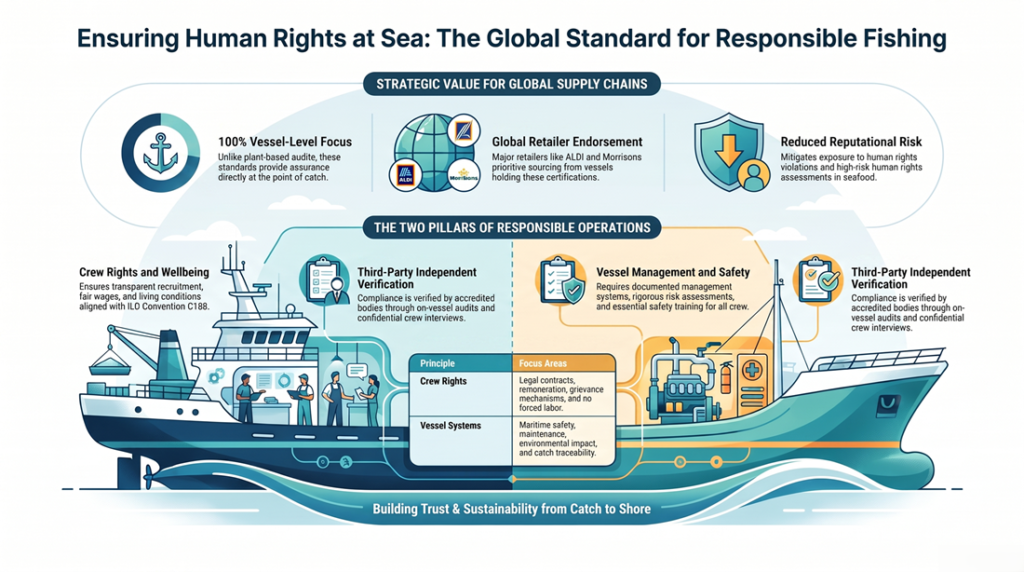
The RFVS, for instance, is built on two core principles:
- Vessel Management & Safety Systems: Requiring documented policies for catching, storage, and maritime safety.
- Crew Rights, Safety, and Wellbeing: Focusing on the human experience and legal protections on board.
This transition moves the industry from voluntary “good vibes” to documented, auditable management systems. As Melanie Siggs, Board Director for Global Seafood Assurances (GSA), notes:
“It is now recognised that assurance of good crew welfare on fishing vessels is critically important and inseparable from good environmental management.”
2. From UK Local to Global Benchmark (The Evolution of RFVS)
The RFVS represents a significant evolution of the UK-based Seafish “Responsible Fishing Scheme” (RFS). In 2020, the standard transitioned to a global program owned by the Global Seafood Alliance (GSA), reflecting the industry’s need for a borderless assurance model.
Since this globalization, the RFVS achieved a landmark milestone: it was the first standard worldwide to achieve recognition under the Consumer Goods Forum’s SSCI “At-Sea Operations” benchmark. This status is a strategic tool for international trade. For example, exporters in Vietnam—who are currently working to lift the EU IUU “yellow card” trade sanction—increasingly view RFVS certification as a way to prove to EU and US buyers that their fleets meet the highest international expectations for both legality and ethics.
3. The Audit is No Longer Just a Paperwork Exercise
In the past, “social compliance” was often a desktop exercise. The new rigors of the RFVS and FISH standards are defined by their technical depth, operating under ISO/IEC 17065 protocols. These require that auditors be not just observers, but specialists trained under APSCA (Association of Professional Social Compliance Auditors) requirements.
Auditors now conduct physical, on-vessel assessments to observe living conditions and conduct confidential crew interviews. To achieve certification, vessels must demonstrate:
- Transparent Recruitment: Proof that crew members were not charged excessive recruitment fees.
- Documented Wages and Hours: Evidence of timely payments and managed rest periods.
- Worker Voice: Access to grievance mechanisms and channels where workers can raise concerns without fear of retaliation.
- Remediation Policies: Documented plans to fix issues if a “Zero Tolerance” breach (like child labor) is discovered.
- Safety Readiness: Mandatory safety equipment and regular emergency drills.
By utilizing these international auditing protocols, the standards move beyond “paperwork” to create a verifiable shield against forced labor and deceptive recruitment.
4. The Provocative Counter-Argument: The “Gravy Train” Critique
To maintain an intelligent perspective on these developments, one must acknowledge the “critical friend” view, most notably championed by independent fisheries adviser Francisco Blaha. Blaha argues that private certifications risk creating “parallel systems” that inadvertently undermine the national institutions of developing countries.
He suggests these standards can become a “gravy train” for Western consultants, where the cost of certification is squeezed out of the maintenance budgets or wages of the very crew the standards intend to protect. Blaha also points to a stinging hypocrisy in the global supply chain: many of the Western nations demanding these private standards—including the US, Australia, and Germany—have not yet ratified ILO C188, the very international labor convention these standards are based on. In a poignant critique, Blaha notes:
“[Consultants] come for data to the people and institutions that the ‘consumer’ does not trust… This has led me to say that I see the whole private certification scene as hypocrisy in the best-case scenario, or neo-colonialism in the worst-case scenario.”
This tension forces us to ask: Is private certification a necessary bridge to protect human rights, or does it uncouple the legal obligations of governments to do their jobs?
5. Retailers are the New “Regulators”
Perhaps the most significant reality is that the drive for ethical fishing is being powered by the supermarket aisle rather than the legislature. Major retailers like ALDI and Morrisons have identified seafood as a “high risk” category for human rights violations and are using their purchasing power to force change.
Retailers are now effectively acting as the industry’s new regulators:
- ALDI supported the development of the RFVS specifically to close the “assurance gap” they identified in their 2018 human rights risk assessment.
- Morrisons now requires UK-caught seafood to come from vessels certified under the RFS/RFVS framework.
This market-based approach turns ethics into a prerequisite for market access. For fishing fleets, compliance is no longer a voluntary “extra”—it is a competitive necessity to remain on the shelves of the world’s largest retailers.
The Future of the “Fair” Catch
While certification is not a silver bullet for the systemic complexities of international maritime labor, it represents a significant leap toward closing the “human gap” in seafood. We are moving toward a future where a “sustainable” label that fails to account for human rights will be considered fundamentally incomplete by both regulators and consumers.
The definition of a sustainable catch is expanding to include the hands that harvest it. This leaves us with a final, thought-provoking question: “As consumers, are we willing to pay the true price of a catch that respects both the ocean and the people who work its waters?”
Contact us to download the bilingual English-Vietnamese PDF standard: from only $50
On the path toward integration and export, correctly understanding and applying international standards is essential. Yet language and technical terminology often pose real barriers. We are pleased to introduce our bilingual (English – Vietnamese) standards documentation service, translated by our own team of certification consultants.
What We Provide
• A clause-by-clause bilingual comparison, easy to consult and file.
• Professional Vietnamese translation in correct technical terminology, ready to use.
• Interpretation notes and application guidance from hands-on experts.
• Fast delivery in editable, easy-to-store PDF/Word format.
Standards Covered
ISO management systems (9001, 14001, 45001, 37001); sustainability certifications (ISCC, FSC, VFCS/PEFC); textiles and recycled materials (GRS, OCS, OEKO-TEX); social responsibility and ESG (SMETA, EcoVadis, Fairtrade), and many other industry standards upon request.
Why Choose Us
Our documents are translated by professionals who directly consult on and audit certifications, so the translation is accurate not only in language but also in real-world application — saving you time and reducing errors when preparing documentation.
Pricing
From only USD 50 per document, depending on length and complexity. Please send us the standard name to receive a free, accurate quotation.
How to Order
1. Contact us with the name of the standard you need.
2. Receive a quotation and delivery time.
3. Make payment and receive your document by email.
Payment
Bank transfer via QR code (provided with the quotation), or via PayPal: ducluongservices@gmail.com.
We look forward to accompanying you on your certification journey.
Best regards,
CONTACT INFORMATION
Hotline: +84 933096426 – +84 868 591 260
Email:
Website:
No responses yet