As global supply chains place increasing emphasis on social responsibility, the Thai Labour Standard (TLS 8001) has become a key reference for companies operating in Thailand and across the regional supply chain. This comprehensive guide explains what TLS 8001 certification involves — its requirements, structure, benefits and implementation process — based on the latest TLS 8001:2020 version.
What is TLS 8001?
TLS 8001 (Thai Labour Standard 8001), known in Thai as มาตรฐานแรงงานไทย (มรท. 8001), is a standard on Labour Corporate Social Responsibility (Labour CSR) developed and issued by the Department of Labour Protection and Welfare (DLPW), Ministry of Labour, Thailand.
It is a voluntary standard designed to establish a common benchmark for the treatment of workers and to demonstrate a company’s commitment to human rights and fair working conditions. The current version, TLS 8001-2020 (B.E. 2563), updates and refines the standard’s principles and requirements in line with international practice.
TLS 8001 is built on the foundation of:
- International Labour Organization (ILO) Conventions — including core conventions such as Nos. 29, 87, 98, 100, 105, 111, 138, 182, 187 and the 2014 Protocol to the Forced Labour Convention;
- United Nations human rights principles;
- Thailand’s prevailing labour law and related regulations.
Objectives of the TLS 8001 standard
The standard pursues three core objectives:
- Operational guideline — helping establishments translate the standard into policy and manage labour in accordance with it.
- Self-assessment and self-declaration — enabling establishments to audit themselves and declare compliance.
- Basis for certification — allowing certification bodies to assess and certify establishments that comply.
Structure and requirements of TLS 8001:2020
TLS 8001 comprises two main sets of requirements that combine systematic management with the protection of labour rights:
1. Labour Management System
These are systemic, quality-management-style requirements ensuring that the treatment of workers complies with the standard in a consistent, continuously improving and sustainable manner. The approach mirrors ISO-style management systems: policy, objectives, leadership commitment, document control, internal audit, corrective action and continual improvement.
2. Labour Rights Management and Protection
These content-based requirements draw on ILO conventions and Thai labour law. Collectively, TLS 8001 covers 12 key areas:
- General requirements
- Management system
- Forced labour — prohibition of all forms of forced or compulsory labour
- Remuneration — wages and benefits
- Working hours — control of working time and overtime
- Discrimination — prohibition of workplace discrimination
- Discipline — fair disciplinary practices
- Child labour — prohibition of child labour
- Female workers — protection of women and pregnant workers
- Freedom of association and collective bargaining
- Occupational safety, health and the working environment
- Workers’ welfare
Professional note: Several TLS 8001 requirements are recognised as being higher or stricter than the minimum levels of Thai labour law — particularly regarding remuneration, benefits, overtime control and anti-discrimination. Companies should carefully reconcile the standard’s requirements with applicable law when building their system.
TLS 8001 certification levels
TLS 8001 is typically certified at different levels of compliance, commonly:
- Initial (basic) level — meeting the minimum prescribed requirements;
- Complete (full) level — complying with all requirements of the standard.
This tiered structure allows companies to follow a step-by-step path, progressing from basic to full compliance. Companies should confirm the exact level structure and conditions with the certification body or competent authority at the time of application, as requirements may be updated.
The TLS 8001 certification process (step by step)
A typical implementation pathway involves seven stages:
- Gap analysis — assess current compliance against TLS 8001:2020 requirements.
- Planning and leadership commitment — secure top-management commitment, appoint a management representative and allocate resources.
- Documentation development — build the Labour CSR policy, manual, procedures and records.
- Training and internal communication — raise awareness among all workers and train internal auditors.
- System operation and internal audit — run the system, conduct internal audits, take corrective actions and hold a management review.
- Certification audit — registration, Stage 1 (documentation review) and Stage 2 (on-site assessment, worker interviews, evidence review).
- Certification and maintenance — receive certification after closing any non-conformities, then maintain the system through periodic surveillance audits.
Benefits of TLS 8001 certification
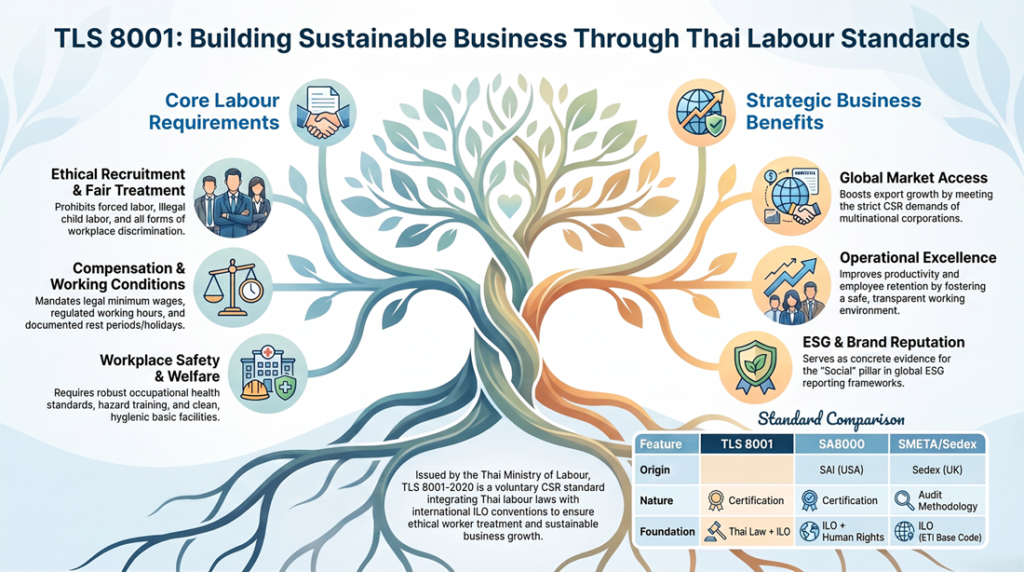
- Expanded export and business opportunities, especially with multinational customers requiring social-responsibility compliance.
- Enhanced reputation and brand image with customers, partners and investors.
- Improved labour relations, fewer disputes, and higher worker engagement and productivity.
- A solid foundation for adopting other social-responsibility standards such as SA8000, SMETA/Sedex and BSCI.
- Reduced legal risk through a structured labour-law compliance system.
- A concrete contribution to ESG and sustainable-development commitments.
TLS 8001 vs SA8000
TLS 8001 is often compared with SA8000, as both are certifiable social-responsibility standards based on ILO conventions. The key distinction:
- SA8000 is an international standard issued by SAI (Social Accountability International), widely recognised worldwide.
- TLS 8001 is Thailand’s national standard, issued by the Ministry of Labour, tailored to the Thai legal and labour context while referencing similar ILO conventions.
Because the two share many principles, a company that has implemented one will have a strong foundation for adopting the other.
Which companies should adopt TLS 8001?
TLS 8001 is particularly relevant for:
- Manufacturing and export companies operating in or partnering with Thailand;
- Companies with Thai investment or regional subsidiaries;
- Suppliers within the supply chains of Thai or multinational corporations;
- Organisations seeking to demonstrate a credible commitment to labour social responsibility and sustainability.
TLS 8001 consulting and training services by ISC Global
As an independent consulting and training provider, ISC Global — together with its partners — supports companies in building and operating systems that meet TLS 8001 effectively. Our services include:
- Gap analysis against TLS 8001:2020 requirements;
- Documentation development — bilingual policies, procedures and records ready for issuance;
- Awareness and internal-auditor training to sustain the system;
- Internal audit support and corrective-action guidance before the certification audit;
- Coordination and support in working with the certification body throughout the project.
Frequently Asked Questions (FAQ)
1. Is TLS 8001 mandatory? No. TLS 8001 is a voluntary standard. However, many large customers and partners require supplier compliance as a commercial condition.
2. How long is a TLS 8001 certificate valid? Certificates are typically valid for a defined period (commonly three years) with periodic surveillance audits. Confirm the exact term with your certification body.
3. How long does it take to achieve TLS 8001 certification? Depending on company size, readiness and the targeted level, projects typically take from a few months to over half a year.
4. Can companies outside Thailand apply TLS 8001? Yes. Companies with operations, partners or supply-chain links related to Thailand can implement TLS 8001 and receive consulting support to prepare for certification.
5. We already have SMETA/SA8000 — does that help? Yes. Because many requirements overlap (based on ILO conventions), existing social-responsibility systems significantly reduce the time and effort needed for TLS 8001.
Contact us for business consulting
ISC Global
Hotline: +84 933 096 426 – +84 868 591 260
Email: info@iscglobal.asia | van.pham@iscglobal.asia
Website: iscglobal.asia | iscglobal.edu.vn
Beyond the Factory Floor: 5 Strategic Takeaways from Thailand’s Ethical Sourcing Revolution
Global brands are currently trapped in the “Transparency Paradox”: a relentless drive for low-cost, high-speed production cycles versus an absolute, zero-tolerance demand from consumers and regulators for radical transparency. In this high-stakes environment, the Thai Labour Standard (TLS 8001-2020) has emerged as much more than a regional regulatory hurdle. For any company sourcing from Southeast Asia, it represents a strategic “gold standard”—a comprehensive blueprint for de-risking operations and establishing verified social performance.
As a global strategist, it is essential to view this standard not as a cost center, but as a framework for sustainable trade competitiveness. Here are the five strategic takeaways from Thailand’s ethical sourcing shift.
1. Eliminating “Plausible Deniability” – The End of Tier 2 and Tier 3 Blindness
From a risk-mitigation perspective, the most dangerous links in a supply chain are the ones you cannot see. TLS 8001-2020 addresses this head-on by eliminating the “plausible deniability” that many primary establishments use to distance themselves from labor scandals.
According to Section 1.1 and the definitions in Section 3.6, the standard’s scope covers the entire workforce of a workplace, including suppliers, subcontractors, and contractors “regardless of the number of levels of sub-contracting.”
This is a paradigm shift. The standard effectively turns the primary establishment into a “private regulator” of its own partners. By requiring written commitments and formal evaluations of third parties, TLS 8001-2020 mandates a transition from passive policing to active partnership. For business leaders, this means the end of Tier 2 and Tier 3 blindness, ensuring that ethical standards are maintained even in the deepest corners of the supply chain.
2. Radical Collaboration: Closing the “Worker Voice” Gap
In many global manufacturing contexts, the “worker’s voice” is the missing link—a structural weakness that leads to sudden strikes, high turnover, and brand-damaging labor disputes. TLS 8001-2020 solves this through a requirement for radical, structural collaboration.
Under Section 4.2.3, establishments are required to move beyond top-down management by appointing a committee of both employer and employee representatives. Most critically, the standard mandates the appointment of at least one “employee representative of non-management level.” This individual is selected by the workers to coordinate and communicate directly with top management.
This creates a bottom-up communication channel that is often absent in Western-led audits of Asian factories. By institutionalizing this “worker’s voice,” the standard pre-empts disputes and increases retention, fulfilling the vision laid out in the Preamble:
“The essence consists of 2 main parts… 1) labour management system… to ensure that the treatment of workers shall be based on the requirements with effective, continuous and sustainable development.”
3. Certification vs. Audit: The Strategic Edge of Verified Systems
To a CFO, the difference between an audit and a certification is the difference between a “snapshot” and a “system.” While methodologies like SMETA (Sedex Members Ethical Trade Audit) are widely used, they provide only a momentary report of compliance. They are not a certification.
In contrast, TLS 8001-2020 is a verified Management System (Standard 4.2). It requires a systemic commitment, verified by authorized bodies that issue a formal certificate. For brands looking to prove their Environmental, Social, and Governance (ESG) credentials to investors, choosing a certification standard over a simple audit is a superior long-term strategy. It provides “Verified Social Performance”—a more robust, trustworthy level of assurance for international stakeholders who are increasingly skeptical of “checklist” compliance.
4. Human-Centric Design: Elevating the “S” in ESG
The standard represents a shift from broad, abstract labor laws to human-centric workplace design. This is most evident in the “micro-protections” afforded to female workers in Section 4.11.
A standout provision (Section 4.11.3) mandates that breastfeeding breaks must be counted as paid working hours. While this may seem like a granular detail, it is a significant strategic asset for the “Social” pillar of ESG. In global benchmarking frameworks like EcoVadis, such specific, verified protections for parental and gender rights significantly elevate a company’s score. By recognizing these biological and social realities, companies don’t just comply with the law; they improve well-being and productivity, demonstrating a sophisticated approach to Human Rights Due Diligence (HRDD).
5. Strategic ROI: Ethics as a Prerequisite for Global Trade
For decades, labor standards were viewed as a “hurdle.” TLS 8001-2020 reframes them as a tool for “world trade competitiveness.” In the modern trade environment, this certification acts as a prerequisite for Master Service Agreements (MSAs) with North American and European buyers who are now under heavy legal pressure from regulations like the German Supply Chain Due Diligence Act (LkSG).
The strategic ROI of TLS 8001 compliance is realized through several key business outcomes:
- Export Growth: Facilitating entry into high-value markets that demand ethical proof.
- Foundational Scalability: Acting as a roadmap that allows factories to easily bridge the gap to other international standards like SA8000 or amfori BSCI.
- Brand Equity: Enhancing both corporate and national reputation as a stable, trustworthy partner.
As the standard highlights regarding national and corporate image:
“Establishments have products and services that are accepted and trustworthy from fair labour management… The country has a good image and capable of sustainable trade competition.”
The TLS 8001-2020 standard is a clear signal that the era of “compliance by accident” is over. As international buyers tighten their social responsibility requirements and ESG performance becomes a non-negotiable metric for investors, this standard provides a clear roadmap for navigating the future of work.
In a global economy where consumers and institutional investors increasingly “vote with their wallets,” every brand must face a critical question: Can you afford not to be certified by a standard that protects the very hands that make your products?
Contact us to download the bilingual English-Vietnamese PDF standard: from only $50
On the path toward integration and export, correctly understanding and applying international standards is essential. Yet language and technical terminology often pose real barriers. We are pleased to introduce our bilingual (English – Vietnamese) standards documentation service, translated by our own team of certification consultants.
What We Provide
• A clause-by-clause bilingual comparison, easy to consult and file.
• Professional Vietnamese translation in correct technical terminology, ready to use.
• Interpretation notes and application guidance from hands-on experts.
• Fast delivery in editable, easy-to-store PDF/Word format.
Standards Covered
ISO management systems (9001, 14001, 45001, 37001); sustainability certifications (ISCC, FSC, VFCS/PEFC); textiles and recycled materials (GRS, OCS, OEKO-TEX); social responsibility and ESG (SMETA, EcoVadis, Fairtrade), and many other industry standards upon request.
Why Choose Us
Our documents are translated by professionals who directly consult on and audit certifications, so the translation is accurate not only in language but also in real-world application — saving you time and reducing errors when preparing documentation.
Pricing
From only USD 50 per document, depending on length and complexity. Please send us the standard name to receive a free, accurate quotation.
How to Order
1. Contact us with the name of the standard you need.
2. Receive a quotation and delivery time.
3. Make payment and receive your document by email.
Payment
Bank transfer via QR code (provided with the quotation), or via PayPal: ducluongservices@gmail.com.
We look forward to accompanying you on your certification journey.
Best regards,
CONTACT INFORMATION
Hotline: +84 933096426 – +84 868 591 260
Email:
Website:
No responses yet