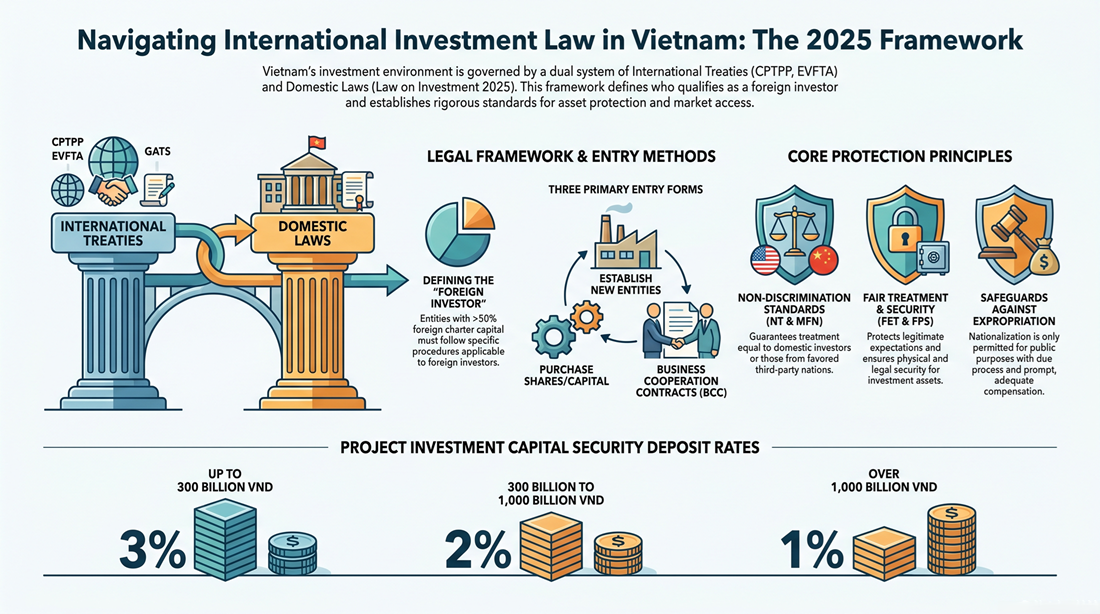
Vietnam has spent the last decade as the undisputed “darling” of global manufacturing, serving as the cornerstone for companies seeking to diversify supply chains away from traditional hubs. However, for the C-suite executive and general counsel, the ground is beginning to move. On March 1, 2026, the Law on Investment 2025 (Law No. 143/2025/QH15) will officially take effect, marking a tectonic shift in the country’s regulatory landscape.
For the unwary, there is a significant “regulatory trap” hidden in the transition timeline: while the primary law takes effect in March, the critical List of Conditional Business Lines is delayed until July 1, 2026. This four-month window creates a period of legal ambiguity that could either be a snare for market entry or a strategic opening for those with the right foresight.
What worked in 2020 is rapidly becoming obsolete. As Vietnam transitions its legal framework, the “rules of the game” for market access, corporate structuring, and investor protection are being rewritten. The following five counter-intuitive truths distill the essential legal nuances that will define the next era of international investment in Vietnam.
1. The “50% Rule” and the Invisible Foreign Investor
Under the Law on Investment 2025, the definition of a “foreign investor” is governed by a rigid and potentially invisible ownership chain. A Vietnamese-incorporated entity can be reclassified as a foreign investor—subjecting it to stricter market access barriers—if it crosses a specific threshold.
Crucially, an economic organization must fulfill foreign-investor procedures if it falls into one of these categories:
- Foreign investors hold more than 50% of the charter capital.
- The organization has a foreign investor holding more than 50% of the capital.
- The Partnership Exception: Regardless of capital percentage, if a majority of the partnership members are foreign individuals, the entity is treated as a foreign investor.
- The organization is part of an ownership chain where foreign-invested entities (as defined above) hold more than 50% of the charter capital.
This logic creates an “infection” effect: a local subsidiary can “become” foreign simply because its parent company—itself a Vietnamese entity—sold a majority stake to a global fund. Strategic counsel must now look two or three levels up the cap table to ensure they haven’t inadvertently lost their “domestic” status.
2. The EVIPA Waiting Game—A Legal Mirage?
While the EU-Vietnam Investment Protection Agreement (EVIPA) is often cited as a gold standard for protection, it remains a legal mirage for the time being. Although Vietnam has ratified the agreement, it is not yet in effect because it requires the individual approval of all 27 EU member states.
Important Note on EVIPA: “The Agreement has been ratified by Vietnam (Resolution No. 103/2020/QH14) but CURRENTLY HAS NO EFFECT, as it awaits ratification by the Parliaments of the 27 EU member states. When it takes effect, it will replace 21 existing Bilateral Investment Treaties (BITs) between Vietnam and EU countries.”
For the modern investor, the “real” shield is not the EVIPA, but the 21 existing Bilateral Investment Treaties that remain in force. Until the mirage of the EVIPA solidifies into law, sophisticated investors are ignoring the headlines and anchoring their protections in these older, proven treaties.
3. Security Isn’t Just About Guards—Physical vs. Legal Safety
In international law, the concept of Full Protection and Security (FPS) traditionally mandated that a host state protect an investor’s physical assets from riots or violence. However, a “Modern/Broad” view emerged in international arbitration where FPS was interpreted as “legal security”—the stability and predictability of the legal framework itself.
Counter-intuitively, the “new-generation” treaties Vietnam has joined, such as the CPTPP and EVIPA, are narrowing this protection back to its traditional roots.
The Expansion Trend vs. New-Gen Restrictions: “The traditional view of FPS is physical security… however, some Arbitration Tribunals have expanded this to ‘legal security.’ New-generation FTAs (CPTPP, EVIPA) limit FPS specifically to physical security according to customary international law, requiring only a reasonable level of protection (police/order) rather than broader legal stability.”
Strategic counsel must now pivot. If your concern is a sudden change in regulatory policy, you can no longer rely on an FPS claim. Protection must instead be sought through the Fair and Equitable Treatment (FET) standard to protect “legitimate expectations.”
4. The “Umbrella Clause”—Turning Contracts into Treaties
One of the most potent weapons in the investor’s arsenal is the Umbrella Clause (Cam kết bao trùm). Found in older treaties like the UK-Vietnam BIT (2002), this clause elevates a simple breach of contract by a government entity into a violation of an international treaty.
Under an Umbrella Clause, a state’s failure to observe a contractual obligation becomes a treaty breach. This is significant because it grants the investor access to Investor-State Dispute Settlement (ISDS)—international arbitration—rather than being forced to settle a contract dispute in local courts. It is essentially a “super-protection” that transforms commercial promises into sovereign obligations.
5. The Rise of HCMC and Da Nang as “Legal Sandboxes”
Vietnam is embracing a model of localized deregulation. Under Resolution No. 222/2025/QH15, Ho Chi Minh City and Da Nang are being transformed into International Financial Centers. These are legal “sandboxes” where participants enjoy perks that are strictly prohibited in the rest of the country:
- Holding Company Facilitation: The right to establish holding companies to mobilize capital from abroad, provided the member is not a commercial bank.
- Procedural Acceleration: Foreign investors can establish economic organizations within these centers without requiring a specific investment project, bypassing a major bureaucratic hurdle.
- Labor Streamlining: A “shortened process” for work permits and labor regulations that ignores the standard national ratios.
- Capital Freedom: The right to freely conduct investment and business activities with entities outside of Vietnam.
By carving out these centers, Vietnam is testing a “high-trust” environment for global capital, provided you aren’t a commercial bank looking to use the holding company perk.
CONCLUSION: The Future of Due Diligence
As the March 2026 deadline—and the subsequent July 1 conditional list transition—approaches, the 2025 legal framework demands a shift from passive compliance to active “Nationality Planning.”
This strategy involves routing investments through specific jurisdictions (such as the UK or certain EU members) that possess active, 2000-era BITs with strong Umbrella Clauses and broad FET protections, rather than waiting for the “mirage” of the EVIPA. In an era where “security” is being redefined and narrowed by new-generation treaties, the ultimate question for any strategic investor remains:
In a world where ‘security’ is being redefined by new-gen treaties, is your current investment structure a shield or a liability?
Contact us to download the bilingual English-Vietnamese PDF standard: from only $50
On the path toward integration and export, correctly understanding and applying international standards is essential. Yet language and technical terminology often pose real barriers. We are pleased to introduce our bilingual (English – Vietnamese) standards documentation service, translated by our own team of certification consultants.
What We Provide
• A clause-by-clause bilingual comparison, easy to consult and file.
• Professional Vietnamese translation in correct technical terminology, ready to use.
• Interpretation notes and application guidance from hands-on experts.
• Fast delivery in editable, easy-to-store PDF/Word format.
Standards Covered
ISO management systems (9001, 14001, 45001, 37001); sustainability certifications (ISCC, FSC, VFCS/PEFC); textiles and recycled materials (GRS, OCS, OEKO-TEX); social responsibility and ESG (SMETA, EcoVadis, Fairtrade), and many other industry standards upon request.
Why Choose Us
Our documents are translated by professionals who directly consult on and audit certifications, so the translation is accurate not only in language but also in real-world application — saving you time and reducing errors when preparing documentation.
Pricing
From only USD 50 per document, depending on length and complexity. Please send us the standard name to receive a free, accurate quotation.
How to Order
1. Contact us with the name of the standard you need.
2. Receive a quotation and delivery time.
3. Make payment and receive your document by email.
Payment
Bank transfer via QR code (provided with the quotation), or via PayPal: ducluongservices@gmail.com.
We look forward to accompanying you on your certification journey.
Best regards,
CONTACT INFORMATION
Hotline: +84 933096426 – +84 868 591 260
Email:
Website:
No responses yet